

Showing posts with label visas and immigration. Show all posts

Sunday, March 4, 2012

Serbia wins support for joining EU European foreign ministers back Balkan nation's candidacy despite resistance from neighbour Romania

The Serbian president, Boris Tadic, speaks in Brussels on Tuesday. Photograph: Virginia Mayo/AP


Serbia took a large step towards integrating with mainstream Europe on Tuesday when European Union foreign ministers called for the country to be made a candidate for union membership.

The breakthrough came despite surprising resistance from neighbouring Romania, and followed a deal last week when Belgrade abandoned boycotting the attendance of Kosovo at regional and international meetings because it views Kosovo as part of Serbia and refuses to recognise its independence.

The decision by the foreign ministers, which needs to be endorsed by EU government heads at a Brussels summit on Thursday, puts Serbia on the path to EU membership, leaving behind the legacy of the 1990s when Balkan wars and ethnic pogroms earned it the status of an international pariah.

But while Belgrade now faces long years of arduous negotiations before it can become a member, Brussels has not yet named a date for opening the negotiations. EU governments will push for greater rapprochement between Serbia and Kosovo before agreeing to start talks.

The tensions with Kosovo, the Albanian-majority former southern province of Serbia which declared independence four years ago, scuppered Belgrade's chances of getting an EU green light in December amid clashes on the Serbia-Kosovo border. But last week, under EU mediation, Serbia yielded – under a complicated formula – to Kosovo attendance and representation at international meetings. Previously Belgrade had boycotted any such meetings on the grounds that it does not view Kosovo as a country.

Tuesday's breakthrough was held up for several hours by Romania, which insisted on greater protections and rights for the Romanian ethnic minority in Serbia, an issue that had not previously been a problem.

While it will be many years before Serbia joins the EU, the Brussels green light represents a boost for the president, Boris Tadic, before elections later this year. He will base his campaign on a policy that claims Serbia can join the EU without giving up Kosovo.

Under last week's deal, Kosovo is to be labelled with an asterisk and without the word republic when its officials take part in international and regional meetings. The asterisk refers to a footnote on the United Nations security council resolution on Kosovo's breakaway status and to an international court of justice ruling that the secession was not a breach of international law.

The granting of candidate status to Serbia is to be balanced by giving Kosovo an association agreement with the EU, the preliminary stage to talks about membership. But this is complicated by the fact that five EU countries do not recognise Kosovo's independence.

Thursday, March 1, 2012

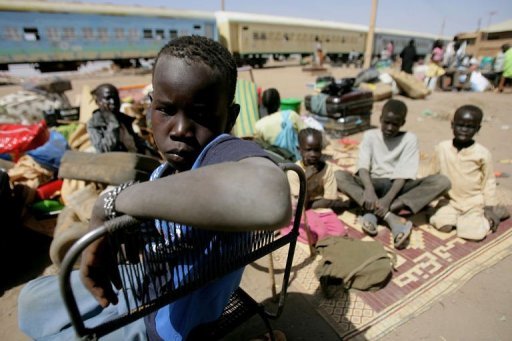
S.Sudanese travel home before deadline


KHARTOUM — With an April 8 deadline looming for ethnic South Sudanese to leave Sudan or acquire documents allowing them to stay in the north, Bol Wunj's family decided on Thursday that it was time to go.

Without a reservation, they showed up at a rubbish-strewn patch of sand where 20 train carriages waited to take around 1,500 South Sudanese home to a country that some of them had not seen for decades.

"My wife is worried about April 8. She is listening to a lot of rumours," Wunj said, hoping his family could get some of the seats still available.

"My children want to leave," said Wunj, 58, who plans to join them once he receives his severance pay from the Khartoum government.

His towering size seemed appropriate for the job he held as a guard in Sudan's prison system until he and all ethnic southerners lost their jobs ahead of South Sudan's independence last July.

The split came after an overwhelming vote in the wake of a 2005 peace accord ending 22 years of civil war which killed two million people and drove many more to the north.

An estimated 500,000 South Sudanese remain in Sudan.

Khartoum has given them until next month to leave or regularise their status, but both options are unworkable, says the International Organisation for Migration (IOM), which organised Thursday's train.

"It is logistically impossible to move half a million people in less than two months," Mohammed Abdiker, an IOM official, said in a February statement.

During a visit to Khartoum on Thursday, Britain's Under-Secretary of State for International Development, Stephen O'Brien, encouraged Sudan to extend the April 8 deadline.

In order to apply for northern residence, people need documents from South Sudan. But even if they have their papers, the north has not put in place the system to legalise their status, the IOM said.

Those travelling by train with the IOM do not need documents.

The intergovernmental body, which is dependent on donor funding, has helped to move more than 23,000 southerners from Sudan to South Sudan, mostly by river barge.

Last month, though, Sudan's military stopped the use of barges from Kosti, about 350 kilometres (217 miles) south of Khartoum, because of suspicions they were also being used by the South to reinforce troops near the tense border, sources said.

With trains still able to move, more than 1,000 southerners registered to board the sky-blue and yellow carriages leaving Khartoum on Thursday.

Another 456 were to join a second train in Kosti, where southerners have been "sitting there basically in the railway station since August," said Julia Hartlieb, of the IOM.

The bloated Kosti way station on the White Nile River, designed for about 2,000 people, now holds more than 11,000, the IOM says.

Mahadia Ramadan, 29, who spent years in the north after fleeing the civil war, has not had a regular income since June when she lost her job as a government office cleaner.

She heard about the April deadline but says it means nothing to her. She just wants to go South, even though she has no job, house or land there.

Ramadan proudly showed off two crates of rabbits she plans to sell for food during the journey, which could take up to 14 days, to Wau in South Sudan's Western Bahr El Ghazal state.

"I'm happy to be going back to my homeland," she said. "The war is in the past now."

She and the other returnees will find a grossly underdeveloped young nation reeling from multiple crises, including ethnic violence and fighting along the disputed border with Sudan.

"I'm not afraid of anything. I'm not worried about anything," said Antoneta Jumaa, 38, who has not seen the south since she was a child.

"God will bless me," she said.

In her hand she held her pink IOM registration form and a white piece of paper confirming that she is healthy enough to make the journey on the wooden benches of the battered-looking train with no air conditioning.

A grey card showed her boarding pass number, 000456, and her destination. "Wau Station," it said.

Court to rule later on Georgia, Alabama's anti-illegal immigration laws

A federal appeals court in Atlanta announced Thursday that it would wait until after the U.S. Supreme Court rules on Arizona’s anti-illegal immigration law before it acts on similar statutes in Georgia and Alabama, keeping parts of those measures on hold for months to come.


Judge Charles Wilson of the 11th Circuit Court of Appeals made the announcement at the start of a three-hour-long hearing on parts of Georgia and Alabama’s laws.

As dozens of people loudly protested against those laws outside the downtown courtroom, Wilson said his three-judge panel agreed to wait until the higher court rules because some of the issues are similar in their cases.

The Supreme Court is expected to take up Arizona’s law next month and rule by the end of June. A lower court put two key parts of Georgia’s law on hold in June following a legal challenge brought by the American Civil Liberties Union and other civil and immigrant rights groups. Georgia is appealing that lower court’s decision to Wilson’s panel.

At issue in the courts is how far states can legally go in combating illegal immigration. Officials in Alabama, Arizona, Georgia, South Carolina and Utah have enacted similar anti-illegal immigration laws in recent years, saying they must act to protect jobs and taxpayer-funded resources because the federal government has failed to seal the nation’s borders.

Opponents of these measures say they are divisive and unconstitutional and complain they are tearing families apart, driving migrant workers away and damaging states’ economies.

“The panel has conferred preliminarily and we have agreed not to issue any opinions in this case until the Supreme Court has decided the Arizona case,” Wilson said Thursday, “since I believe that some of these provisions of both the Georgia law and the Alabama law are very similar to the provisions in Arizona.”

Wilson and the other two judges then proceeded to ask many probing questions of the attorneys representing Georgia and Alabama, including whether their measures interfere with the federal government’s authority to regulate immigration and manage foreign relations.

Wilson singled out a provision in Georgia’s law that would authorize state and local police to investigate the immigration status of certain suspects and detain those who are determined to be in the country illegally and take them to jail.

The judge asked what would happen if all 50 states adopted statutes similar to Georgia’s. Specifically, he asked how that would affect federal immigration officials who are required to respond to queries from local police about the legal status of suspects.

“I wonder what the increased burden would be on the Department of Homeland Security to respond to all these data-gathering requests?” he asked. “You would have to create an entirely new bureaucracy, wouldn’t you, just to respond to these requests?”

Senior assistant Attorney General Devon Orland pointed out Georgia’s law makes it optional for police to do immigration status checks. She also denied the measure is preempted by federal law.

“What the plaintiffs are talking about is -- their definition of harm is they are more likely to get caught,” she said. “More likely to be caught is not sufficient for standing, it is not sufficient for harm and it is not sufficient to show preemption.”

The judges then turned to parts of Alabama’s law, including a provision that that would require public school officials to determine the immigration status of their students. The Obama administration is suing to block that law. And in October, the appeals court temporarily put that provision on hold.

Judge Beverly Martin expressed concerns about how information about students’ immigration status could be used. She pointed out that Alabama must turn over such information to federal authorities if they ask for it, potentially making it possible for students to be deported. The Supreme Court has ruled that school districts must educate all children regardless of their legal status.

“Once they declare themselves, doesn’t that interfere with their constitutional right to a basic public education, which has been declared by the Supreme Court, as you know?” she asked.

Moments later, Wilson asked whether the law is a “scare tactic.”

Alabama officials denied that and said the law would not deny students their constitutional rights. Prim Escalona, a deputy solicitor general for Alabama, said federal officials are the ones who determine who is deported. She added collecting information about the immigration status of students could help Alabama officials make school spending and policy decisions.

“Perhaps they collect this data and the numbers are low and it informs the public debate and they say, ‘Well, maybe we don’t need certain laws or maybe we do need certain policies,’” Escalona said.

Near the end of Thursday’s hearing, Cecillia Wang, director of the ACLU Immigrants’ Rights Project, pressed the court to not wait and instead issue an injunction against several parts of Alabama’s law – also called House Bill 56 – that have not been put on hold. Among those provisions is one that would require police to investigate the immigration status of certain suspects.

Wang said some of the plaintiffs in the case are seeking legal status in the United States and would be “subject to police inquisition if they should be stopped for a traffic violation. They are subject to detention, arrest and indeed criminal prosecution.”

“The plaintiffs that we represent in this case are suffering an ongoing harm because of HB56 and these particular provisions,” she said.

Georgia Attorney General Sam Olens, who sat by Orland’s side at Thursday’s hearing, said it makes sense for the appeals court to hold off on acting on Georgia’s law until the Supreme Court rules on Arizona’s statute since similar issues are at play in both cases. He defended Georgia’s law in an interview during a break in the proceedings.

“The states,” he said, “would not be passing these laws if the federal government did its job.”

Twitter Delicious Facebook Digg Stumbleupon Favorites More

 
Design by Free WordPress Themes | Bloggerized by Lasantha - Premium Blogger Themes | GreenGeeks Review