Showing posts with label Alabama immigration law. Show all posts

Friday, June 22, 2012

Immigration policy shift creates benefits for K-12 students, schools


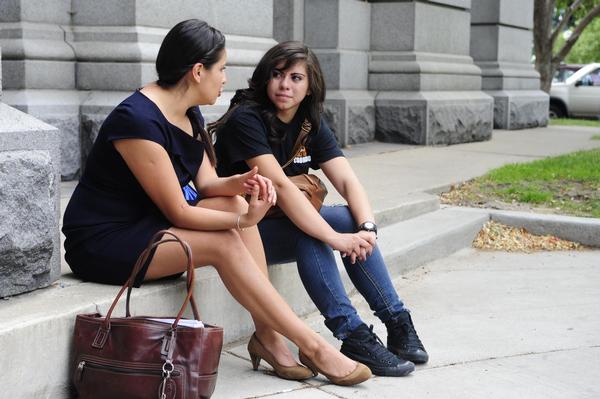
Carmen Medrano, community organizer for Together Colorado, left, talks to Yesenia, a 17-year-old undocumented student at Bruce Randolph High School who asked that her last name not be used. ( Heather Rousseau | The Denver Post)


Although Colorado education experts hesitate to predict exactly how a more lenient immigration policy may affect K-12 trends, some anticipate positive impacts on graduation, dropout rates and even student achievement.

But there seems to be agreement on at least one point: schools will need to fine-tune their academic counseling to reflect new opportunities.

The new Obama administration policy, which grants qualifying young people a two-year reprieve from deportation and the possibility of legal employment, already has encouraged many illegal immigrant students who have grown up in the U.S. shadowed by fear and uncertainty.

The timing of the directive, coinciding roughly with Metropolitan State College of Denver's announcement of a new tuition rate for those students, has prompted even higher hopes — despite the fact that the state attorney general has cast legal doubt on the Metro State move.

"This isn't the whole cake, but it's part of it," said 17-year-old Yesenia, who asked that her last name be withheld because her parents entered the U.S. from Mexico illegally when she was 3.

"It's my senior year," she added, noting that the two-year, renewable window allows her to put away more money for college. "And to have those two things lifted off of me takes away a lot of the stress."

School administrators preface any speculation by emphasizing that districts don't attempt to determine the immigration status of their students, and any conclusions they draw are largely anecdotal.

But Sandra Smyser, superintendent of Eagle County schools, said she already has heard from some recent graduates who have renewed hope for finding legal work . And she suspects younger students who have abandoned their education will now reconsider.

"We don't have a big dropout problem related to this issue," she said, "except we do know there are students out there who I believe would re-enroll and work toward graduation now, given that they can also work to support themselves as they do that."

A former principal of a high school serving immigrant students in Eagle County foresees not only an uptick in enrollment — and the accompanying state dollars — but an increased district obligation to make sure families understand the ramifications of the policy shift.

"Now, knowing that there's hope, I see an onslaught of kids coming back to school," said Kathy Brendza, who until recently headed the 62-student New America High School in Gypsum. "But I also think we're going to have to be carriers of that message. We're going to have to be clear on what this means to kids.

"It's the ticket, the golden ticket, for the rest of their lives. Especially for those children who have been in this system since kindergarten."

Latin American Educational Foundation director Jim Chavez, whose organization helps students plan for college and also offers scholarship help, predicted that the new policy will trigger widespread improvement in student achievement at all grade levels — and higher test scores as well.

"It's almost like a positive peer pressure by having more people pursuing and improving their academic abilities," he said. "Like a contagious effect of success."

In the Jefferson County School District, the state's largest, superintendent Cindy Stevenson imagines, at most, modest positive effect in areas like dropout and graduation rates. The most likely result, she adds, is a new sense of motivation for impacted kids — and the need to make sure guidance counselors can help them adapt to the new landscape.

"This has to sharpen our staff as far as counseling kids," Stevenson said. "It wouldn't be a structural change, but a change in how we talk to kids and motivate kids."

Counseling conversations that once took place privately now can be broached in a more straightforward way, said Mike Epke, principal of the 412-student New America charter in the Mapleton Public Schools.

But the most positive aspect of the new policy will be the "intrinsic motivation, the internal drive" for students to press on with their education, he added.

"Schools like New America or other traditional schools are going to benefit when kids get more engaged," Epke said, "and have that light at the end of the tunnel instead of waning engagement."

One Colorado teen said many of her peers would meet the five-point criteria — including those who had given up hope and dropped out of school. Some of them already have vowed to resume their education in order to qualify.

"Before, a lot of them felt: Why graduate or even try in school? " said Cesiah, a 17-year-old senior at Westminster High School who arrived with her parents illegally 11 years ago. "Nothing good would happen afterward.

"This means a future for them."
Saturday, December 10, 2011

Illegal immigration, water transfer

In response to “Fewer migrants caught crossing border” (Dec. 7): It’s terrific news that apprehensions of illegal immigrants at the border are at their lowest level in 42 years. But if your editorial board thinks that’s a reason to ease up on border enforcement and consider some form of immigration amnesty, it’s mistaken. There are still 11 million illegal immigrants in the U.S., and 8 percent of births in the U.S. are to illegal-immigrant parents.
Letters policy

The Union-Tribune encourages community dialogue on important public matters and welcomes letters to the editor. To enable us to publish as many letters as possible, please be aware that lengthy letters might reduce the chances for publication. All letters are subject to editing for accuracy, space, grammar, clarity or other reasons. It is our policy to publish letters supporting or opposing a particular issue in a ratio reflecting the number received on each side. Letters must include a full name, community of residence and a daytime telephone number, though the phone number will not be published.

A 2004 study by the Urban Institute found that while illegal immigrants constitute 3 percent of the nation’s population, they account for 17 percent of its inmate population. And a study by the Center for Immigration Studies projected that legalization would cost taxpayers $29 billion for public benefits such as the earned-income tax credit, Medicaid, food stamps and housing – services already available to illegal immigrants with U.S.-born children.

So, when planning holiday season gift-giving, please cross immigration amnesty off the list. – Doug Bell, Rancho Peñasquitos
Up in the air

In response to “Court supports S.D. water transfer” (Dec. 8): I was astounded to see Imperial County argue air quality as a basis to block the agreement to transfer water from the Colorado River to San Diego. Yes, increasing the exposure of the Salton Sea’s bed to air will create more desert surface to blow in the wind. However, the pollutants from the decrepit New River and Alamo River are still there, and still arriving, and so pollution is a problem in the Imperial Valley, whether of the air, water or ground and whether or not the agreement is changed or canceled.

I have had family continuously living in Imperial Valley for almost 94 years and I studied the air quality there when I attended Imperial Valley College during the mid-1970s. What Imperial County probably concealed from the Court and your paper is (a) that historically (when I lived there 35 to 38 years ago) the particulate levels were over twice those in downtown Los Angeles, and (b) that there could not be any substantial degradation of the already dismal air quality there from more exposed seabeds given the air pollution already caused by windblown desert sands, tilled fields, feedlot feed, bedding and manure, primitive field burnings and aerial spraying of fertilizer, herbicides and pesticides by corporatized agribusiness interests dominating agriculture there. I conducted my study because I spent five continuous months there with debilitating respiratory illness that has had no parallel before or after in my life.

My decided opinion is that Steve Peace’s plan should be fervently pursued; it would provide for a swap of San Diego County effluent and Colorado River water, which would remove the city of San Diego’s despicable dumping of the effluent into the Pacific Ocean, provide a source of potable water for San Diego -- avoiding full reclamation of effluent or ocean water -- and deliver to Imperial Valley agricultural interests the water it needs with limited reclamation. – Robert Burns, Ocean Beach

Immigration Authorities Release Alabama Woman After Appeal To Janet Napolitano

WASHINGTON -- Immigration officials released an undocumented Alabama woman from custody on Thursday, about four hours after a Democratic congressman told Department of Homeland Security Janet Napolitano about her case.


The woman, a 19-year-old named Martha, was stopped on Dec. 3 for driving without lights, and then arrested because she did not have a driver's license. Although police planned to release her, she remained in jail at the request of Immigration and Customs Enforcement agents -- even though she has a clean criminal record, is married to a U.S. citizen and has an American-born daughter.

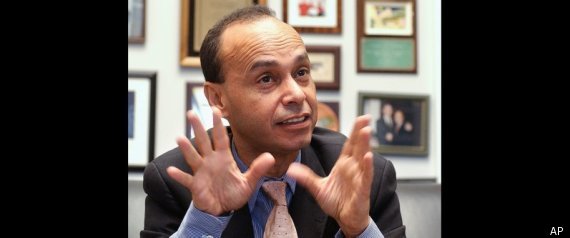
Her case caught the attention of Rep. Luis Gutierrez (D-Ill.), who traveled to Alabama in November to talk to residents about the impact of the state's HB 56 immigration law. He brought up Martha's situation and a recently announced "prosecutorial discretion" policy by Immigration and Customs Enforcement to drop deportation cases against some undocumented immigrants deemed low priority. Gutierrez requested that Martha's last name be left out to protect her identity.

Martha should fit into that category, he said, but was instead being held in jail because of her immigration status.

A few hours after Napolitano's meeting with members of Congress ended, Martha was released and returned to her husband and children. On Friday, Immigration and Customs Enforcement dropped all proceedings against the woman.

"It upsets us that it took so long," Gutierrez told HuffPost of Martha's release. "On the positive side, she's with her husband. ... She's back with her child and with her husband, and for the immediate future she's not deportable."

He declined to comment on what he heard from Napolitano on Thursday, saying it was a private meeting. But Gutierrez said he believes Napolitano is committed to implementing the prosecutorial discretion policy, even though it is not yet implemented in every case.

A Department of Homeland Security spokesman did not respond to an inquiry about whether the woman's release was connected to the secretary's meeting with members of Congress.

Gutierrez is pushing immigration officials to release other immigrants who have long-standing ties to the United States. He is also working with a man in South Carolina, another state with a recently-passed immigration law, who was released after the congressman helped prove that the man entered the United States as a child and had citizen family members.

Of course, not all detained undocumented immigrants can receive help from advocacy groups or members of Congress. Gutierrez said he wants to pressure immigration officials to ensure the prosecutorial discretion policy is implemented nationwide and encourage undocumented immigrants to carry papers that show their ties to the United States.

"The complaint is it's just not working on its own," he said. "Lots of things don't work on their own. Every day you have to be an activist to ensure that government is being fair and equitable with people."

Sunday, December 4, 2011

Australia immigration minister wants more refugees

SYDNEY — Australia's Immigration Minister Chris Bowen Saturday called for a lifting of the nation's annual refugee intake from 13,750 to 20,000 but said he still wanted asylum-seekers processed offshore.

The proposal won the support of the ruling Labor Party at its national conference in Sydney, but Bowen has said the target is aspirational while plans to send boatpeople to other countries have been blocked by the High Court.

"We have to tackle this with a soft heart and a hard head," Bowen told delegates.

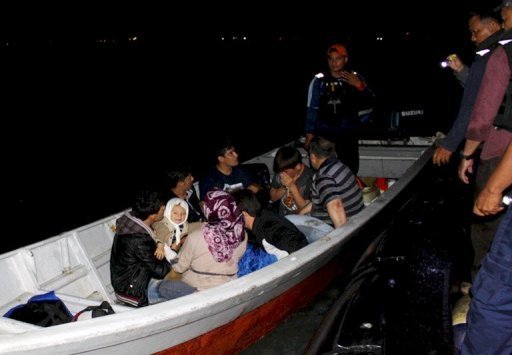
Bowen said refugees were risking their lives on boat journeys between Australia and Indonesia, a perilous stretch which saw close to 50 people drown in a shipwreck off Christmas Island a year ago.

"There have inevitably been others that we simply don't know about," he said.

In a bid to deter people-smugglers, Canberra in May announced plans to send 800 boatpeople to Malaysia in exchange for accepting 4,000 of the Southeast Asian nation's registered refugees.

But the plan collapsed in August after Australia's High Court ruled offshore processing illegal.

Bowen has said he still wants to see a regional solution to the problem which in 2010 peaked when people-smugglers brought close to 7,000 asylum seekers on the dangerous boat journey to Australia.

The issue provoked debate Saturday, with some Labor delegates saying the Malaysia solution violated Australia's international obligations.

"Australia cannot contract out its legal obligations," backbencher Melissa Parke said.

But in backing Bowen, Home Affairs Minister Brendan O'Connor said people-smugglers were "not modern-day Oskar Schindlers" -- a reference to the German industrialist credited with saving Jews during WWII.

"Nothing could be further from the truth," he said.

"This is profiting from desperate people."

After the High Court blocked offshore processing, which was also slated to include Papua New Guinea, the government of Prime Minister Julia Gillard has taken on onshore processing and widened community detention.

Since the so-called Malaysia plan was scuppered, the number of boatpeople arriving in Australia has ballooned, with two more boats carrying close to 100 asylum seekers intercepted off Western Australia on Friday.

Two other boats carrying more than 200 asylum-seekers were intercepted on Thursday.

Alabama gets black eye over immigration crackdown

BIRMINGHAM, Alabama (Reuters) - America's toughest immigration crackdown was meant to drive illegal workers from Alabama.

But after two employees with foreign automakers Mercedes-Benz and Honda were stopped by police in recent days, it is giving many pause for thought. The companies have poured billions of dollars of investment into the state.

Republican backers of the state crackdown say they have been talking to business leaders, and have been considering "tweaks" to some of the provisions of the law which came into force in September.

"I've met with a lot of members of the business community ... and yes that it is a concern about the image we are creating and does it affect economic development in our state," J.T. "Jabo" Waggoner, the state's Republican senate majority leader told Reuters.

"But let me hasten to add, this is a federal issue that the federal government has refused to act on. They have run from the issue ... it may have been an overreach or an overkill, but we had to do something," he added.

As Republican presidential candidates sparred over who can be tougher on immigration in recent weeks, Alabama experienced the downside of taking a hardline stance.

Although legally in the United States, German Mercedes-Benz executive Detlev Hager was arrested in Tuscaloosa in November after failing to provide a passport or driver's license required by the law. The charges were later dropped.

Then this week, a Japanese worker assigned to the Honda assembly plant in nearby Lincoln was ticketed for not having proper identity documents.

The Alabama law, which was passed in June, requires police to detain people they suspect of being in the U.S. illegally if they cannot produce proper documentation when stopped for any reason. A U.S. appeals court has blocked Alabama from enforcing part of the new law, including a provision that permits Alabama to require public schools to determine the legal residency of children upon enrollment but left most of it untouched.

The recent incidents triggered dismay and ridicule in Alabama, where Mercedes-Benz opened a plant in 1993, and was followed by Honda, Hyundai and Toyota. The four have together made, or announced, investments totaling $8.2 billion in the state through 2014.

Mercedes did not respond to a request for comment. Mark Morrison, Honda's spokesman for the Lincoln plant, said the company would take all necessary steps to comply with the law.

Several U.S. states have passed tough laws targeting the undocumented, charging that President Barack Obama and the Congress have failed to act on the issue.

Alabama Republicans who support the state's immigration law say it will help create jobs for legal residents by driving out undocumented workers and their families, pegged at 75,000 to 160,000 by the Pew Hispanic Center.

Waggoner says it would save some of the $280 million he says is spent annually by the state on health and education services for the undocumented.

But some Alabama businesses and civic leaders say it jeopardizes economic development by making it a less-attractive location for firms from overseas, or from other parts of the U.S.

"I don't think that start-up businesses, or entrepreneurs or expansion-type businesses are going to be looking to locate in a hostile area," said Jerome Leader, 79, a Birmingham-based commercial realtor with several empty properties on his books.

"And this immigration law has ... created a hostile and unsavory environment," he said.

Birmingham immigration lawyer Mike Thompson said the arrests of the Honda and Mercedes executives gave the state a "black eye".

"Unfortunately, the ... immigration law is creating an outside impression that the state is not welcoming to foreign persons, documented or undocumented," he added.

In the weeks after the law came into effect, tens of thousands of undocumented farm workers have picked up their checks and headed out of state to avoid the risk of being detained and deported, sources said.

Jerry Spencer, who founded Birmingham-based Grow Alabama, which distributes locally grown food from a network of more than 200 independent farmers, said the labor shortfall left sweet potato and tomato farmers very anxious in the run up to the February planting season.

"There's a great deal of angst and anticipation (among farmers) about the upcoming season, and this has to be settled fairly quickly, or it could be really disastrous," said Spencer, adding that jobless Americans were unable to step in and fill the jobs.

"It became very clear to anybody paying any attention since September that a regular, unemployed American citizen simply can't do this work, and the farmers aren't set up in any way to train them for it," he said. He noted that Hispanic migrant-worker crews are equipped to "walk right in and take the farm over after a basic setup is done."

SHOW ME YOUR PAPERS STATE

Former President George W. Bush brought the last attempt at an immigration overhaul to a vote in 2007, but it was killed off by Republicans in the U.S. Senate.

While it's not yet clear if any foreign firms have been scared off by Alabama's law, its discomfort has already been seized on by some in neighboring states, hungry to pick up fresh investment.

In an editorial after Hager's arrest, the St Louis Post-Dispatch invited Mercedes-Benz to head to Missouri where Ford and General Motors have expanded operations in the past year. "Our state has many advantages over Alabama. We are the Show-Me State, not the 'Show me your papers' state," the editorial read, reveling in schadenfreude.

"You've got two choices. Either ask your executives to carry their immigration papers at all times, or move to a state that understands gemuchlichkeit (sic)," a misspelling of the German word for "coziness."

The events were also noted in Michigan, the U.S. auto industry's traditional home, whose governor, Rick Snyder, traveled to China, Japan and South Korea in September to drum up new investment.

"We'd be foolish not to want to encourage immigration when we've got so much of the base economy here in Michigan founded by immigrants," said Doug Smith senior vice president for economic development at the Michigan Economic Development Corporation.

PITFALL FOR REPUBLICANS

There are an estimated 11.2 million illegal immigrants in the United States, though since the financial crisis and recession hit in 2008 the number of arrests on the southwest border with Mexico has fallen by more than half.

Alabama, Georgia, Indiana, South Carolina and Utah have all passed "omnibus" immigration crackdowns since Arizona blazed the trail in 2010 with a law requiring police to check the status of all those they arrested and suspected of being in the country illegally - a measure since blocked by a court.

There is some indication nationally that a drive toward tough, enforcement-heavy laws may be slowing, with the ousting in an election in Arizona last month of Russell Pearce, the powerful state senate president who championed the state's crackdown.

But any sign of a significantly softer tone from Republican presidential candidates looks remote as the rivals battle for support from conservatives in early voting states like Iowa and South Carolina.

Presidential hopeful Newt Gingrich has been pummeled by rivals Mitt Romney and Michele Bachmann for suggesting in a televised debate that he was in favor of a pathway to citizenship for some illegal immigrants.

Romney, a former Massachusetts Governor has distanced himself from previous comments he made in the 2008 race backing a comprehensive immigration overhaul.

"Any proposal that has the least bit of moderation or even common sense is a potential pitfall for the Republican candidates," said Mark P. Jones, a political scientist at Rice University.

They have painted themselves into such a corner that it will be very difficult to move back to the center without being seen as inconsistent," Jones added.

FRUSTRATION AT OBAMA

As a fears over the potential damage from the state's immigration law takes hold in Alabama there is growing anger at the U.S. Congress and the Obama administration for not acting to mend a broken immigration system.

Obama has failed to deliver on a campaign promise to push through a comprehensive overhaul, tightening border and workplace enforcement, and easing a path to citizenship for illegal immigrants who paid fines, learned English and went to the back of the line.

"Congress needs to step up, put on the big boy pants and address the immigration issue instead of leaving it to the states," said Lew Watson, the mayor of Lincoln, Ala., where Honda employs 4,000 people. "They've known about the problem for years," he added, speaking hours after the Japanese Honda worker was ticketed on Wednesday.

No further attempts are expected at a large overhaul before Obama seeks reelection next November, while the issue itself will likely be eclipsed during a presidential campaign that will likely focus on the parlous state of the U.S. economy.

But for some, including U.S. Hispanics who as a bloc turned out by a 2-to-1 margin to elect Obama three years ago, patience is wearing thin.

"He's not doing enough, he needs to do more," said Isabel Rubio, the executive director of the nonprofit Hispanic Interest Coalition of Alabama, who declined to say if she voted for Obama. "The Latino community elected him because of what he wanted to do on immigration ... I understand that it's very difficult but he has not delivered," she added.

(Additional reporting by Kelli Dugan in Mobile and Emily Flitter in New York; Editing by Martin Howell in New York)

Alabama to stop immigration checks for government transactions, but fed help may be months away

HUNTSVILLE, Alabama -- In a plainly worded letter last week, Alabama Attorney General Luther Strange advised government officials across the state to stop requiring people to demonstrate U.S. citizenship or lawful immigration status during transactions for things like car tags.

The announcement touches a major and far-reaching area of the Alabama immigration law.

And it is unclear how long that part of the law will be on hold.

Strange said local governments should not check immigration status until they establish a relationship with the U.S. government's SAVE program, as called for in the immigration law. The program offers a computer check on immigration status when someone wants to enter a government business transaction.

But so far, of Alabama's 460 incorporated cities and 67 counties, only Pell City is signed up with SAVE, according to the United States Citizenship and Immigration Services, which runs the program. And the review process can take months before a local government or agency is signed up, said spokeswoman Sharon Scheidhauer.

SAVE participation was a major factor in a recent federal lawsuit that led to a section of the law being temporarily blocked. The court order may have also had an impact on Strange's guidance letter.

The lawsuit was filed in federal court in Montgomery to ensure mobile home tags could be renewed by people living in Alabama. U.S. District Judge Myron Thompson found last month that the verification of immigration status approach used by the Alabama Department of Revenue and the Elmore County probate judge conflicted with federal law, as they were not verifying people through SAVE.

Sam Brooke, an attorney for the Southern Poverty Law Center, and one of the attorneys suing the state to block the law's implementation, said Strange's order was overdue.

"This is a big deal for immigrants, but also for all Alabamians, who are no longer going to have to wait in long lines to get their car tag, driver's license, etc.," Brooke said. "It is just unfortunate they didn't issue this guidance months ago, because counties and cities have been out of compliance with the law for a long time now, for no reason."

But, despite Strange's letter directing that governments "should not require anyone to demonstrate their citizenship or lawful presence in the United States," the law has another, possibly complicating wrinkle.

The Alabama League of Municipalities issued guidance Friday suggesting that "individuals still need to declare their citizenship or lawful status under penalty of perjury."

Lori Lein, a general counsel for the league, said the law's Section 7, dealing with state or local public benefits, requires a declaration of citizenship be made.

That section says if the effort to verify a person's status through SAVE is delayed or inconclusive, the person can be given the benefit - license, car tag, etc. - but has to sign a declaration swearing they are here lawfully. Lein said the declaration is not regarded as burdensome for local governments, since they are not checking that information for accuracy.

The SPLC's Brooke said any claim that a declaration is required is an inaccurate reading of the law and of what a "public benefit" means.

Strange's letter and a frequently asked questions section on the Alabama Attorney General's website covering immigration, don't mention the declaration requirement.

Alabama Revenue Commissioner Julie Magee advised probate judges and license and tax officials across the state in a Thursday memo to stop checking immigration status until they are part of SAVE.

Magee's message was blunt.

"Under no circumstances is a state or county official or employee to make a determination as to whether an alien is lawfully present in the United States," Magee wrote. The memo does not mention a declaration requirement.

Madison County Attorney Julian Butler said Friday he is still studying the issue and will advise the Madison County Commission next week.

Huntsville City Attorney Peter Joffrion said since Huntsville is still waiting to become part of the SAVE program, the only people who've been asked to provide a declaration in Huntsville are U.S. citizens. Joffrion said it is still unclear if the city will need to require people to swear they are lawfully in the U.S.

Saturday, December 3, 2011

Alabama immigration law catching the wrong people?

Since the implementation of new, tougher immigration laws in Alabama, there have been more than a few changes and plenty of controversy. One of the first things we heard was that crops were rotting in the fields with nobody left to harvest them. In those cases, the argument could still certainly be made that the workers in question were there illegally in most cases, so the system was working as designed. But now there seem to be new situations where the law of unintended consequences has come into play. Officials have now detained two executives from auto manufacturing companies operating in the state. The latest one was from Honda.

To arrest one foreign car-making executive under Alabama’s new tough immigration laws may be regarded as a misfortune; to arrest a second looks like carelessness.

A judge has acted to put a Japanese employee of Honda Motor Company out of his misery by dismissing immigration charges against him, three days after he was booked under Alabama’s new immigration laws that have been billed as the most swingeing in America. Ichiro Yada is one of about 100 Japanese managers of the company on assignment in southern state.

Yada was stopped in Leeds, Alabama, at a checkpoint set up by police to catch unlicenced drivers. He was ticketed on the spot, despite the fact that he showed an international driver’s licence, a valid passport and a US work permit.

The previous case involved the arrest of a representative of Mercedes-Benz under similar circumstances. So while well intentioned, the wide net of the law seems to be catching more fish than anyone anticipated, and it’s going to be embarrassing to have to keep tossing them back.

Mr. Yada was in possession of three different forms of identification which clearly showed that he was in the country and operating legally. But the import of this goes far beyond one employee of one company. The success of bringing foreign automobile manufacturing operations to the American south was widely touted as smart economic policy leading to the stimulation of business growth and all of the badly needed jobs which come with it. Too many incidents like this are going to have corporate leaders thinking twice about bringing their operations to a place where their workers may be unduly harassed.

It may be time for a fresh look at this law to see if it might not have been worded a bit better.

Twitter Delicious Facebook Digg Stumbleupon Favorites More

 
Design by Free WordPress Themes | Bloggerized by Lasantha - Premium Blogger Themes | GreenGeeks Review