Showing posts with label us visa and immigration. Show all posts

Sunday, March 4, 2012

Student Finds U.S. Immigration Laws Tough To Navigate


NORTH MIAMI (CBS4) – The North Miami High School Valedictorian fighting to stay in the United States has hired a new attorney.

On Friday, Daniela Pelaez, 18, retained Nera Shefer to fight a potential deportation back to her native Colombia. On Monday an immigration judge granted Pelaez an order for voluntary deportation.

“As part of the strategy of the case sometimes we as lawyers sometimes recommend to take this. Yes it is something that we have to request,” said Shefer. “But its not offered to everybody and sometimes we do take that in lieu of a deportation order. But at the end of the day, it could have the same effect and it appears in Daniela’s case, it would have that same effect if nothing is done immediately.”

The immigration judge on Monday denied Pelaez’s request for a green card, surprising immigration advocates like Cheryl Little.

“She’s entitled to a green card… it’s my understanding through other means,” said Little, Executive Director of Americans for Immigrant Justice. “I think she has a very compelling case. I think at the end of the day she’ll get it.”

Right now Pelaez has a number of legal options. Immediately her lawyer said she will file an appeal. That process could take two to four years. In the interim, Shefer said Daniela should be able to stay in the United States.

She can also take the route of filing for citizenship under her father. He recently became a permanent resident under his son, Daniela’s brother. Johan Pelaez is a U.S. citizen because of his service in the U.S. Army.

“We are really against the clock,” said Shefer. “We are trying to do everything that is available to us under the law in order for her to stay here permanently.”

Thursday, March 1, 2012

Air travel may help explain clots in marathoners

(Reuters Health) - Marathon runners who travel by air to the race may end up with higher blood levels of molecules that have been linked to clots, a new study shows.

That doesn't mean flying is actually likely to trigger a blood clot in endurance athletes, researchers say, or that air travel is a no-go. But it does suggest a possible explanation for the rare but mysterious reports of clots in otherwise healthy marathoners who flew to a race.

"It seems that the two activities could have a compounding effect when they are carried out back-to-back," said Beth Parker at Hartford Hospital in Connecticut, who led the research.

Blood clots usually form in veins, and can be dangerous if they break off and block blood supply to the lungs or heart.

The Centers for Disease Control and Prevention estimates that between one and two per 1,000 Americans experience a life-threatening blood clot each year. The elderly and those with genetic risk factors are at increased risk.

In the new study, published in the American Journal of Cardiology, Parker and her colleagues took blood samples from 41 healthy non-smokers who participated in the 2010 Boston Marathon.

Twenty-three of them lived more than a four-hour plane flight away, while 18 participants -- the comparison group -- lived within a two-hour drive of Boston. The researchers collected blood after the runners landed in Boston, immediately after the marathon, and again when the participants were back home the next day.

After returning home, six people in the air travel group had elevated levels of a substance called D-dimer, which has been used as a sign of possible blood clots. By contrast, none of those who lived close to Boston did.

Air travel is known to double or triple the risk blood clots in the veins of the legs, called deep vein thrombosis, according to Parker.

And endurance exercise, such as marathon running, may also raise the number of blood molecules that aid clotting.

What the elevated D-dimer levels meant is unclear. None of the athletes showed actual symptoms of deep vein thrombosis, such as leg pain or swelling, shortness of breath or rapid heart rate.

The researchers also found that older athletes had significantly higher levels of an inflammatory blood compound that could be associated with heart attack risk, regardless of whether they flew to the marathon or not.

One expert who wasn't part of the study cautioned that none of the molecules the researchers looked at has been shown to clearly identify individuals at increased risk of clots or heart disease.

"I wouldn't let these findings alarm runners traveling to marathons," Dr. Kenneth Bauer of Beth Israel Deaconess Medical Center in Boston told Reuters Health by email.

Parker agrees that while the research suggests marathon running and air travel to get to marathons could contribute to a slightly increased risk of blood clots or other cardiovascular events, the benefits of endurance running far outweigh the small risks for most people.

Simple precautions will reduce the risk of blood clots while flying, said Dr. Mary Ann Bauman, medical director for women's health at INTEGRIS Health in Oklahoma City.

She recommends staying hydrated, wearing loose clothes, and not cross your legs for long periods of time. Walking around the cabin every one to two hours and wearing compression stockings can help too, she Told Reuters Health.

One of the researchers on Park's team consults for AstraZeneca, which makes the cholesterol-lowering drug Crestor, and a number of other major pharmaceutical companies that make heart drugs.

S.Sudanese travel home before deadline


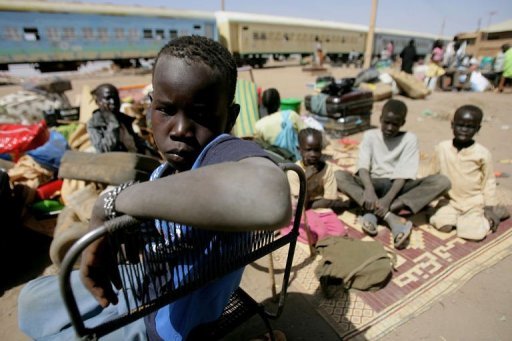
KHARTOUM — With an April 8 deadline looming for ethnic South Sudanese to leave Sudan or acquire documents allowing them to stay in the north, Bol Wunj's family decided on Thursday that it was time to go.

Without a reservation, they showed up at a rubbish-strewn patch of sand where 20 train carriages waited to take around 1,500 South Sudanese home to a country that some of them had not seen for decades.

"My wife is worried about April 8. She is listening to a lot of rumours," Wunj said, hoping his family could get some of the seats still available.

"My children want to leave," said Wunj, 58, who plans to join them once he receives his severance pay from the Khartoum government.

His towering size seemed appropriate for the job he held as a guard in Sudan's prison system until he and all ethnic southerners lost their jobs ahead of South Sudan's independence last July.

The split came after an overwhelming vote in the wake of a 2005 peace accord ending 22 years of civil war which killed two million people and drove many more to the north.

An estimated 500,000 South Sudanese remain in Sudan.

Khartoum has given them until next month to leave or regularise their status, but both options are unworkable, says the International Organisation for Migration (IOM), which organised Thursday's train.

"It is logistically impossible to move half a million people in less than two months," Mohammed Abdiker, an IOM official, said in a February statement.

During a visit to Khartoum on Thursday, Britain's Under-Secretary of State for International Development, Stephen O'Brien, encouraged Sudan to extend the April 8 deadline.

In order to apply for northern residence, people need documents from South Sudan. But even if they have their papers, the north has not put in place the system to legalise their status, the IOM said.

Those travelling by train with the IOM do not need documents.

The intergovernmental body, which is dependent on donor funding, has helped to move more than 23,000 southerners from Sudan to South Sudan, mostly by river barge.

Last month, though, Sudan's military stopped the use of barges from Kosti, about 350 kilometres (217 miles) south of Khartoum, because of suspicions they were also being used by the South to reinforce troops near the tense border, sources said.

With trains still able to move, more than 1,000 southerners registered to board the sky-blue and yellow carriages leaving Khartoum on Thursday.

Another 456 were to join a second train in Kosti, where southerners have been "sitting there basically in the railway station since August," said Julia Hartlieb, of the IOM.

The bloated Kosti way station on the White Nile River, designed for about 2,000 people, now holds more than 11,000, the IOM says.

Mahadia Ramadan, 29, who spent years in the north after fleeing the civil war, has not had a regular income since June when she lost her job as a government office cleaner.

She heard about the April deadline but says it means nothing to her. She just wants to go South, even though she has no job, house or land there.

Ramadan proudly showed off two crates of rabbits she plans to sell for food during the journey, which could take up to 14 days, to Wau in South Sudan's Western Bahr El Ghazal state.

"I'm happy to be going back to my homeland," she said. "The war is in the past now."

She and the other returnees will find a grossly underdeveloped young nation reeling from multiple crises, including ethnic violence and fighting along the disputed border with Sudan.

"I'm not afraid of anything. I'm not worried about anything," said Antoneta Jumaa, 38, who has not seen the south since she was a child.

"God will bless me," she said.

In her hand she held her pink IOM registration form and a white piece of paper confirming that she is healthy enough to make the journey on the wooden benches of the battered-looking train with no air conditioning.

A grey card showed her boarding pass number, 000456, and her destination. "Wau Station," it said.

In Arizona, Republicans shy away from immigration debate


PHOENIX, Arizona — Immigration fuels fierce passions in Arizona, both for and against the waves of immigrants who cross its southern border with Mexico -- but you would hardly know it to listen to Republican candidates.

Mitt Romney, who won the party's primary here handily this week, barely mentioned it in his campaign stops, as he focused on the economy and jobs, issues on which it is easier to find common ground in these tough times.

Arizona Senator John McCain, who won the Republican candidacy in 2008 but lost the White House to Democrat Barack Obama, acknowledged as much here on Tuesday when he spoke on behalf of Romney, who he has endorsed since January.

In a brief speech he trumpeted the former Massachusetts governor's economic credentials, as well as his ability to be commander in chief and restore America's power and influence in the world.

But not a word about immigration.

"I think it's pretty clear that immigration was not the biggest issue in this campaign, in fact it wasn't mentioned that much. The biggest issue on this campaign is jobs and the economy," he told AFP.

Arizona, which has a vast legal and illegal Hispanic population, has been in the eye of a storm since it became the first US state to vote a law -- so called "SB1070" -- allowing police to stop and search any person they suspect.

The Obama administration opposed the law, and has managed to freeze its most contested parts until a Supreme Court ruling in June -- although this has not stopped other states including Utah and Alabama from following Arizona's lead.

Republican state lawmaker John Kavanagh agrees with McCain that immigration has not featured as prominently as one might have expected.

"It's gone on the back burner because our dismal economy has pushed (it) to the side," he told AFP, adding "immigration is still a big problem in Arizona."

"Less illegals are crossing the borders because there are less jobs, but the underlying problem is still there, and we know that when the economy improves and the jobs come back, so too will the illegals," he added.

For civil rights groups, the real problem for Republicans -- who held a TV debate here last week -- is not that they relegate immigration to a secondary campaign issue, but that they don't propose any solutions.

"They are basically talking about keeping 11 million in the same situation, and they are talking about deportation," said Eduardo Barraza, director of the Hispanic Institute of Social Issues in Mesa, outside Phoenix.

In the debate, the candidates did agree on one thing: the need to secure the border with Mexico, by whatever means possible.

And Romney took the opportunity to vigorously defend Arizona's immigration law, and to reiterate his opposition to the so-called DREAM Act, which would let youngsters who came to the US illegally to go to college or join the army.

"I wouldn't say that immigration has not been addressed," said Alessandra Soler Meetze, head of the Arizona branch of the American Civil Liberties Union (ACLU).

"I feel like they are propagating and perpetuating immigration myths to please their public... what is certainly missing is a serious discussion about it. We have to move beyond this extremist rhetoric."

For Camila Gallardo, spokeswoman of the National Council of La Raza, the main Hispanic rights group in the US, "so far unfortunately the Republicans' arguments are pretty negative."

"We hope that once the primaries are finished, the person chosen will make an effort to talk to our community respectfully, and that they will make real proposals," she added.

Because, while neglected in the primaries, immigration could return as a major theme in the real presidential campaign, between whoever wins the Republican nomination and Obama in the run-up to the November vote.

Soler Meetze said the Supreme Court's decision in June will "send a very important message to the states.

"It's gonna answer this question as to who has the authority to regulate immigration matters. I do think that after this decision, the issue is going to rise again."

Barraza is more doubtful, notably if the economy is still flagging during the campaign leading up to the November 6 presidential election.

"Because how in the world could anybody think now, in the political context, that bringing all these people into legality, legalizing all these people is gonna benefit the economy?" he asked.

"In a way yes, because they will pay taxes, but in the same way it is gonna be seen as millions of people being able to get jobs legally. So is that something that this society is ready to accept? I would say no."

Twitter Delicious Facebook Digg Stumbleupon Favorites More

 
Design by Free WordPress Themes | Bloggerized by Lasantha - Premium Blogger Themes | GreenGeeks Review