Showing posts with label immigration reform 2011. Show all posts

Friday, June 22, 2012

Rubio Claims Immigration is Politicized Issue for Both Parties


U.S. Senator Marco Rubio said the issue of immigration is being used by both Republicans and Democrats for political purposes in an election year rather than finding a real solution for the complex problem that affects millions of people.

"Why is this issue simplified? I will tell you right now. Because it is powerful politics. It is a powerful political issue," Rubio told the Hispanic crowd of 1,200 meeting at the annual convention for NALEO -- the National Association of Latino and Elected Officials. "How did we ever get to this point? How can immigration be a controversial and divisive issue in a nation of immigrants?"

President Barack Obama last week initiated an executive order that essentially took major parts of a conservative DREAM Act plan Rubio had proposed to ameliorate the process for undocumented immigrants who had been brought to the U.S. as children by their parents. The move by the president placed the issue of immigration, and subsequently Latino voters at the forefront of political headlines this week.

"I don't care who gets the credit. I don't,” Rubio said. “But it exposes that this issue is all about politics for some people. Not just Democrats, Republicans too.”

Rubio also chided critics who consider immigration reform proposals as a slight against the Latino community.

“Anyone who disagrees with their ideas on illegal immigration is anti-immigrant and anti-Hispanic. That's ridiculous. Ridiculous,” Rubio said. “Everything is about politics. "

Rubio, who released a new book called "American Son", also repeatedly emphasized that both parties needed to find common ground on the divisive issue in order to find a middle ground and a reform policy that works.

“As long as this issue of immigration is a political ping pong that each side uses to win elections and influence votes I'm telling you it won't get solved,” Rubio said.

The Florida senator mostly avoided criticism of President Obama who spoke later in the day. However at point, it seemed like he could not resist.

“The president hasn't been here three years and it's election year, why didn't he make this priority," Rubio said to some laughter in the crowd. “I guess I just did.

Wednesday, April 4, 2012

How To Book Cheap Air Tickets For Domestic Flights

By Hetansh V Agarwal

There is hardly any shortcut to find cheap air tickets for domestic flights. You need to browse various tours and travel sites to check out the best offers waiting for you. Further you also need to compare the deals offered by these travel portals and go for the one that fits your bill.

These tips mentioned below will surely help you save lots of money on your air tickets:

1. Advance Booking: Domestic flights ticket fares usually rise 21, 14 and 7 days prior to the date of journey. So it is always better to make reservations of your air tickets at least before a month or two. Domestic flights are usually over booked during peak travel time. So last-minute booking may prove to be a costly affair.

2. Booking at the last moment: Sometimes it happens that the flights go half loaded. In such case, domestic airlines provide tickets at low rates. But this may prove to be quite risky. If your journey is important then it is better to skip this way. But if you can afford to take a risk, then you should try this option.

3. Surf the Net: Various tours and travel sites have come up online. It is recommended that you go through each and every site and view their tariffs. Each site has something different to offer. Tariffs differ from dealer to dealer.

4. Think twice before you book: Never be in a hurry to book your air tickets. You never know when the tariffs of domestic flights may come down. You may visit Bing.com. This site offers a prediction chart through which you can get certain idea of the tariffs in the coming days.

5. Frequent Flier Card: Traveling is a hobby to some people. They constantly search for reasons to travel to some or the other place. Such regular travelers can apply for this Frequent Flier Card. This card helps frequent travelers to earn Air-miles. These Air-miles can be accumulated and redeemed in your next Air tickets transaction.

6. Check for regular updates: If you are not in a hurry to book your domestic flights tickets then you may surf the net daily for few days. Everyday some or the other tours and travel portal update new deals on their website. Check if there is any good scheme available. If you find any attractive deal then instantly book your tickets.

You can book a ticket of almost every domestic flight through the internet. By following the above mentioned few simple tips you may easily get your air tickets at affordable cost.

Article Source: http://EzineArticles.com/6962420

Monday, February 27, 2012

Video: Immigration was hot topic at white house hispanic action summit

Elyria – February 18 at Lorain County Community College (LCCC) in Elyria was by all accounts a special occasion in which White House officials came to Ohio on their multi – city White House Hispanic Action Summit tour. The discussion groups created by participants ranged from education to how to increase voter turnout, but by far the most pressing issue that day, as it has been around the country from Orlando to San Antonio, has been immigration.

The immigration discussion was allocated the largest space at LCCC, it also hard the largest numbers and the most vocal participants. In the end, information was shared, opinions were changed, and a better understanding of the situation became clear.

When the country discusses of immigration, most immediately turn to the Southwestern states such as Arizona, Texas, and New Mexico, but because of its closeness to Canada and its ever increasing migrant workers, Ohio has seen an increase in undocumented immigrants, not only those from Latino descent, but European as well.

Immigration advocates say many of those who are in Ohio illegally came one of two ways, either they arrived on a work VISA and overstayed the expiration date, or came into the country at a young age without knowledge of the illegal activity.

The plight of illegal immigration and the concerns it causes on both government and people are on display in Painesville, which has increasingly become an area of concern for Immigration and Customs Enforcement (ICE) officials. Over the past decade or so, this area has become home to migrant workers that came on a work VISA but did not return to their home country once the VISA expired.

The latest U.S. Census says 4,298 Hispanics live in Painesville, but in 1990, there were just 389. Twenty-two percent of the city’s 19,563 residents identify themselves as Hispanic or Latino and more than half claim Mexican descent.

When participants at the summit mentioned these concerns to the White House, Julie Chavez Rodriguez, associate director of the White House Office of Public Engagement, said policies may be adjusted based on the summit results and future immigration policies may be dictated from the summit as well, but those in attendance wondered what they can do to improve the situation.

“You need to partner and collaborate,” said Rodriquez. ““We need the business leaders, the community leaders and the churches to stand up”

Rodriquez also said it’s important to strategize and come together and put a “face to immigration.” She also said Congress must pass comprehensive immigration reform to make change. Most recently the DREAM Act was passed in the U.S. House, but failed in the Senate. The DREAM Act is a piece of legislation designed to give path to citizenship to those who either attend higher education and graduate, or join the military. Ohio U.S. 10th Congressional District Rep. Dennis Kucinich (D – Cleveland), attended the summit. He voted for the DREAM Act and could not understand why anyone would vote against it.

“There’ are countless young people who are adversely affected,” said Kucinich. ““We have to make sure that we pursue a path that upholds all of us,”

A Marcus Atkinson Production: White House Hispanic Action Summit speaks on immigration


U.S. Congresswoman Marcy Kaptur (D – Toledo) was one of the House members who voted “no” on the DREAM Act. She shared the same concerns as other representatives did who voted no. One of the provisions in the legislation made it mandatory for all those who signed up for the DRAEM to disclose their parents legal status, during the candidates’ night in Lorain Feb. 22, the 9th Congressional distinct representative said the DREAM Act as written, is the wrong way to pass immigration reform.

According to the 2010 Census, Lorain and Cuyahoga counties lost population over the past decade, but the Hispanic population grew in both counties. Some feel this may hurt the overall economy; cities with high Hispanic populations may become “sanctuary cities” – a city that does not enforce immigration laws – and put a burden on taxpayers to provide bilingual services. Also illegal immigrants may have children or “anchor babies”, which provides a sentimental reason for them to stay in the states while at the same time burdening the already deficit run government heath care system.

Those who do live in Ohio without proper documentation say they fear deportation if they go to a doctor or hospital when ill, there is fear to call police if a crime is seen or if they are a victim of a crime. Those who have children born in the U.S. fear the possibility of being deported and having to make a decision to leave their legal children in the states or take the child back to their native country. In some cases, even those who marry a U.S. citizen can face deportation. .

Lilleana Cavanaugh, Executive Director of the Ohio Commission on Hispanic/Latino Affairs, a non-partisan governmental body says this issue is very important not just for Hispanics but for everyone. She says well have a stake in this issue.

“Our issues are the same across the counties,” said Cavanaugh. “We need to stop dreaming and make it a reality”

Net migration to the UK stuck at 250,000 despite Cameron's tough talk on slashing numbers

Net migration swells population by a quarter of a million in 12 monTotal number of migrants coming into the country now stands at 593,000 - one of the highest figures recorded


Immigration has swelled the population by a quarter of a million people in just 12 months despite the government’s pledge to cut net migration, official figures showed today.

The figure – the number of people added to the total population after immigration and emigration are both taken into account – has remained steady since it peaked at 255,000 in the year to September 2010.

Net migration for the year to June 2011 was 250,000.

The Government has pledged to cut net migration to 1990s levels of the tens of thousands by 2015.

The latest figures mean that ministers are likely to have to deal with increasing criticism from Tory backbenchers and migration pressure groups about their failure to get to grips with immigration.

The number of people leaving the UK has fallen considerably from a peak of 427,000 in 2008, the ONS said.
But net migration has been going up rather than down and is currently running around 15,000 higher than when David Cameron entered Downing Street

The latest figure is up from the figure of 235,000 for the year to June 2010, according to the ONS.

The impact of immigration was boosted by record numbers of people coming to live in Britain from countries classed as part of the New Commonwealth.

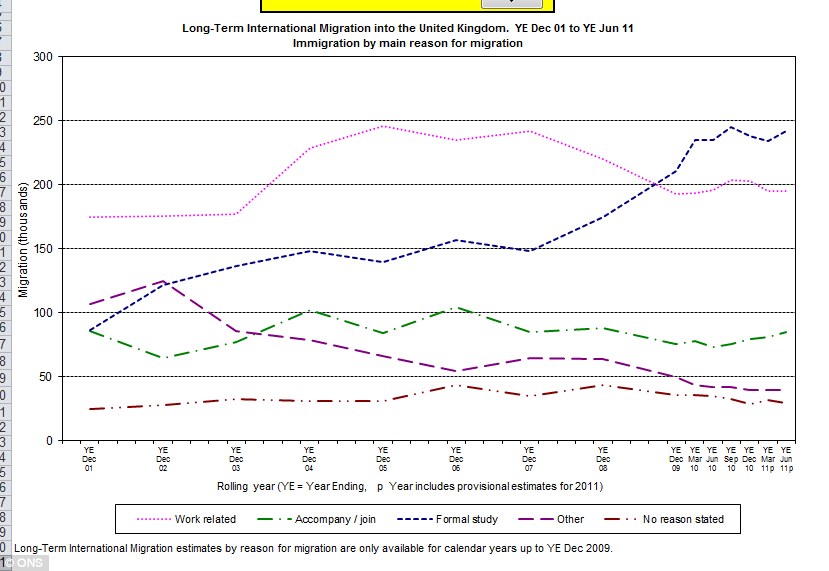
UK Migration 2001-2011
While emigration has dipped since 2008, immigration has remained steady, meaning an increase in net migration since the Coalition came to power

An unprecedented 170,000 people in a year came from countries in Africa, Asia and the Caribbean, two out of three of them to study at British universities and colleges.

The full number of migrants coming into the country in the 12 months to June 2011 was 593,000, itself one of the highest totals ever recorded, and a level which shows that immigration into Britain has not fallen since Labour opened the borders to Poles and other Eastern European citizens in 2004.

That figure is up from 582,000 in the year to June 2010, estimated figures published by the ONS showed.

This means that Britain’s population will grow by 2.5million people because of immigration alone in 10 years, and it suggests that the landmark 70 million population total will be reached 15 years from now.

Net migration was high because many fewer Britons have been emigrating to live abroad since the recession began.
Net migration has actually worsened int he past two years, today's figures show

Some 343,000 British people left the country in the year to June 2011, nearly 10 per cent down on the numbers in 2008.

Study remains the most common reason for migrating to the UK, with 242,000 students coming in the year to June 2011.

Immigration Minister Damian Green said: 'Our reforms are starting to take effect.

'Home Office figures from the second half of last year show a significant decrease in the number of student and work visas issued, an early indicator for the long-term direction of net migration.

'Net migration remains too high but, as the ONS states, it is now steady, having fallen from a recent peak in the year to September 2010.

Reasons for immigration to UK
The number giving no stated reason for coming to the UK has remained steady in the past decade
----------------------------------------------------------------------------------
Growing numbers of foreign students
Overseas students coming to study in the UK has been one of the biggest drivers of immigration
-----------------------------------------------------------------------------------
'This Government remains committed to bringing net migration down from the hundreds of thousands to the tens of thousands over the course of this Parliament.'

Sir Andrew Green, chairman of campaign group Migration Watch UK, said: 'These figures are disappointing.

'They show that the immigration supertanker has been brought to a halt but massive efforts by the Government will be essential if their manifesto promise is to be kept.

'For example, the student visa system, which admits half a million non-EU students a year, needs a much more effective means of testing whether the applicants are genuine and intend to return home.'
Net migration has remained steady despite a pledge by David Cameron to tighten borders

Shadow immigration minister Chris Bryant said: 'On net migration, rather than the Prime Minister's 'no ifs, no buts' pledge to cut net migration to the tens of thousands, this data shows it's still going in the wrong direction.

'We need honesty and competence from this Government on immigration. Instead we get tough rhetoric not matched by the reality on the ground. The country deserves better than that.'

He added: 'These figures show the Government's complete failure to combat illegal immigration.

'This Government is deporting fewer foreign criminals, stopping fewer people who shouldn't be in the UK from coming in, and removing fewer people who should not be here. That is a serious failure of this Tory-led Government.'
Migration from New Commonwealth countries has been one of the key drivers of immigration
---------------------------------------------------------------------------------
Meanwhile, asylum applications rose 11 per cent last year to 19,804, compared with 17,916 in 2010, separate figures published today by the Home Office showed.

The figures for every quarter last year were higher than 12 months earlier, mainly due to an increase in applications from Pakistan, Libya and Iran, officials said.

And the number of people removed or departing voluntarily from the UK last year fell 13 per cent to 52,526 from 60,244 during 2010.

Matt Cavanagh, associate director of the Institute for Public Policy Research (IPPR) think-tank, said: 'Reducing immigration is a legitimate goal, but politicians should be wary of promising what they can't deliver.

'There is also a risk that ministers will be tempted to take more extreme measures in pursuit of their elusive target, including on those areas of immigration which are most important to our economy, and which surveys show the public are less bothered about, including skilled workers and overseas students.'

The ONS figures published today also showed that 690,000 national insurance numbers were allocated to non-UK nationals in the 12 months to September last year, up 11 per cent from the 623,000 in the previous year.

Mr Cavanagh said these figures were 'one way of estimating the total number coming here to work' and were 'likely to reinforce widespread fears that immigration is exacerbating unemployment'

Villawood asylum seeker dies


An asylum seeker from Sydney's Villawood detention centre has died in hospital, the Immigration Department says.

The 44-year-old man was transferred to hospital with chest pains on Saturday but died early on Monday, the department said.

Refugee activist Ian Rintoul said the man was Iranian and had fled his home country in 2010 after being arrested and jailed for participating in pro-democracy protests.

He arrived in Australia by plane in April 2010 and had been in detention since then.

Mr Rintoul said the man had a wife and two children in Iran and a cousin in Australia.

He said he had been living in Villawood's housing section for four weeks before being taken to hospital.

The man is the ninth immigration centre detainee to die in the last five years, a spokesman told AAP.

Counsellors were supporting staff and detainees at the centre, the department said.

Guest commentary: Immigration debate is about economics, not politics

What do Jeremy Lin of the Knicks and Nicklas Lidstrom of the Red Wings have in common? Both owe their success to immigration – and both are creating jobs and strengthening our economy.

Lin, whose parents came from Taiwan, and Lidstrom, who was born in Sweden, are helping their teams sell tickets and merchandise, while also helping tavern owners sell burgers and beers. But they are also helping the NBA and NHL to expand in overseas markets – something every major corporation in America is trying to do. The more a company expands its overseas exports, the more jobs it can create here in the U.S. – and the more tax revenue it produces for local, state, and federal governments.

In a presidential election in which both sides are debating economic growth and immigration separately, all parties should emphasize the relationship between them. The fact is the link between legal immigration and job creation couldn’t be stronger.

Immigrants, especially those with advanced degrees, play a vital role in helping U.S. companies create jobs, as a recent study by the conservative American Enterprise Institute and the bipartisan Partnership for a New American Economy has shown. The study found that each foreign graduate with an advanced degree from a U.S. university who stays and works in the innovation-rich fields of science, technology, engineering, and math ("STEM" fields) creates on average 2.62 jobs for American workers.

Yet right now, even though many of the world’s brightest STEM students train in our universities, the federal government forces many of them to leave as soon as they are handed a diploma. When these graduates return to their home countries, they go to work for foreign companies that compete against us – or they found companies that will create jobs overseas, rather than here in the U.S. This is the federal government at its most frustrating. And it is doing real damage to our economy.

Immigrants also drive new business creation. More than 40% of our Fortune 500 companies were founded by an immigrant or a child of an immigrant – companies like Google, Yahoo, and Intel. In Michigan, major companies like Dow, Masco and Meijer were founded by immigrants, as were major New York City companies like Pfizer, Foursquare and Nathan’s Famous. Yet the longer we wait to fix our broken immigration laws, the more these innovative companies will be founded overseas. If that is allowed to happen, we will do enormous damage to America’s future and our standing as the world’s economic superpower.

Economists are in agreement that our broken immigration policies hurt our economy and make it harder for our companies to compete. And interestingly, so are the candidates for president. All the major candidates in both parties have come out in support of reforming our immigration laws to attract the world's brightest minds. (Learn more at www.NoDebate.org).

The trouble is that the debate around immigration is too often focused on politics, not economics. If both parties would pass legislation based on their points of agreement, rather than engage in endless debates over their points of disagreement, we could create thousands of jobs all across the country at a time when so many out-of-work Americans need them.

America needs more superstars like Jeremy Lin and Nicklas Lidstrom – in every industry. And we need our leaders in Washington to stop blocking sensible legislation and start scoring some points for the American worker.

Michael Bloomberg is mayor of New York City. Rick Snyder is governor of Michigan.

Saturday, December 10, 2011

Unions And Immigrants Join Occupy Movements

by David Bacon


Oakland, California - When Occupy Seattle called its tent camp "Planton Seattle," camp organizers were laying a local claim to a set of tactics used for decades by social movements in Mexico, Central America and the Philippines. And when immigrant janitors marched down to the detention center in San Diego and called their effort Occupy ICE (the initials of the Immigration and Custom Enforcement agency responsible for mass deportations),people from countries with that planton encampment tradition were connecting it to the Occupy movement here.

This shared culture and history offer new possibilities to the Occupy movement for survival and growth at a time when the federal law enforcement establishment, in cooperation with local police departments and municipal governments, has uprooted many tent encampments. Different Occupy groups from Wall Street to San Francisco have begun to explore their relationship with immigrant social movements in the US, and to look more closely at the actions of the 1 percent beyond our borders that produces much of the pressure for migration.

Reacting to the recent evictions, the Coalition for the Political Rights of Mexicans Abroad recently sent a support letter to Occupy Wall Street (OWS) and the other camps under attack. "We greet your movement," it declared, "because your struggle against the suppression of human rights and against social and economic injustice has been a fundamental part of our struggle, that of the Mexican people who cross borders, and the millions of Mexican migrants who live in the United States."

Many of those migrants living in the US know the tradition of the planton and how it's used at home. And they know that the 1 percent, whose power is being challenged on Wall Street, also designed the policies that are the very reason why immigrants are living in the US to begin with. Mike Garcia, president of United Service Workers West/SEIU, the union that organized Occupy ICE, described immigrant janitors as "displaced workers of the new global economic order, an order led by the West and the United States in particular."

Criminalizing the act of camping out in a public space is intended, at least in part, to keep a planton tradition from acquiring the same legitimacy in the US that it has in other countries. That right to a planton was not freely conceded by the rulers of Mexico, El Salvador or the Philippines, however - no more than it has been conceded here. The 99 percent of those countries had to fight for it.

Two of the biggest battles of modern Mexican political history were fought in the Tlatelolco Plaza, where hundreds of students were gunned down in 1968, and three years later in Mexico City streets where more were beaten and shot by the paramilitary Halcones. In both El Salvador and the Philippines, strikers have a tradition of living at the gates of the factory or enterprise where they work. But even today, that right must be defended against the police, and (at least until the recent election of the Funes and Aquino governments) even the military.

Plantons or encampments don't stand alone. They are tactics used by unions, students, farmers, indigenous organizations, and other social movements. Each planton is a visible piece of a movement or organization - a much larger base. When the plantons are useful to those movements, they defend them. That connection between planton and movement, between the encampment and its social base, is as important as holding the physical space on which the tents are erected.
Leobardo Benitez Alvarez. a fired SME member, in the union's planton. (Photo: David Bacon)

For the last two years, that relationship has been very clear in the Zocalo, Mexico City's huge central plaza. During that time, fired members of Mexico's independent left-wing electrical workers union, the SME, have lived in a succession of plantons. They've often been elaborate, with kitchens, meeting rooms and communications centers, in addition to the tents where people slept and ate.

At various time, the SME encampment was one of several in the huge square. A year ago, the workers were joined by indigenous Triqui and Mixtec women from Oaxaca, who protested the violence used by their state's previous governor against teachers' strikes and rural organizations. The social movement in Oaxaca, which the women represented in Mexico City, grew strong enough to finally knock the old ruling party, the PRI, from the governorship it had held for almost 80 years.

In the Zocalo plantons, people from different organizations mix it up. Last September's Day of the Indignant brought together people from very diverse movements. Some see electoral politics as a vehicle for change, but many indigenous activists and SME members don't. Even among those who do, there are deep disagreements over how to participate in the electoral process.

But the people in the Zocalo have two things in common. Different plantons may not see every political question eye to eye, but each represents a social movement in the world outside the plaza. And the planton itself has value primarily because it forces public attention to focus on the crisis that has led each group to set up its encampment.

The SME workers used their plantons to dramatize repression by the federal government. When Mexican President Felipe Calderon dissolved the state-run power company for central Mexico and fired its 44,000 employees, he sought to destroy their union and move toward the privatization of the electrical system - to benefit Mexican and foreign 1 percenters. A year ago, several SME members conducted a hunger strike at the planton that generated front-page headlines for weeks, and lasted so long that doctors warned participants they were risking death. At the height of the protest, the union battled police in front of the power stations, as it tried to exercise its legal right to strike and picket.

The planton and the movement outside it were intimately connected. The hunger strikers were few, but spoke for a union of tens of thousands of workers. In the end, the SME negotiated the removal of its last planton in return for government acknowledgement of its right to exist. It organized other unions to resist the government's assault on labor rights, and mobilized electricity consumers to protest rising bills and cuts in service. The planton helped to focus attention on these demands, and to pull the union's allies into action.

Clearly, someone in Seattle knows this tradition of plantons in the Zocalo, perhaps even as a participant. When the painter made the Seattle banner, she or he also included, right next to the word "planton," the anarchists' "A" with the circle around it. This symbol was a reminder of another aspect of cross-border fertilization. Many anarchists or anarcho-syndicalists - members of the Industrial Workers of the World - fought in the Mexican Revolution. Because of that revolutionary upheaval, even today, almost a century later, ordinary Mexicans expect certain rights, including the right to set up a tent in the Zocalo. US workers crossed the border to fight alongside Mexicans in that insurrection long ago, for a government that would acknowledge that right. The planton, therefore, is a common heritage, with a history that makes it as legitimate on Wall Street as it is in Mexico City.

Not long after the OWS camp was set up in Zuccotti Park, the planton/occupy movement crossed the US/Mexico border. In Tijuana, home to a million people, mostly displaced migrants from Mexico's south, activists came together and set up an occupation on the grassy median of the Paseo de los Heroes. Their tents were pitched in the middle of the Zona del Rio, where the city's 1 percent meet in fancy hotels and work in government offices. Then, on October 18, police reacted even earlier than they did in most US cities, arresting two dozen activists at the urging of local businessmen. Occupy Tijuana condemned the detentions, declaring, "We are not assassins, delinquents, tramps or crooks."
In the US, we have our own history of defending public space for protest, and it isn't necessary to reach back a 100 years to find it. In just the last few decades, immigrant workers have popularized the use of the planton here, helping unions recover the militant tactics of their own past. In 1992, immigrants trying to join the United Electrical Workers mounted the first strike among production workers in Silicon Valley, and set up a planton and conducted a hunger strike to pressure their employer. A year later, other Latino immigrants in San Francisco erected their tents on the sidewalk in front of Sprint's headquarters, after their workplace was closed days before they were scheduled to vote in a union election.

A decade ago, anti-globalization activists and unions shut down the meeting of the World Trade Organization in Seattle. Young protesters chained their arms together inside metal pipes, and lay down in the intersections of downtown Seattle. Tens of thousands took over the streets. Other anti-globalization protests followed, in which activists battled for their right to use public space to challenge the international policies of the 1 percent.

Working-class support for the battle in Seattle had its roots in the impact of the North American Free Trade Agreement (NAFTA). Workers could see the cost of free trade in the loss of their own jobs, as production moved south. Over the last two decades, many have also discovered that those same agreements and policies didn't make Mexicans better off, but led to their impoverishment as well.

NAFTA and free-market policies forced on developing countries produced opportunities for banks and corporations to reap profits. They drove down wages, forced farmers off their land and destroyed the unions and livelihood of millions of people. This system was designed on Wall Street, by the same bankers Occupiers hold responsible for the current crisis of foreclosures and unemployment in the US. The current economic crisis doesn't stop at the border. In fact, in Mexico, Central America, the Philippines, and elsewhere, it's been a fact of life for a long time. This is the source of forced migration - what Garcia condemned at Occupy ICE.

The 99 percent live in all those countries where free-trade agreements and structural adjustment policies are imposed. They also live in the communities of people who have come here as a result. Who, then, are more natural allies for Occupy protesters than people who've been on the receiving end of these policies for years?

In New York, this connection wasn't lost on Occupy Wall Street. In October, a group called Occupy Wall Street - Español was formed at the first Asemblea en Español. They, in turn, translated the first issue of the Occupied Wall Street Journal. Participants formed a subgroup, Occupy Wall Street Latinoamericano to spread the movement to Spanish-speaking communities, recognizing that the city is home to so many Mexicans from the state of Puebla that its nickname is PueblaYork, as well as much older established communities of Puerto Ricans, Colombians, Ecuadorians, and other Spanish-speaking people. The group will soon publish the first issue of its own newspaper, with articles talking about immigration, globalization, and the specific attacks by the 1 percent on Latinos.

Claudia Villegas, a women's rights activist working with the group Occupy Wall Street Latinoamericano, helped organize a demonstration of immigrant women four days after police raided the Zuccotti Park encampment. "We decided to change our original plan for a march because we were afraid they would stop it," she says. "Nevertheless, 23 organizations participated including women's rights groups and above all, those working with immigrant women."

In San Francisco, a joint march of immigrant activists and Occupy participants helped to defend that city's encampment. In the general assembly meeting preceding it, participants talked about the city's offer to move the Occupiers into an abandoned building in the Latino Mission District several miles away. Few wanted to give up the camp on Justin Herman Plaza, and most felt the city was just trying to move them out of sight. But many people also felt that having an Occupy camp in the barrio was a good idea.

"We're still really working in parallel," Villegas says. She draws attention to the potential power of the immigrant rights movement, and what it could mean to OWS. "We have to include the movement that began in 2006, when there were hundreds of thousands of people in the streets across this country. People were reacting to the injustice of the system then too." They're separate movements, though, she warns, and "our agenda has to come from immigrants themselves. We need to integrate, and at the same time the Occupy movement has to learn to accept us. But we're all on the same path."

Bringing the immigrant and Occupy movements together means more than setting up an encampment. The San Diego demonstration didn't set up an overnight camp, but it brought thousands of workers and supporters down to the ICE detention center to protest the firings of immigrant janitors.

The Occupy ICE protest was intended to draw public attention to the federal government's immigration enforcement strategy that requires employers to fire undocumented workers. In Southern California, the multinational corporations that clean office buildings are terminating 2,000 union members. Earlier waves of firings have targeted unionized building cleaners in Minneapolis, Seattle and San Francisco; sewing machine operators in Los Angeles; food service workers on university campuses; and thousands of others.

Garcia says ICE and the employers are in collusion. After firing union janitors with high seniority and benefits, using immigration status as a pretext, the companies can then hire new workers at lower wages with fewer benefits.

"To hide their greed the commercial real estate industry has used the tools of government to confuse and divide the 99 percent," he charges. "They first said we were unskilled workers who should be happy to be working. They then weakened worker protections to make organizing virtually impossible. Over the last decade the industry has used immigration as a wedge to intimidate and, if need be, replace our workers. ICE is doing what the 1 percent corporate real estate industry wants: using immigration laws to recycle well paid janitors in the hopes of taking back gains in pay and benefits our union has won." (Ironically the week United Service Workers West organized Occupy ICE its parent union, SEIU, endorsed the re-election of President Obama, who is responsible for the ICE policy of firing workers.)
For Occupy, defending workers under attack is a way to survive, grow roots and develop a strong base. That's not always the direction activists take, however. Near Oakland, over 200 immigrant workers at the largest foundry on the West Coast, Pacific Steel Casting in Berkeley, are being fired in another "silent raid" like that hitting the janitors. Through the summer and fall, foundry workers went to city councils, unions, churches and community organizations, seeking help to pressure ICE not to force them from their jobs. Their campaign held "the migra" off for months, but the firings began nevertheless in November. Now, these immigrant families are trying to survive. Occupy Oakland has yet to respond, however.

Instead, some of its activists are trying to shut down work in Oakland's port a second time, as well as others along the West Coast. An earlier march to close the port after the first eviction of Occupy Oakland drew thousands of people. The proposal for a second coast-wide shutdown, however, is opposed by the longshore union. The International Longshore and Warehouse Union's (ILWU) opposition does not come from conservatism. The union, whose members make a living from international shipping and trade, has been one of the most vocal critics of US free-trade agreements. ILWU members have taken action many times to defend the SME and unions in Mexico, as well as other countries. Its locals and members, however, had no role in the decision to try to close the ports, nor did other port workers.

Real solidarity is a two-way street, based on mutual respect. In most cities, including Oakland and San Francisco, labor has welcomed Occupy and sought to defend the encampments. In New York, Occupy activists have been given resources in many union halls, and unions have mobilized against police raids at Zuccotti Park. An alliance of unions, immigrants and Occupiers has great potential strength, not just in numbers, but also in the exchange of ideas and tactics. Unions in particular might benefit from wider use of the planton or Occupy encampment. Occupy ICE challenges the Occupy movement to take up the firings of immigrant workers, but it's also a challenge to unions themselves, many of whom have watched in silence as longtime members were forced from their jobs.

The vision of Occupy - the 99 percent vs. the 1 percent - has enormous support among immigrants and unions. In place of the tired rhetoric of politicians, shedding crocodile tears for the "middle class" while demonizing the poor, Occupy gives workers a vision of their commonality in the 99 percent. This powerful message blows away illusions that higher-paid workers have more in common with stockbrokers than with immigrants laboring at minimum wage, or unemployed young people on the streets of African-American ghettos or Latino barrios.

The Coalition for the Political Rights of Mexicans Abroad shares the same vision of class-based commonality. "We are outraged," it says, "that US citizens, when they demand justice and expose the inequalities that exist in their society, are treated like criminals. With the same outrage, we condemn the criminalization of migrant Mexicans by the US government, the raids by immigration authorities [and] the militarization of the border ... No human being should be treated as a criminal because they struggle to find better conditions in which to live."

Ala. GOP leaders have 2nd thoughts on immigration

MONTGOMERY, Ala. (AP) — Alabama Republicans who pushed through the nation's toughest law against illegal immigrants are having second thoughts amid a backlash from big business, fueled by the embarrassing traffic stops of two foreign employees tied to the state's prized Honda and Mercedes plants.


The Republican attorney general is calling for some of the strictest parts of it to be repealed.

Some Republican lawmakers say they now want to make changes in the law that was pushed quickly through the legislature.

Gov. Robert Bentley, who signed the law, said he's contacting foreign executives to tell them they and their companies are still welcome in Alabama.

"We are not anti-foreign companies. We are very pro-foreign companies," he said.

Luther Strange, the attorney general who's defending the law in court, this week recommended repealing sections that make it a crime for an illegal immigrant to fail to carry registration documents and that require public schools to collect information on the immigration status of students. Both sections have been put on hold temporarily by a federal court.

Two foreign workers for Honda and Mercedes were recently stopped by police for failing to carry proof of legal residency. The cases were quickly dropped, but not without lots of international attention that Alabama officials didn't want.

One of the groups challenging the law in court said the auto workers' cases turned public opinion.

"Suddenly the reality of what the state has done hit people in the face," said Richard Cohen, president of the Southern Poverty Law Center.

Before 2011, Republicans tried repeatedly to pass an immigration law but were always stopped by the dominant Democrats. That changed when Alabama voters elected a Republican legislative super majority — the first since Reconstruction. The result was a law described by critics and supporters as the toughest and most comprehensive in the nation.

It requires a check of legal residency when conducting everyday transactions such as buying a car license, enrolling a child in school, getting a job or renewing a business license. After the U.S. Justice Department and other groups challenged the law, the federal courts put some portions on hold, but major provisions took effect in late September.

Alabama suddenly found itself at the center of the nation's immigration debate, ahead of other states with tough laws, including Arizona, Georgia and South Carolina.

Within Alabama, much of the debate is within the business community that helped fund Republicans' new strength.

The Birmingham Business Alliance this week called for revisions in the law, expressing worry that it's tainting Alabama's image around the world. The group also said complying with the law is a burden for businesses and local governments, but did not offer specific changes.

James T. McManus, chairman of the Alliance and CEO of one of the state's largest businesses, the Energen Corp., said revisions "are needed to ensure that momentum remains strong in our competitive economic development efforts."

In Thomasville, a town of 4,700 about 80 miles southwest of Montgomery, Mayor Sheldon Day worries about recruiting industries.

He said about 25 foreign companies have visited the town to consider possible plant sites since Thomasville recruited a Canadian steel company in July 2010.

"Up until a few months ago, nobody raised the immigration issue," he said. But in the last few months, it's been brought up regularly. Day suspects competing states are portraying Alabama as hostile to foreigners even though he says that is not the truth. Based on the questions he gets from industrial prospects, he also believes competing states are recounting stories from Alabama's civil rights past.

"It's bringing back old images from 40 or 50 year ago," he said.

The governor says he's declined many national TV interviews about the law because he doesn't want to fuel comparisons with what he sees as Alabama's long gone past. "It's going to take us a long time to outlive those stereotypes that are out there among people that Alabama is living in the '50s and '60s," Bentley said.

The Republican sponsors of the immigration legislation promoted it as a jobs bill that would run off illegal immigrants and open up employment for legal residents. That was an easy political sale in a state suffering from nearly 10 percent unemployment. Even some Democrats voted for the law.

Since the law took effect, Alabama's unemployment rate has dropped a half percentage point. Economists and state officials who compile the statistics say it's too early to say whether to credit the immigration law.

But one of the sponsors, Republican Sen. Scott Beason of Gardendale, said neighboring states without a similar law haven't seen the same drop. "There is nothing else to attribute it to," he said.

If there has been any damage, he said it's the fault of inaccurate portrayals in the news media. He said the media ought to be reporting: "This law establishes a safer, more secure environment for people to come here and invest their money."

Republican House Speaker Mike Hubbard of Auburn said no industrial recruiters have complained to him about the law, and he will only support "tweaks" that make it more effective without weakening it.

Some Democratic Party leaders have called for repeal, but the party is now so weak in Alabama that the real debate is among Republicans.

The governor says the law is "very complicated" and needs to be simplified. He hasn't recommended any specifics, but he says Alabama won't abandon its goal of ensuring that only legal residents get jobs.

Strange, the attorney general, says his recommended changes "don't weaken the law, they just make it easier to defend."

Beason, however, said Strange's proposals would weaken the law by repealing two sections that allow private citizens to sue state and local officials to enforce it. Beason said that's needed because some officials are already saying they won't follow the law.

Other Republicans say the law is causing unnecessary problems for legal residents. Senate Republican Whip Gerald Dial of Lineville said legislators hear complaints from people about digging out documents to prove their legal residency when renewing professional licenses and buying car tags.

"I made some mistakes in voting for this bill, and I want to step up and fix them," he said.

Gingrich defends state's immigration law, Perry seeks momentum during Upstate visits

Newt Gingrich brought his rapidly ascending campaign to Greenville on Thursday, declaring that as president he would end the government’s legal action against South Carolina’s immigration law.

Rick Perry also brought his hopes to town, declaring his campaign still was on the march.

The 2012 Iowa caucuses are less than four weeks away — South Carolina’s primary is six weeks out — and the two Republicans reached out to local voters, one in the unaccustomed role as frontrunner and the other looking for a comeback.

Gingrich told a gathering of business and community leaders that on the day he’s inaugurated, he will sign an executive order dropping lawsuits against South Carolina, Alabama and Arizona “because I think the federal government should be stopping illegal immigration, not stopping the states from enforcing the laws.”

Gingrich also said U.S. Sen. Lindsey Graham, a Republican from Seneca, will introduce a measure, possibly as a constitutional amendment, to address “birth tourism,” referring to people who come to the U.S. on a tourist visa to have children, who then can be considered Americans.

“That’s clearly not what the 14th Amendment (to the U.S. Constitution) implied, and I think it’s inaccurate to interpret that way,” Gingrich said, referring to the provision that persons born or naturalized in the United States are U.S. citizens.

A spokesman confirmed Graham is examining two approaches, including a constitutional amendment. The other would seek a new Supreme Court interpretation of a century-old case.

“We’re still working on the i’s and t’s of it, but we are going to be introducing something,” said Kevin Bishop, Graham’s spokesman.

Last year, in an interview on Fox News, Graham said he might introduce an amendment to address birthright citizenship. It brought a barrage of criticism from supporters and detractors alike who interpreted it as a reversal of his stated positions on immigration reform.

South Carolina’s immigration law, which takes effect Jan. 1 and borrowed some portions from Arizona’s measure, would require that law enforcement officers, upon “reasonable suspicion” that a person might be in the country illegally, check his or her immigration status.
However, officers couldn’t stop or arrest a person merely on that suspicion.

The U.S. Justice Department sued the state in federal court in Charleston, contending certain provisions of South Carolina’s immigration law are unconstitutional and interfere with the federal government’s authority to set and enforce immigration policy.

Federal officials argue that the Constitution and the federal immigration laws “do not permit the development of a patchwork of disparate state and local immigration policies throughout the country.”

The American Civil Liberties Union and a coalition of civil rights groups also have filed a federal lawsuit against South Carolina’s law, charging that it is unconstitutional, that it invites racial profiling and that it interferes with federal law.

At the Global Trade Park in Greenville, Gingrich said his immigration policy centers on controlling the U.S. border, creating a new visa program, establishing “earned legality” for the millions of people who are in the U.S. outside the law and quick deportation of criminals and gang members.

He also would ensure that every new citizen and every young American learn American history, Gingrich said.

“I have a very aggressive position on immigration,” he said. “I think that we should have absolute control of the border by Jan. 1, 2014, and I’m prepared to put in the resources and I’m prepared to change the law to enable us to get the whole thing completed.”

Perry has defended a law he signed allowing children of illegal immigrants in Texas to pay in-state tuition rates for state colleges. As a border-state governor, he also opposes a border fence to block illegal immigration.

Until now, Perry had stressed his state’s record in job creation. His pivot to social issues — including a sharp critique on gay rights — shows he is looking to his party’s most conservative base to find new momentum.

“There’s something wrong in this country when gays can serve openly in the military but our kids can’t openly celebrate Christmas or pray in school,” Perry says in his new TV ad.
Gingrich, long consigned to the fringes of South Carolina conservatives’ hunt for a change agent, is riding a wave of support that includes tea party factions six weeks before South Carolina’s primary that Gingrich says he must win.

A new Winthrop University poll pegged Gingrich’s support at 38 percent among likely voters, well ahead of Mitt Romney’s 21 percent and 9 percent for Perry.

Campaigning in Greenville, Perry greeted diners at an Orchard Park restaurant to press forward with his campaign.

He said he isn’t going down without a fight.

With a huge new television ad campaign targeting social conservatives, the presidential hopeful signaled Wednesday he intends to try to resuscitate his faltering candidacy in Iowa, which holds kickoff caucuses in less than four weeks. It’s a tall order for Perry, who entered the race to great fanfare in August only to see his popularity plummet throughout the fall.

“We’re sitting in a good place at this particular point in time,” Perry told CNN. “Obviously, we’re going to be in South Carolina a good bit over the course of the next two weeks. But Iowa is the real focus.”

Illustrating that, Perry’s campaign has launched a $1.2 million ad buy in the caucus state leading up to the Jan. 3 contest. The campaign plans to spend more than $650,000 this week alone on a commercial showcasing his Christian faith.

Gingrich’s popularity is flourishing, despite political baggage and questions about his conservatism, in part because of how he talks in packed venues across the state, say some conservative activists and political experts.

“Our country’s in real trouble and we need change,” said John Symons, former executive vice president of the Mauldin-based Bi-Lo grocery chain and now a local businessman.

“We need a very intelligent leader. We need an experienced leader. We need someone who can change the direction of the United States of America. I think we have that candidate in Newt Gingrich.”

Greenville Mayor Knox White welcomed Gingrich at the trade park but stopped short of a direct endorsement, telling the crowd, “Like you, I’m here to hear him and to assess what he has to say.”

White called the former U.S. House speaker “one of the transformative leaders of the latter part of the 20th century and the 21st century now.”

Gingrich’s leadership on hallmark legislation reforming welfare and to balance the federal budget proves he’s “not afraid of big ideas and doing big things,” White said.

“It’s big ideas that have transformed Greenville and made it is what it is today,” White said.

In August, Perry campaigned with White at his side along Main Street.

For 55 minutes Thursday, in a speech and question-and-answer period, Gingrich extolled the virtues of shrinking the government and bolstering the economy.

Not everyone seemed convinced of his approach.

Vivian Wong, the trade park’s founder, accompanied Gingrich and told GreenvilleOnline.com that she hoped “to give everybody a chance to hear him.”

Asked if she was endorsing Gingrich or supporting his candidacy, Wong said, “I will let you know later.”

Kenney’s Anti-Immigrant Mean Streak Continues As He Targets 6500 Immigrants For Citizenship Fraud

Saturday, December 10th, 2011


Immigration Minister Jason Kenney’s anti-immigrant mean streak isn’t just directed at immigrants who became citizens but his department has also been working on cases of those who are not yet citizens. Kenney claims nearly 4,400 people with permanent resident status who are known to be implicated in residence fraud have been flagged for additional scrutiny should they attempt to enter Canada or obtain citizenship. There is nothing wrong with cracking down on immigration and citizenship fraud but the Conservatives as usual go gung-ho in targeting immigrants and this comes across as actions of a government bent on attacking and vilifying immigrants. This seems like overzealousness given that since 1867, Canada has only revoked the citizenship status of 66 people but under the Stephen Harper Conservatives thousands of immigrants are on the chopping block.

By R. Paul Dhillon

SURREY — Immigration Minister Jason Kenney’s anti-immigrant mean streak continues as he targets an additonal 6500 people for citizenship after already stripping 1800 of citizenship earlier.

On Friday, Kenney announced that the Conservative government is now investigating 6,500 people from more than 100 countries for fraudulently attempting to gain citizenship or maintain permanent resident status.

“Canadian citizenship is not for sale,” the always boastful Kenney boasted. “Canadians are generous people, but have no tolerance or patience for people who don’t play by the rules and who lie or cheat to become a Canadian citizen. The Government will apply the full strength of Canadian law to those who have obtained citizenship fraudulently.”

In July, Kenney announced that Citizenship and Immigration Canada (CIC) was beginning the process to revoke the citizenship of up to 1,800 citizens who he claimed obtained it fraudulently; that number has now risen to more than 2,100.

Kenney’s mean streak isn’t just directed at immigrants who became citizens but his department has also been working on cases of those who are not yet citizens. Nearly 4,400 people with permanent resident status who are known to be implicated in residence fraud have been flagged for additional scrutiny should they attempt to enter Canada or obtain citizenship. The majority of these individuals are outside the country.

There is nothing wrong with cracking down on immigration and citizenship fraud but the Conservatives as usual go gung-ho in targeting immigrants and this comes across as actions of a government bent on attacking and vilifying immigrants. This seems like overzealousness given that since 1867, Canada has only revoked the citizenship status of 66 people but under the Stephen Harper Conservatives thousands of immigrants are on the chopping block.

According to Kenney, in typical cases, permanent residents will use the services of an unscrupulous immigration consultant to establish evidence of residence in Canada while living abroad most, if not all, of the time. This fraud is perpetrated so that individuals can maintain their permanent residence status and later apply for citizenship. A family of five may pay upwards of $25,000 over four or more years to create the illusion of residence in Canada.

“My department is working closely with the Canada Border Services Agency, the Royal Canadian Mounted Police, and Canadian offices abroad to prevent people who are suspected of non-compliance with the permanent residence requirement from being admitted to Canada without proving they meet the requirements and take enforcement action when necessary,” Kenney added.

Critics say Kenney as usual being high handed in this witch hunt given that under the Conservatives immigration reforms it’s taking a long time for people to become citizens

Immigration lawyers say even a simple citizenship application can take a year to process and suggested the crackdown needed to be supplemented with pragmatism.

To date, of the 4,400 permanent residents who have been flagged, nearly 1,400 people have withdrawn or abandoned their citizenship application because of new scrutiny.

Permanent residents must acquire three years of residence out of four years to apply for Canadian citizenship. To retain their status as permanent residents, they must be physically present in Canada for two years out of five.

“I encourage anyone who has information regarding citizenship fraud to call our tip line to report it,” Kenney urged.

He’s asking Canadians to spy on their immigrant neighbours and report cases involving false representation, fraud or knowingly concealing material circumstances in the citizenship process – for example, pretending to be present in Canada to meet the residence requirements for obtaining citizenship. They can report by calling the citizenship fraud tip line at CIC’s Call Centre at 1-888-242-2100 (in Canada only, 8:00 a.m. to 4:00 p.m. local time, Monday through Friday). Tips may also be reported by e-mail at Citizenship-fraud-tips@cic.gc.ca. Those overseas can contact the nearest Canadian visa office.

All other fraud types related to immigration should be reported to the CBSA’s Border Watch Tip Line at 1 888-502-9060. Tips accepted by the Border Watch Tip Line include, but are not limited to, suspicious cross-border activity, marriages of convenience, misrepresentation in any temporary or permanent immigration application, or the whereabouts of any person wanted on an immigration warrant.

Kenney’s department has been cracking down on the actions of crooked consultants – consultants are calling it a witch hunt and so are many immigrants – during the immigration process. Bill C-35, originally introduced as the Cracking Down on Crooked Consultants Act, came into force on June 30, 2011. The Act imposes penalties on unauthorized representatives who provide, or offer to provide, advice or representation for a fee at any stage of an immigration application or proceeding.

Sunday, December 4, 2011

Chapter 5: Arizona immigrant students find way together

May 18 was a surprisingly cool day for a desert spring. Rain fell in the evening as Jonathan and Gerson prepared to go to their graduation ceremony.

Alejandro, who was still living at the trailer when he wasn't at his grandmother's apartment, had gone out.

He had told the boys he would be there for them at graduation. They were not sure if they believed him.

Gerson put on his robe and sashes at the trailer and wore them all the way to Veterans Memorial Coliseum.

Before the ceremony, all of the North High students gathered in a cavernous concrete room in the bowels of the stadium, wearing their blue robes and mortarboards. They formed into small clusters, hugging and laughing, before breaking apart and forming new groups. They were saying goodbye.

"I feel a little sad," Jonathan said. "I don't know what I am going to do next."

Teachers tried to shepherd them into alphabetical order, but in the sea of blue robes, it was nearly impossible to tell the students apart. They all looked so alike.

The graduation itself was a raucous affair. Anytime there was a quiet moment, a mother or father would yell a child's name.

After pomp and circumstance and the national anthem, Principal Telles addressed the students. "Do more than dream your dream," she told the students. "Love your dream."

The valedictorian spoke next. She was going to Europe for the summer and would enroll at the University of Southern California in the fall.

"Leave no stone unturned," she reminded her classmates.

Then the salutatorian: "Each man is the architect of his own future."

Then the senior-class president: "What lies behind us and what lies before us are tiny matters compared to what lies within us."

---

Alejandro never showed up for the ceremony.

Since quitting high school, he had been taking some shift work cleaning hotel rooms. When he was lucky, he was assigned to the same hotel as his grandmother so they could drive in together.

He said he no longer knew what his dream was.

"This is not living," he said. "I am cleaning the hotel rooms of businessmen. And I don't even get many shifts because the hotels like the cleaning to be done by ladies."

Some days he would sleep until the evening, then maybe take a bus somewhere. He would come home late to watch movies and listen to music.

He heard from men at the trailer park that there was work in Maricopa, an hour south, picking melons for $60 a day. But he had no way to get there.

If there was any future for him at all, he thought, it was not in Arizona.

A few years back, Alejandro had joined the Church of Jesus Christ of Latter-day Saints. His friend Jordie had baptized him.

By graduation time, he began thinking he should move to Utah, that things might be better there.

Jordie was planning to move to Utah with his brothers.

Jordie said his brother told him there was work there and that life was easier for an illegal immigrant.

Alejandro decided he would join them.

Any state, he thought, may be better than Arizona for an illegal immigrant.

---

Sitting in his cap and gown, Jonathan tried to imagine his future, but it felt difficult to think he was its architect.

His family was gone to Texas, and while he had the trailer, he had little else.

As the spring faded and tourists left, Jonathan's dishwashing hours declined. Money was tight again.

He kept thinking of the afternoons when he would come home from school and his mother would be cooking in the kitchen.

"Are you hungry, mijo?" she would always ask him. Then she would make him a plate of beans and rice, burritos or tamales, something to hold him until dinner.

He had been thinking of his father, too. Thinking of the afternoons when the two of them would work on the car for hours.

"Sometimes we would not talk at all," Jonathan said with a laugh. "But he taught me a lot about cars and how to fix things around the house."

Maybe he should move to Texas, Jonathan thought.

---

Sitting in his shiny blue robe, Gerson thought about what lay behind him and before him.

He had left his mother, sick with cancer and unable to care for him. He had crossed the border, lived with his father, lived on his own. He had learned English, and here he was, finally, graduating from high school.

As he waited for the moment when they could walk across the stage, he realized that all that would really matter now was his legal status.

School administrators always look the other way when it comes to a student's immigration status. Every child in their district has a right to an education.

Gerson was beginning to realize that as soon as he received his diploma, all of those protections would evaporate.

"From here on, there are so many uncertainties," he said. "But it's a great feeling. We are done."

Gerson had once promised his mother that he would return to Mexico City the day after he graduated. But that week, he told her he was going to stay.

He did not want to leave Phoenix. It was where he grew up and made his own life. His friends and his girlfriend were here .

His mother, disappointed, told him that he could stay only if he was with family. His father, after being deported, had returned to the United States, and Gerson could move in with him again.

So Gerson knew what lay before him. He would leave the trailer.

He would work and save money -- enough, maybe, to take a couple of classes at a time at a community college. Then, if things changed, he might be able to transfer to a four-year school. He was hoping for the Dream Act, federal legislation that might create a path to citizenship for young students.

He was beginning to think he might make it in Arizona.

"Yes," he would say. Then: "Maybe."

---

Toward the end of the graduation ceremony, Ben Miranda, a governing-board member in the Phoenix Union High School District, took the stage. He repeated a theme the students had heard before: All students need a supportive family.

"I want you to look around and find your family and acknowledge them!" he shouted into the microphone, and the building erupted with cheers.

The students pointed to their parents. There was clapping and stomping and shouting back and forth.

Gerson tried again not to cry. But this time, he did.

One by one, their names would be read. The students would cross the stage, shake the principal's hand, walk down a small flight of stairs and pose in front of an American flag for their official portrait.

Then, in a North High School tradition, they would shake the hand of every teacher at the school, all of whom were up along the bleachers.

When Gerson reached Mrs. Garcia, she gave him a long hug. They both were crying.

He knew how much she had done to help him. He wanted her to know that he would try to do the same someday.

Gerson whispered into her ear: "Le prometo, maestra, que voy a ser como usted cuando sea grande."

"I promise you, teacher, I will be like you when I grow up."

Immigration Minister Chris Bowen set to revive Malaysia Solution

IMMIGRATION Minister Chris Bowen says the government will again try to get its Malaysia Solution through the parliament, just days after the Labor party endorsed offshore processing for the first time.

But Mr Bowen conceded the Malaysia Solution would ultimately fail on the floor of the parliament without a change in the Coalition's opposition to the policy.

Saturday, December 3, 2011

Australian Immigration May Ban Kim Kardashian From Traveling While Sis Dates Aussie Bieber

As Kim Kardashian faces a possible ban by Australian immigration which may prevent her from traveling to Australia, her half sister Kylie Jenner is dating Cody Simpson, known as the Aussie Bieber.

The Kardashian sisters are always making the news. Now Kim Kardashian is facing scrutiny from the Australia Department of Immigration regarding three separate visa incidents as her little half sis dates the Aussie Bieber.

Always jet-setting, it seems the Immigration Department in Canberra believes Kim Kardashian was visiting for more than a pleasure trip. Apparently Kim in on a watch list after three separate incidents related to her visa.

While Kim's visa application indicates she is a tourist, she was actually in Australia for a business appearance. It was as heavily promoted as the rest of her life including her recent split from ex-husband Kris Humphries.

After looking closely at the most recent trip, the Department of Immigration checked out Kim's previous travel to Australia. Apparently KK did the same stuff in 2010 and dating back to 2007.

The Daily Telegraph reported future visits by Kim Kardashian will now be closely watched by the Immigration Department. If Kim breaches the condition of her visa, the department can cancel it or counsel her.

During her most recent trip to Australia, Kim promoted her handbag range at Hugo's. She also promoted her television show and Blonde beer during previous visits. With vast media coverage, the visa issue was sure to get noticed eventually.

Meanwhile, Kylie Jenner needs to take note of her sister's situation since she recently started dating 14-year-old Australian pop star Cody Simpson. Known as the Australian Justin Bieber, Simpson was signed by Bieb's manager Scooter Braun. Kylie Jenner, 14, is the youngest of the famous Kardashian sisters and has done modeling and appeared on their reality show.

According to E!Online, Kylie and Cody met at the Hollywood premiere of Breaking Dawn: Part 1 in November. Kylie and sis Kendall interviewed Cody Simpson for Ryan Seacrest's On Air radio show. Kylie told Cody, “You are my rumor boyfriend on Twitter. Nice to finally meet you.”

Later Kendall said, “I think Kylie should date Cody Simpson because they'd be so cute together.” After the premiere, an enthusiastic Cody Simpson tweeted the Jenner sisters and indicated he had a good time on the red carpet and “see ya soon I hope.” Now the adorable duo was spotted over the weekend kicking back at L.A.'s Grove Mall. Kylie had said, “I'd marry an Australian.”

As Kim Kardashian's fairytale romance goes down the tubes, it seems her little sister Kylie Jenner has found sweet teen romance with the hope of her own fairytale wedding. Of course the Kardashians should still maintain good will with the Australian Department of Immigration despite the fact Cody Simpson moved to the United States. According to the Herald Sun, Simpson released his Coast to Coast EP in September which debuted at number 12 on the Billboard 200.

A source told US Weekly, “They are a couple! They are so cute together.” Representatives for Kylie Jenner and Cody Simpson have not commented yet about the suspected coupling.

Friday, December 2, 2011

County receives U.S. aid, for now, to fight illegal immigration

It has become an annual exhibition in the government's eternal struggle to balance budgets and fight illegal immigration.

Politicians propose removing the federal funds that flow to local law-enforcement agencies as reimbursement for the costs of housing undocumented immigrants, and every year those funds are reinstated.

This year's restoration of funding came just before Thanksgiving in a quietly passed appropriations bill that included funding for farms, research and transportation. The bill also included $240 million to reimburse jailers for the costs of housing undocumented inmates.

On Wednesday, the Maricopa County Board of Supervisors passed a portion of those funds through to the Sheriff's Office, giving the agency $2.2 million to offset some of the costs associated with undocumented inmates.

The federal funds also included more than $9 million for the Department of Corrections.

The money is allocated annually based on the number of days each undocumented immigrant is housed in a jail or prison. The reimbursement rate is about $30 per inmate per day.

Daily incarceration costs can vary based on factors such as where the inmates are housed. It costs about $56 each day to keep a convict in an Arizona state prison.

County jails and the state have received nearly $100 million through the program since 2006, but federal lawmakers eye the money each year when it comes time to balance the budget.

This year's allotment was in jeopardy after President Barack Obama introduced a budget in the spring that eliminated the money, but the funding found its way into a multifaceted appropriations bill that Obama signed Nov. 18.

Officials in Arizona were thankful for the $12 million that came the state's way this year but said it does not come close to covering taxpayers' costs.

"Some money's better than nothing," Maricopa County Sheriff Joe Arpaio said. "It's still not as much as we should be receiving."

It is a familiar refrain that crosses party lines.

Former Democratic Gov. Janet Napolitano regularly billed the federal government in an attempt to recapture some of the expenses the state incurred to house undocumented inmates. And former Republican state Treasurer Dean Martin followed suit and sent federal officials a $1 billion bill in early 2010 in an ill-fated attempt to recoup some of the same expenses.

But in a climate where every federal dollar spent is being scrutinized, it can be hard for politicians to balance their desire for the federal government to meet its obligations and for fiscal conservatism.

Gov. Jan Brewer is among them.

Brewer is sensitive to the federal government's budget crunch, said spokesman Matt Benson, but Brewer wants cuts to come from areas other than the State Criminal Alien Assistance Program.

"The governor doesn't believe that SCAAP funding for states is the best approach to reducing federal spending because ultimately those costs are being born by the states," Benson said. "It's not like they disappear."

Rep. Jeff Flake, a fiscal conservative, was among the six Arizona delegates who voted against the appropriations bill that included SCAAP funds. Sen. John Kyl and Reps. Ed Pastor and Paul Gosar voted for the measure, and Rep. Gabrielle Giffords did not vote.

Flake said Arizonans who are not accustomed to the money serving as a political football should get used to it.

"Unfortunately, I think that what's past is prologue here. We're going to see more of this battle every year," Flake said. "There will be increased pressures, I think, on all funding. It's not like you have to rob something in another area of government (to continue funding the program)."

Keeping the reimbursement program alive, Flake said, will require reducing some of the money that flows from the Department of Homeland Security to state and local law-enforcement agencies if there is not an obvious connection to federal mandates.

"Whether we like it or not, providing funding for local fire departments and (Community Oriented Policing grant) funding, that certainly is appreciated by folks at the local level, but there's not really a federal nexus there," Flake said. "Here, there is

It's Politics: Rep. Grace Napolitano signs on in challenging Alabama anti-immigration law Read more: It's Politics: Rep. Grace Napolitano signs on in challenging Alabama anti-immigration law

Rep. Grace Napolitano, D-Santa Fe Springs - who recently returned from a trip to Alabama, is one of 39 congressional Democrats who signed on in support of the U.S. Department of Justice's lawsuit against Alabama's anti-immigrant law.

The amicus brief, which was filed Nov. 21, asserts foremost that the Alabama statute is unconstitutional because it is preempted by federal law.

H.B. 56 requires schools to demand documentation from enrolling students and police to check the immigration status of "reasonably suspicious" people during routine stops, who they would then hand over to federal authorities.

Landlords cannot rent to undocumented tenants; employers cannot hire undocumented workers.

"The entire state is now suffering the consequences of these extreme policies, and it is clearer than ever before that we need real immigration reform at the national level," Napolitano said.

ASSEMBLY CAMPAIGNING: Ana Valencia, the Norwalk-La Mirada Unified School District board member who is running for the Assembly, will hold a "Holiday Celebration" from 3-6 p.m. Sunday at the Half-Off Book Store, 6708 Greenleaf Ave., Whittier.

There will be food, music by Latin Flavors and a raffle.

Those coming are asked to bring a nonperishable food item to be donated to Neighbors Helping Neighbors in South Whittier.

The suggested donation is $20.

Bentley says immigration job arrests won't stop Alabama job recruitment

MONTGOMERY, Alabama -- Gov. Robert Bentley said the arrests of two international auto plant workers under Alabama's immigration law "look bad" but maintained the state will still be successful in recruiting industry.

"We have had some unfortunate incidents that certainly look bad. But we are continuing to recruit jobs to the state. We have announcements that will be coming up very soon," Bentley said in response to questions about the arrests.

"Jobs are still coming to Alabama. We feel like Alabama is open for business," Bentley said.

Alabama's new immigration law has ensnared two international workers from two of the state's much coveted foreign automobile manufacturers.

A visiting German Mercedes-Benz executive was arrested and taken into custody after being unable to produce proper documents while driving a rental car in Tuscaloosa. The man was released after an associate retrieved his passport, and the charge was dismissed.

A Japanese man employed by Honda was issued a ticket for driving without a valid license and was arrested for being in violation of a section of Alabama's immigration law that requires everyone to have a valid license while driving. The worker produced a valid passport and a Social Security card that allowed him to work in the United States, but did not have a valid Alabama or Japanese license with him.

City officials said he was released on a signature bond at the checkpoint and was not taken to jail. The charge was dismissed after a copy of his Japanese license was shown to the court.

Critics have said the state is giving the impression that it is hostile to foreigners. The St. Louis Post-Dispatch wrote an editorial inviting Mercedes to move to Missouri.

"Our state has many advantages over Alabama. We are the Show-Me State, not the 'Show me your papers' state,'" the paper wrote.

But proponents of the law have dismissed those concerns, saying the law worked and that the incidents have been exaggerated in the media.

Bentley, as he has said before, stated he is open to tweaks in the law, particularly those that would make it clearer.

"We are going to look at all aspects of it and see if there are any simplifications or clarifications that need to be made," Bentley said.

JOEY KENNEDY: Alabama's harmful immigration law creating labor shortages

Alabama's overreaching immigration law has done a great job of chasing people out of the state and opening up jobs. Problem is, Alabama people aren't filling those jobs.

Analysis has already shown that the drop in Alabama's unemployment rate is not because of the harsh immigration law but, instead, due mostly to seasonal hiring, government hiring and thousands of unemployed jobseekers giving up.

There are jobs out there, but not the kind many Alabamians apparently want to do or are trained to do. I know, I know. What's the evidence?

John McMillan, Alabama's commissioner of Agriculture and Industries, is holding a meeting in Mobile on Tuesday to address the chronic labor shortages created by the immigraton law in south Alabama.

McMillan is a conservative Republican, but he knows the immigration law is hurting the state's construction industry and farmers. And before somebody starts hollering that illegals shouldn't be holding those jobs, understand that many of the people who have left the state are documented workers but fled because they didn't want be harassed under the law. Why work in a state where you are looked upon with suspicion when you can drive 50 or 100 miles and work in a state that accepts you for your skills and work ethic?

The press release from the agriculture department says the "purpose of the meeting is to bring agribusiness owners and farmers together with federal and state officials to help solve the chronic labor shortages created by Alabama's new immigration law."

This supposed job-creation law turns out to be more of a labor shortage creation law. That's what happens when lawmakers really have no clue what they're doing, but do it anyway to get a thrill out of being able to brag how tough they are. Macho-men!

That's not new, though. There's never been a shortage of bullies in Alabama who like pushing around others, especially those who are less fortunate. Sadly, it's part of our state's personality, and we fail to learn from our mistakes.

The US Immigration Test

If you have applied for naturalization, you will need to pass the citizenship test in order to get your US citizenship. Many applicants worry about this US immigration test, but millions of Americans pass this test regularly. With a little work and preparation, so can you. The citizenship requires you to know two basic things: the English language and US civics. As part of the US immigration test, you will be required to speak, read, and write in English. You will also be required to show knowledge of US history and civics by answering questions about these subjects. You can pass the citizenship test, however, if you:

Start early. The earlier you start preparing for your US immigration test, the more time you will have to master the knowledge. Ideally, start preparing as soon as you apply for naturalization or as soon as you realize that you want to apply for naturalization.

Sign up for classes. Classes are an excellent way to prepare for the citizenship test, since they allow you to work with a teacher and other students to get the support you need. Your community likely has citizenship classes that help you prepare for the naturalization test specifically. You may also want to sign up for additional English classes if you need additional work on your English.

Find more resources to study. Even if you have an excellent citizenship class in your area, the class will likely only meet a few times a week. You will be able to prepare far more fully if you study on your own in addition to taking classes. There are many resources that can help you. The USCIS website has a great deal of information about the citizenship test, including practice questions. Your local library generally will have books about the citizenship test. As well, the American Immigration Center Inc. has a number of interactive study kits that can help you prepare for the citizenship test on your own time and at your own pace.

Set aside time every day and every week to study. If you are working and taking part in all your usual activities while also trying to prepare for your naturalization US immigration test, it may be hard to find time to study. A good solution is to schedule time to study every day or every week. This way, you will have enough time to devote to mastering the material.

Take practice tests and focus on those areas where you are having trouble. The best way to pass the naturalization test is to find out which areas you need to work on and focus mostly on those areas. Taking practice tests and taking a citizenship class can show you which subjects you need to spend more time studying.

U. S. Legislative Immigration Update August 8, 2011

Department of Justice Sues Alabama

In a complaint filed early last week, the U.S. government filed suit against the State of Alabama to prevent the state’s recently-passed immigration law from taking effect in September. In the filings, the U.S. argued for H.B. 56 to be preliminarily and permanently enjoined from enforcement. The federal government asserts that numerous provisions of Alabama’s law are preempted by federal laws and therefore violate the Supremacy Clause of the Constitution. (U.S. Const., Art. VI, Cl. 2) The complaint also claims one of the provisions violates the Constitution’s Commerce Clause. (U.S. Const., Art. 1, Sec. 8, Cl. 3)

The U.S. government is petitioning the courts to rule that the power to regulate immigration is one of the authorities that is exclusively vested in the federal government, and therefore H.B. 56 is preempted. (U.S. Const. Art. 1, Sec. 8, Cl. 4 assigns the federal government with the power to establish an uniform Rule of Naturalization) The complaint acknowledges that while a “state may exercise its police power in a manner that has an incidental or indirect effect on aliens, it may not establish its own immigration policy or enforce state laws in a manner that interferes with the federal immigration laws.” (U.S. v. State of Alabama & Governor Bentley, p. 2)

The federal government asserts that the state has gone too far with its enactment of H.B. 56, crossing the constitutional line from being able to regulate legitimate areas of local concern into interfering with federal immigration law and corresponding policies of the federal government. By emphasizing maximum enforcement of immigration laws, the government argues, “H.B. 56 ignores the many other objectives that Congress has established for the federal immigration system.” (U.S. v. State of Alabama & Governor Bentley, p. 4) The complaint notes that “assuring effective enforcement of provisions against illegal immigration and unlawful presence is a highly important interest, but it is not the only goal of the federal immigration laws. The laws also take into account other uniquely national interests, including facilitating trade and commerce; welcoming those foreign nationals who visit or immigrate lawfully and ensuring their fair and equitable treatment wherever they may reside; responding to humanitarian concerns at the global and individual levels; and otherwise ensuring that the treatment of aliens in our nation does not harm our foreign relations with the countries from which they come or jeopardize the treatment of U.S. citizens abroad.” (Id. at 10, 11)

In particular, the federal government seeks to immediately prevent the implementation of the following provisions of H.B. 56:

§ 6: This section requires all Alabama state and local law enforcement agencies to enforce H.B. 56 to their full extent. If an enforcement agency refuses to do so, the agency may be subject to a private right of action by any lawful resident of Alabama and be forced to pay a civil penalty. The agency may also face sanctions and a loss of appropriations from the State of Alabama.
§ 10: Section 10 makes it a criminal offense in Alabama to violate federal laws which require aliens to carry their registration cards (8 U.S.C. § 1304) and register with the federal government (8 U.S.C. § 1306(a)). Under federal immigration laws, unlawful presence by itself is not a criminal offense, although it may subject an alien to the civil remedy of removal. (8 U.S.C. §§ 1182(a)(6)(A)(i), 1227(a)(1)(B)&(C)) Federal laws provide that unlawful presence may become an element of a criminal offense when an alien is unlawfully present after having previously being removed or voluntarily departing from the U.S. (8 U.S.C. § 1326) It is unlawful entry into the U.S. that the federal immigration laws have deemed to be a criminal offense. (8 U.S.C. § 1325) Additionally, the federal government asserts its control over alien registration, including some situations where the federal government may have knowledge of an alien’s presence even though the alien may not have proof of their registration. (U.S. v. State of Alabama & Governor Bentley, p. 16)
§ 11(a): This section makes it a crime for an unauthorized alien to solicit work in the state of Alabama.
§ 12: Section 12 allows Alabama law enforcement officers to verify an individual’s immigration status with the federal government if reasonable suspicion of unlawful presence arises during a lawful stop, detention or arrest.
§ 13: Section 13 makes it a crime to knowingly: conceal, harbor or shield an illegal alien from detection; inducing an illegal alien to come to reside in the state; transport an illegal alien in furtherance of the individual’s unlawful presence. It also renders it a state crime to knowingly enter into a rental agreement with an illegal alien.
§ 16: This section penalizes employers who knowingly seek a tax deduction for wages paid to illegal aliens.
§ 17: Section 17 allows lawful citizens of Alabama a private right of action to sue employers who have discharged or failed to hire a citizen employee while hiring or retaining an alien unauthorized to work in the U.S.
§ 18: This section requires motor-vehicle drivers to carry a license with them. If an individual is arrested for driving without a license and an officer cannot verify that the individual actually has a valid driver’s license, authorities must initiate an inquiry into the individual’s immigration status and may detain the person while verification is pending.
§ 27: This provision prevents Alabama state courts from enforcing the terms of a contract of which an illegal alien is a party to the contract, and the other individual had knowledge that the alien was unlawfully present at the time of the contract.
§ 28: Section 28 requires public elementary and secondary schools to determine the citizenship status of enrolling students for reporting purposes.
§ 30: This section makes it a felony for an illegal alien to enter into a business transaction with a state or local government within Alabama.

By moving for a preliminary injunction, the U.S. is asking the federal courts in the Northern District of Alabama to prevent H.B. 56 from taking effect until a full trial can be heard on the merits of the case. The motion is scheduled to be heard on August 24. (The Birmingham News, August 4, 2011)

Civil rights and religious groups have also filed suit against the state. In addition, Mexico and 15 other nations filed amicus briefs to support the U.S. government’s suit against Alabama. (The Birmingham News, August 4, 2011) The law’s original sponsor, Rep. Micky Hammon, continues to stand by H.B. 56. "The Obama administration and the federal bureaucrats have turned a blind eye toward the immigration issue and refuse to fulfill their constitutional duty to enforce laws already on the books.” Hammon said. “Now, they want to block our efforts to secure Alabama's borders and prevent our jobs and taxpayer dollars from disappearing into the abyss that illegal immigration causes." (Associated Press, August 2, 2011)
DHS Tells Governors it Doesn’t Need Their Permission for Secure Communities

On Friday, the Department of Homeland Security (DHS) sent letters to governors of the 39 states participating in Secure Communities, informing them that it was rescinding their memorandums of agreement to participate in the fingerprint-sharing program. (LA Times, Aug. 6, 2011) The rescissions, however, do not signal an end to the program, but rather an acknowledgement by the government that Secure Communities is a mandatory program that does not require an agreement with the state. (Id.) “This change will have no effect on the operation of Secure Communities in your state,” clarified Immigration and Customs Enforcement (ICE) Director, John Morton, in the letters.

The open-borders lobby was outraged over the announcement. Chris Newman, Legal Director of the National Day Laborer Organizing Network (NDLON) alleged in a statement, “All the deception in the world can’t hide the fact that the S-Comm [Secure Communities] is horrible policy. By entangling local police in immigration enforcement, S-Comm is criminalizing immigrants and leading to the Arizonification of the country.” (NDLON Press Release, Aug. 5, 2011) Margaret Huang, Executive Director of the Rights Working Group, argued, “By continuing to support this program they [the U.S. government] are sanctioning racial profiling, eroding the trust local law enforcement agencies have built with communities of color and showing the international community that our immigration system does not respect the basic human rights of all persons in our country.” (Rights Working Group Press Release, Aug. 5, 2011)

The decision by federal immigration officials to rescind the separate state agreements and continue to set up the program unilaterally comes on the heels of several governors insisting the program was voluntary. Since May, the governors of New York, Illinois, and Massachusetts—states with some of the largest illegal alien populations in the U.S.—have announced the cancellation or suspension of their agreements to participate in the program. (New York Times, Aug. 6, 2011; see also FAIR Legislative Update, June 6, 2010) The federal announcement could also affect legislative efforts in California to prevent the state from participating in Secure Communities. (Fox News Latino, May 27, 2011) There, the California Assembly passed AB 1081, which would require local jurisdictions wishing to participate in Secure Communities to do so expressly by passing a local ordinance. (See AB 1081 at §2) AB 1081 would also limit the submission of fingerprints to those convicted of – rather than arrested for – a crime. (Id.)

According to DHS, Secure Communities is scheduled to take effect nationwide by 2013.
House Passes Two Immigration Bills before Recess

Monday, the U.S. House of Representatives passed two immigration bills: H.R. 398 and H.R. 1933. (See Roll Call Votes 684 and 685) The first bill, H.R. 398, is sponsored by Immigration Subcommittee ranking chair Rep. Zoe Lofgren (D-CA). H.R. 398 would amend the Immigration and Nationality Act to toll (stop from running) the 90-day period in which an alien and petitioning spouse must file a petition and complete an interview to remove the alien’s conditional legal permanent resident status while either the alien or petitioning spouse is a member of the U.S. military serving abroad. (H.R. 398 at § 1(a)) Under current law, when a legal resident marries a foreign national, the alien spouse is granted lawful permanent residence on a conditional basis for the first two years they are in the country. (INA § 216(a)(1)) The Attorney General removes this conditional status only after he makes a favorable determination that the marriage between the alien spouse and petitioner is legitimate. (INA § 216(c))

The second bill, H.R. 1933, is sponsored by Judiciary Chair Lamar Smith (R-TX). H.R. 1933 would reinstate an expired program that admits nonimmigrant nurses to work in “health professional shortage areas.” The expired program, which terminated in 2009, provided for 500 nonimmigrant visas each fiscal year to aliens who obtained a nursing license, passed the requisite exam, and were otherwise eligible. (See the Nursing Relief for Disadvantaged Areas Act of 1999, Public Law 106-95) Each alien was granted an admission period of three years under the prior Act. Similarly, H.R. 1933 would allow the government to issue 300 visas to eligible foreign nurses each year for the next three years. (H.R. 1933 at §§ 1(a)-(b)) At the end of this initial period, admitted nurses can extend their stay for an additional three-years. (Id. at § 1(a)) Under the bill, visa recipients may also accept new employment as a nurse upon the successful petition of a new hospital employer. (Id. at § 1(c))

Twitter Delicious Facebook Digg Stumbleupon Favorites More

 
Design by Free WordPress Themes | Bloggerized by Lasantha - Premium Blogger Themes | GreenGeeks Review