
Showing posts with label Los Angeles. Show all posts

Sunday, December 4, 2011

Chapter 1: Arizona immigrant students find way together

Alejandro Sau had been alone before. When he was a boy in Mexico, he said, his mother left him at a friend's house and didn't come back. That friend took him, and his two sisters, to a home for abandoned children in Sonora. He lived there for a year until his grandmother came to take care of them.

His mother later returned. But after a few days, Alejandro said, she took his younger sister and left again. She said she was just running an errand.

In November 2007, when Alejandro was 15, his grandmother paid to use someone else's visa for him to cross the border. She put him in a car filled with people he did not know. Alejandro was afraid.

"It was very quiet. Nobody talked," he said. "I didn't know their names."

The car dropped Alejandro at a gas station in Nogales, Ariz. His grandmother picked him up and drove him to his new home in Phoenix. He enrolled at North High School.

They lived in a one-bedroom apartment behind a shopping center. His grandmother cleaned hotel rooms, and Alejandro helped on weekends.

In summer 2010, his grandmother lost her job. The new immigration law made finding work more difficult for her. Alejandro began to feel like a burden.

That fall, during his senior year, Alejandro decided to move out so his grandmother could get a smaller apartment and not need to feed him. He called his friend Gerson.

---

In 2006, lawmaker Russell Pearce introduced legislation making it an Arizona state crime to be an illegal immigrant.

He proposed a law like it again in 2007, 2008 and 2009.

In 2009, Pearce wrote that his bill was necessary to stop an "illegal invasion." The law, he wrote, would mean "less crime, lower taxes, smaller class sizes, shorter lines in our emergency rooms and reduced deaths, murders, maiming, drugs, home invasions, carjacking and kidnappings. There will be fewer jobs taken from Americans and increased wages."

In January 2010, Pearce introduced the idea again, as Senate Bill 1070.

In February, the bill passed the state Senate, as it had before.

Then, on March 27, an Arizonan named Robert Krentz was checking fences on his ranch in Cochise County when he was shot and killed. Authorities followed tracks from the scene 20 miles south to the Mexican border.

Suddenly, SB 1070 found traction. People were frustrated and angry. Polls began showing widespread support for the bill.

On April 19, an amended version of SB 1070 passed the state House.

On April 23, Gov. Jan Brewer signed it into law.

---

Gerson Gonzalez grew up in Iztapalapa, a borough of Mexico City. His mother sold trinkets and candy at a corner store to earn a living.

In 2007, his mother told him she had uterine cancer and was afraid she would not be able to care for him. She told him he had to go live with his father in the United States.

"I was afraid I would never see her again," Gerson said. "I did not want to come. I could not understand why she wanted me to go."

Gerson was 15 years old at the time, no longer a boy but not yet a man.

In March of that year, Gerson stood next to the fence in Nogales, Sonora, and looked through the slats. The houses on the other side looked bigger. To him, the United States looked like a dream.

His father -- a man he had never met -- was in Phoenix.

Maybe we will become close, Gerson thought. Maybe he will call me mijo.

That night, he jumped the fence with a coyote and four other men and started walking north.

He carried a gallon of water, a gallon of Gatorade and a can of beans. He thought of the crossing as an adventure, a mission.

The first attempt failed. The second attempt succeeded. The coyote crammed him into a truck and drove him from southern Arizona to a Phoenix house, where he stayed until his father came and paid for him.

Gerson remembers going to his father's apartment and eating a heaping plate of food. He sat down on the bed and fell asleep before he could untie his shoes.

He had walked into a life he had not expected. His father had another family, and Gerson had half-siblings.

Gerson was angry that his mother had sent him. But he was here. He enrolled at North High School and started learning English.

Gerson lived first with his father's other family. Then, when his father and girlfriend broke up, he and his father moved out and lived on their own in a one-bedroom apartment off Indian School Road and 12th Street.

In September 2010, Gerson's friend Alejandro called him, needing a place to stay.

By then, the two were 18. Alejandro moved in with Gerson and his father.

Alejandro was the only one of the boys who owned a cellphone. In October, the phone rang. Gerson's father, also an illegal immigrant, was calling -- from Mexico. He had been picked up and deported.

The two boys could not stay in the apartment for long. Two weeks later, they called their friend Jonathan.

---

As 2010 progressed, families living illegally in Arizona faced new pressures.

The economy was worsening, and as of July, suddenly the state had the toughest immigration law in the country.

"Things became unmanageable for these families," said Nina Rabin, a law professor at the University of Arizona in Tucson. "It was so disruptive, people could not stay here."

Rabin is the co-author of a report released in September 2011, based on a survey of 70 students, parents and teachers in Pima County.

It was a small sampling, but Rabin's findings were consistent: In the face of the law, families were separating, with parents making the choice to leave their children in Arizona to continue school.

She interviewed a school counselor who specialized in working with students without parents.

In a typical year, the counselor reported working with 40 to 60 students. In 2010-11, she worked with 120.

The passage of SB 1070 was not the sole reason for the departures. But it was, Rabin found, the last straw.

She called it the "determinative factor." "Arizona," she said, "became unlivable."

---

In 2006, when Jonathan Labrada was 14, he and his mother took a bus north and walked across the desert to join his father in Arizona.

He was picked up by Border Patrol agents once and then again. On his third attempt he made it.

His younger brother and sister, who had both been born in the United States but lived in Mexico City, came later. The family lived in a two-bedroom mobile home, in a trailer park off West Van Buren Street and 31st Avenue in Phoenix.

Jonathan went to North High School, began learning English and joined the wrestling team.

After the immigration law passed, Jonathan's father moved to a small town in central Texas, where work was easier to find. Jonathan and his mother, brother and sister stayed in Phoenix.

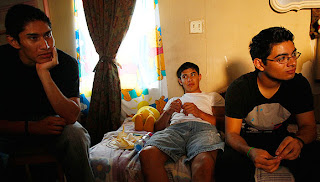
In October 2010, his friends Gerson and Alejandro arrived at their door.

Yes, Jonathan's mother told them. You can stay here.

Jonathan, Gerson and Alejandro shared a room in the back of the trailer. Jonathan's little brother slept on a bed in the kitchen. His mother and sister slept in the front room.

Jonathan's father sent money, the boys went to school and Jonathan's mother cooked for them every night. It was the most stability Gerson and Alejandro had felt in years.

But it was short-lived. Weeks after the others moved in, Jonathan's mother sat him down. We will all move to Texas, she said, and we will be a family again.

Jonathan said no. He wanted to graduate from North High School, the place where he learned English and made friends. The teachers there cared for him. And he wanted one more season wrestling for the Mustangs.

Over fall break, he drove his mother, brother and sister to Texas in the family's aging minivan. Then he turned around and drove back to Phoenix.

He and his two friends had a plan.
California initiative would allow one million illegal workers to live freely

While many states in America are passing tough immigration laws, California has introduced an initiative that would allow nearly one million undocumented immigrants could live and work openly. The initiative would allow the workers to live openly with little or no fear of

.
LOS ANGELES, CA (Catholic Online) - Democratic Assemblyman Felipe Fuentes is helping spearhead the measure, which is called the California Opportunity and Prosperity Act.

The proposal was filed last week with the state Attorney General's Office, marking a first step toward a drive to collect the 504,760 voter signatures needed to qualify for the ballot.

Fuentes says the measure is a "moderate, common-sense approach" necessitated by the federal government's inability to pass comprehensive immigration reform.

"I hope this shows Washington, D.C., that if they fail to act, California will take the lead on this critical issue," Fuentes said in a written statement.

In addition, supporters say that the initiative could generate up to $325 million in new tax revenue from undocumented workers that could assist education, public safety and other state programs.

However - even if the majority of Californians support such a measure, its implementation would depend solely upon the federal government agreeing not to prosecute participants.

Assemblyman Tim Donnelly, a Republican, blasted the proposal as an attempt to sidestep immigration law, predicting that it wouldn't have a "snowball's chance in hell" of winning voter approval.

"There's a proper process for coming to this country," Donnelly said. "Why don't you respect that?"

Some argue that if the initiative is passed, this would add to the nation's "patchwork of immigration laws" which illegal alien advocates often cite when complaining about states such as Arizona and Alabama which have passed their own anti-illegal immigration laws.

"It would be interesting to see if Obama would sue California for officially creating a sanctuary for those here illegally, the same way he has sued those states that have sought to protect themselves from illegal aliens," Columnist Dave Gibson says.

The proposed initiative would apply to illegal immigrants who have lived in California for four years, have no felony convictions, are not suspected terrorists, pay a fee to administer the program, and can speak English or are learning it.

Mike Madrid, former California Republican Party official, said a committee to stir support and seek donations will be created this week.

Saturday, December 3, 2011

New Asheville exhibit presents diversity of immigrant experience in WNC

Community exhibit presents diversity of experience in WNC
ASHEVILLE — For Carolina McCready, art, the language of the human spirit, teaches people how to feel about complex issues, cutting through the static of biased politics and hate.

That theory is the organizing principle behind The Artery’s new exhibit about immigration, “Nuestras Historias, Nuestras Voces” (Our Stories, Our Voices). The community art project is sponsored in part by Latino Advocacy Coalition, where McCready is co-director. The exhibit reception is 7-9 p.m. today.

“Art talks to people’s hearts — people can learn much more through art and the way that it speaks to you,” McCready said. “Since immigration is such a polarized and complicated topic, we hope to speak to people’s hearts and not their minds.

“The effects of local immigration enforcement efforts on our communities are large, and the general public needs to feel these stories.”

The pieces in the multimedia exhibit — which includes works from seven artists with roots in Texas, Mexico, Romania and elsewhere — are inspired by The 100 Stories Project, a documentation project focusing on human rights abuses, and designed as a tool for organizing in immigrant communities, McCready said.

“The stories project started in 2008 spearheaded by five grassroots groups in Henderson and Buncombe counties,” she said. “Immigrants living in Western North Carolina have faced dramatic discrimination and abuse in recent years.”

Those abuses, she said, include workplace raids, such as the 2008 raid at Mills Manufacturing in Asheville and this week’s raid at Shogun Buffet and Hibachi Grill, as well as denial of driver’s licenses for undocumented residents, limited access to higher education and constant use of discriminatory license checkpoints.

“The local deportation programs had devastating effects on immigrants in Western North Carolina,” McCready said.

Those effects prompted the groups to start documenting these stories and have been used in theater pieces, art exhibitions, meetings with elected officials, and in protests and marches.
These stories inspired artist Martha Skinner to create a “10 X 10” table and performance. The project involves a collective drawing by 10 local immigrants to the stop-and-go rhythm of music created by another 10 local immigrants, she said in an email.

She envisions the piece to represent “the many faces of immigration and the transformation that takes place when one merges the stories of two cultures.”

Curator Victor Palomino conceived the exhibit to demonstrate this community’s diversity of experience and emotion.

“As artists, we hope to create dialogue and include the voices of those living in the shadows,” Palomino said. “This exhibition conveys the moments of resilience and celebration, as well as episodes of discrimination and fear experienced in a diverse range of ways.”

Organizers plan to take the exhibit to UNC Asheville and Warren Wilson College. “We would love to see the exhibit travel to other community locations and centers,” McCready said.

“By presenting the stories of Latino experiences in WNC and sharing them widely, we can take a first step in creating an environment in which cross-cultural dialogue might begin,” McCready said.

Also contributing to the 100 Stories Project are the Center for Participatory Change, WNC Workers Center and Nuestro Centro Coalition of Latin American Organizations.
In addition to Skinner, a Colombian designer and educator, the multimedia exhibit at The Artery features Sandra Garcia, a visual artist of Colombian descent; DeWayne Barton, a sculptor, poet, and African American organizer; Adrianna Vasiut, a Romanian painter; Kenna Sommer, a local visual artist and teacher; Chris Corral, a Texas native of Mexican descent who is a figurative painter; Oscar Santana, local Latin music DJ from Mexico.

Friday, December 2, 2011

U. S. Legislative Immigration Update August 8, 2011

Department of Justice Sues Alabama

In a complaint filed early last week, the U.S. government filed suit against the State of Alabama to prevent the state’s recently-passed immigration law from taking effect in September. In the filings, the U.S. argued for H.B. 56 to be preliminarily and permanently enjoined from enforcement. The federal government asserts that numerous provisions of Alabama’s law are preempted by federal laws and therefore violate the Supremacy Clause of the Constitution. (U.S. Const., Art. VI, Cl. 2) The complaint also claims one of the provisions violates the Constitution’s Commerce Clause. (U.S. Const., Art. 1, Sec. 8, Cl. 3)

The U.S. government is petitioning the courts to rule that the power to regulate immigration is one of the authorities that is exclusively vested in the federal government, and therefore H.B. 56 is preempted. (U.S. Const. Art. 1, Sec. 8, Cl. 4 assigns the federal government with the power to establish an uniform Rule of Naturalization) The complaint acknowledges that while a “state may exercise its police power in a manner that has an incidental or indirect effect on aliens, it may not establish its own immigration policy or enforce state laws in a manner that interferes with the federal immigration laws.” (U.S. v. State of Alabama & Governor Bentley, p. 2)

The federal government asserts that the state has gone too far with its enactment of H.B. 56, crossing the constitutional line from being able to regulate legitimate areas of local concern into interfering with federal immigration law and corresponding policies of the federal government. By emphasizing maximum enforcement of immigration laws, the government argues, “H.B. 56 ignores the many other objectives that Congress has established for the federal immigration system.” (U.S. v. State of Alabama & Governor Bentley, p. 4) The complaint notes that “assuring effective enforcement of provisions against illegal immigration and unlawful presence is a highly important interest, but it is not the only goal of the federal immigration laws. The laws also take into account other uniquely national interests, including facilitating trade and commerce; welcoming those foreign nationals who visit or immigrate lawfully and ensuring their fair and equitable treatment wherever they may reside; responding to humanitarian concerns at the global and individual levels; and otherwise ensuring that the treatment of aliens in our nation does not harm our foreign relations with the countries from which they come or jeopardize the treatment of U.S. citizens abroad.” (Id. at 10, 11)

In particular, the federal government seeks to immediately prevent the implementation of the following provisions of H.B. 56:

§ 6: This section requires all Alabama state and local law enforcement agencies to enforce H.B. 56 to their full extent. If an enforcement agency refuses to do so, the agency may be subject to a private right of action by any lawful resident of Alabama and be forced to pay a civil penalty. The agency may also face sanctions and a loss of appropriations from the State of Alabama.
§ 10: Section 10 makes it a criminal offense in Alabama to violate federal laws which require aliens to carry their registration cards (8 U.S.C. § 1304) and register with the federal government (8 U.S.C. § 1306(a)). Under federal immigration laws, unlawful presence by itself is not a criminal offense, although it may subject an alien to the civil remedy of removal. (8 U.S.C. §§ 1182(a)(6)(A)(i), 1227(a)(1)(B)&(C)) Federal laws provide that unlawful presence may become an element of a criminal offense when an alien is unlawfully present after having previously being removed or voluntarily departing from the U.S. (8 U.S.C. § 1326) It is unlawful entry into the U.S. that the federal immigration laws have deemed to be a criminal offense. (8 U.S.C. § 1325) Additionally, the federal government asserts its control over alien registration, including some situations where the federal government may have knowledge of an alien’s presence even though the alien may not have proof of their registration. (U.S. v. State of Alabama & Governor Bentley, p. 16)
§ 11(a): This section makes it a crime for an unauthorized alien to solicit work in the state of Alabama.
§ 12: Section 12 allows Alabama law enforcement officers to verify an individual’s immigration status with the federal government if reasonable suspicion of unlawful presence arises during a lawful stop, detention or arrest.
§ 13: Section 13 makes it a crime to knowingly: conceal, harbor or shield an illegal alien from detection; inducing an illegal alien to come to reside in the state; transport an illegal alien in furtherance of the individual’s unlawful presence. It also renders it a state crime to knowingly enter into a rental agreement with an illegal alien.
§ 16: This section penalizes employers who knowingly seek a tax deduction for wages paid to illegal aliens.
§ 17: Section 17 allows lawful citizens of Alabama a private right of action to sue employers who have discharged or failed to hire a citizen employee while hiring or retaining an alien unauthorized to work in the U.S.
§ 18: This section requires motor-vehicle drivers to carry a license with them. If an individual is arrested for driving without a license and an officer cannot verify that the individual actually has a valid driver’s license, authorities must initiate an inquiry into the individual’s immigration status and may detain the person while verification is pending.
§ 27: This provision prevents Alabama state courts from enforcing the terms of a contract of which an illegal alien is a party to the contract, and the other individual had knowledge that the alien was unlawfully present at the time of the contract.
§ 28: Section 28 requires public elementary and secondary schools to determine the citizenship status of enrolling students for reporting purposes.
§ 30: This section makes it a felony for an illegal alien to enter into a business transaction with a state or local government within Alabama.

By moving for a preliminary injunction, the U.S. is asking the federal courts in the Northern District of Alabama to prevent H.B. 56 from taking effect until a full trial can be heard on the merits of the case. The motion is scheduled to be heard on August 24. (The Birmingham News, August 4, 2011)

Civil rights and religious groups have also filed suit against the state. In addition, Mexico and 15 other nations filed amicus briefs to support the U.S. government’s suit against Alabama. (The Birmingham News, August 4, 2011) The law’s original sponsor, Rep. Micky Hammon, continues to stand by H.B. 56. "The Obama administration and the federal bureaucrats have turned a blind eye toward the immigration issue and refuse to fulfill their constitutional duty to enforce laws already on the books.” Hammon said. “Now, they want to block our efforts to secure Alabama's borders and prevent our jobs and taxpayer dollars from disappearing into the abyss that illegal immigration causes." (Associated Press, August 2, 2011)
DHS Tells Governors it Doesn’t Need Their Permission for Secure Communities

On Friday, the Department of Homeland Security (DHS) sent letters to governors of the 39 states participating in Secure Communities, informing them that it was rescinding their memorandums of agreement to participate in the fingerprint-sharing program. (LA Times, Aug. 6, 2011) The rescissions, however, do not signal an end to the program, but rather an acknowledgement by the government that Secure Communities is a mandatory program that does not require an agreement with the state. (Id.) “This change will have no effect on the operation of Secure Communities in your state,” clarified Immigration and Customs Enforcement (ICE) Director, John Morton, in the letters.

The open-borders lobby was outraged over the announcement. Chris Newman, Legal Director of the National Day Laborer Organizing Network (NDLON) alleged in a statement, “All the deception in the world can’t hide the fact that the S-Comm [Secure Communities] is horrible policy. By entangling local police in immigration enforcement, S-Comm is criminalizing immigrants and leading to the Arizonification of the country.” (NDLON Press Release, Aug. 5, 2011) Margaret Huang, Executive Director of the Rights Working Group, argued, “By continuing to support this program they [the U.S. government] are sanctioning racial profiling, eroding the trust local law enforcement agencies have built with communities of color and showing the international community that our immigration system does not respect the basic human rights of all persons in our country.” (Rights Working Group Press Release, Aug. 5, 2011)

The decision by federal immigration officials to rescind the separate state agreements and continue to set up the program unilaterally comes on the heels of several governors insisting the program was voluntary. Since May, the governors of New York, Illinois, and Massachusetts—states with some of the largest illegal alien populations in the U.S.—have announced the cancellation or suspension of their agreements to participate in the program. (New York Times, Aug. 6, 2011; see also FAIR Legislative Update, June 6, 2010) The federal announcement could also affect legislative efforts in California to prevent the state from participating in Secure Communities. (Fox News Latino, May 27, 2011) There, the California Assembly passed AB 1081, which would require local jurisdictions wishing to participate in Secure Communities to do so expressly by passing a local ordinance. (See AB 1081 at §2) AB 1081 would also limit the submission of fingerprints to those convicted of – rather than arrested for – a crime. (Id.)

According to DHS, Secure Communities is scheduled to take effect nationwide by 2013.
House Passes Two Immigration Bills before Recess

Monday, the U.S. House of Representatives passed two immigration bills: H.R. 398 and H.R. 1933. (See Roll Call Votes 684 and 685) The first bill, H.R. 398, is sponsored by Immigration Subcommittee ranking chair Rep. Zoe Lofgren (D-CA). H.R. 398 would amend the Immigration and Nationality Act to toll (stop from running) the 90-day period in which an alien and petitioning spouse must file a petition and complete an interview to remove the alien’s conditional legal permanent resident status while either the alien or petitioning spouse is a member of the U.S. military serving abroad. (H.R. 398 at § 1(a)) Under current law, when a legal resident marries a foreign national, the alien spouse is granted lawful permanent residence on a conditional basis for the first two years they are in the country. (INA § 216(a)(1)) The Attorney General removes this conditional status only after he makes a favorable determination that the marriage between the alien spouse and petitioner is legitimate. (INA § 216(c))

The second bill, H.R. 1933, is sponsored by Judiciary Chair Lamar Smith (R-TX). H.R. 1933 would reinstate an expired program that admits nonimmigrant nurses to work in “health professional shortage areas.” The expired program, which terminated in 2009, provided for 500 nonimmigrant visas each fiscal year to aliens who obtained a nursing license, passed the requisite exam, and were otherwise eligible. (See the Nursing Relief for Disadvantaged Areas Act of 1999, Public Law 106-95) Each alien was granted an admission period of three years under the prior Act. Similarly, H.R. 1933 would allow the government to issue 300 visas to eligible foreign nurses each year for the next three years. (H.R. 1933 at §§ 1(a)-(b)) At the end of this initial period, admitted nurses can extend their stay for an additional three-years. (Id. at § 1(a)) Under the bill, visa recipients may also accept new employment as a nurse upon the successful petition of a new hospital employer. (Id. at § 1(c))

OUR VIEW: Getting officers on same page on immigration law

Alabama’s more than 16,000 sworn law enforcement officers are about to hit the classroom for four hours of mandatory training on how to enforce the state’s controversial immigration law.
It’s about time.
Stressed-out, underfunded law enforcement agencies that already had much on their collective plates have pleaded for guidance since the legislation cracking down on illegal immigrants took effect Sept. 29.

They have complained that its provisions are difficult to understand, and there have been reports of the law being inconsistently interpreted and applied in different areas of the state. Federal court rulings that have tossed out bits and pieces of the law have further complicated things.

So the Alabama Police Officers’ Standards and Training Commission last month decided to mandate the training. The requirement wasn’t publicized until Thursday, but about 1,000 officers already have completed it. Some of those officers will conduct the sessions for colleagues at their respective departments.

The training will focus on situations officers in the field are likely to face in connection with the law, with the emphasis on what to do with people who don’t have proper identification proving their legal status.

We think that’s a wise approach. This is not the time to get into the political and philosophical issues surrounding this debate. An officer’s role is to enforce the law as it stands, and this is the law in Alabama right now.
The course materials reiterate that only the federal government can determine whether a person is in the U.S. illegally and that law enforcement agencies are barred from profiling suspects or proactively trying to round up suspected illegal immigrants, but could face consequences if they don’t enforce the state law.
Agencies should have an easier time doing that with uniform training that has everyone reading from the same school book. Alabama’s judges are slated to go through similar training during a conference in January.
It’s likely to be a continuing education scenario, though. More federal court rulings are anticipated that could change the way the law has to be enforced, on the way to an ultimate decision on its constitutionality by the U.S. Supreme Court. That will mean additional training time, which might be at odds with the current training materials’ assertion that enforcing the immigration law shouldn’t interfere with officers’ other duties.
But if that’s what it takes to end the confusion and ensure consistent enforcement of the law throughout Alabama, so be it.

Thursday, December 1, 2011

Changes in Limits for US Work and Family Visas

The bill that ends employment-based visas caps and changes family-based visas caps per country has been passed by the House on November 29, 2011.

The legislation, which passed 389-15, would eliminate the limit for worker-based immigration visas per country set by the current law. The number of worker-based visas is no longer required to be no more than 7 percent of the total number of such visas given out. Instead, permanent residence visas or green cards would be handled on a first-come, first-served basis.

As Rep. Jason Chaffetz, R-Utah indicated, the bill would encourage high-skilled immigrants who were educated in the U.S. to stay and contribute to the U.S. economy rather than work in other countries using skills they learned from the U.S.

There are currently about 140,000 green cards issued a year to immigrants working in the U.S. with degrees from U.S. universities.

It is said that skilled workers seeking to stay in the U.S. from India and China, two large countries that account for more than 40 percent of the world's population, and high-tech companies would benefit from the change.

Also under the approved legislation, the family-based visa limits would increase from 7 percent to 15 percent per country. The change could slightly ease the backlog for naturalized citizens, particularly from Mexico and the Philippines, trying to bring relatives into the U.S.

"This will significantly shorten the wait for the people in the family queues," stated Tamar Jacoby, president of ImmigrationWorks USA, a national federation of small business owners working for changes in immigration laws.
If you are interested in Visas to the USA, contact Migration Expert for information and advice on which visa is best suited to you. You can also try our visa eligibility assessment to see if you are eligible to apply for a visa to the United States of America.

Justice Department: Alabama Immigration Law Complicating Enforcement

Alabama's new law against illegal immigration may hamper enforcement rather than being the tough crackdown sought by its supporters -- by taking officers away from the vital job of prosecuting and deporting immigrants with criminal records, Justice Department lawyers said Monday.

The president of the Alabama Association of Chiefs of Police, Boaz Police Chief Terry Davis, agreed that officers are stretched by multiple duties, particularly with tight budgets. But, he said, enforcing the state law should not conflict with the broader federal goal of nabbing criminals who are in the country illegally.

"I can see where they're coming from ... but I think it's just another tool to use in doing our job," Davis said of Alabama's tough, new law. "We're going to get the federal folks involved just like we always have. I would hope it doesn't cause a conflict because we're all in this together."

U.S. Attorney Joyce Vance, the top federal prosecutor for 31 counties in north Alabama, said local agencies already strapped for money and manpower are been forced to develop their own plans for enforcing the state law rather than concentrating on prosecuting and deporting illegal immigrants with criminal records, the priority set by the Obama administration.

Vance said she and the head of the Justice Department's civil rights division, Tom Perez, have met with local authorities to discuss what she called a "significant problem" of both enforcing the state law and tracking down criminal immigrants with only limited resources.

"Rather than strengthening immigration enforcement opportunities at a time, quite frankly, there are fewer resources than we have had in the past, this had made a more difficult environment for us to work in," Vance said.

Press aides to Gov. Robert Bentley, who signed the bill into law, and Attorney General Luther Strange, who is defending it in court challenges, didn't return messages seeking comment.

Vance commented during a news briefing with Perez and Assistant U.S. Attorney General Tony West. West was in Birmingham for a private meeting with business leaders, members of the state's immigrant community and others to discuss the law, which the Obama administration has filed suit to block.

While the administration has filed suit to block similar laws in Arizona, South Carolina and Utah, West said the situation in Alabama is different than anywhere else.

"We have a unique situation in this state because portions of the law have gone into effect, which we have not seen in other states," he said.

The department said it has received more than 1,000 telephone calls and emails to a hotline established for people to report possible abuses under the law, which supporters say is meant to make it impossible for illegal immigrants to live in Alabama.

Federal courts ruling in lawsuits filed by the Obama administration and other opponents of the law have temporarily blocked some of its provisions, but police are still required to ask for proof of citizenship and detain people who can't provide it. The administration contends federal law prohibits states from enacting immigration laws, but Republican supporters argue the federal government has failed to enforce immigration statutes for years.

Twitter Delicious Facebook Digg Stumbleupon Favorites More

 
Design by Free WordPress Themes | Bloggerized by Lasantha - Premium Blogger Themes | GreenGeeks Review