Showing posts with label immigration in usa. Show all posts

Wednesday, April 4, 2012

APNewsBreak: Most Ala. firms miss immigration goal

By Jay Reeves
Associated Press / April 4, 2012
FILE - This 2007 file photo shows Bumper Nets owner Homer Brown, whose business in Hoover, Ala., is among the employers that have complied with a new requirement under Alabama's immigration law, that all business entities in the state register with the federal E-Verify system. Statistics show that thousands of employers failed to meet the April 1 deadline for registering with the system. (AP Photo/The Birrmingham News, Hal Yeager, File)

PELHAM, Ala.—Tens of thousands of Alabama businesses have missed a deadline set by the state's strict immigration law to register with a federal database used to verify the citizenship status of job applicants, according to registration numbers.

Some companies said they didn't know about the requirement that they use E-Verify to check on new employees, or didn't think it applied to them. Others rushed to fill out the Internet-based registration in the days before the April 1 deadline.

Failing to register doesn't result by itself in charges or fines, but using the system affords employers legal protection in certain cases if they are found to employ illegal immigrants. State officials and industry groups are urging more employers to complete the free registration.

"Right now we're not penalizing businesses. We're trying to help them, to be a safe harbor," said Katheryn Kennedy, a spokeswoman for the Alabama Department of Homeland Security.

The immigration crackdown signed into law last year gave every Alabama employer or business entity until the start of this month to enroll in E-Verify, which is run by U.S. Citizenship and Immigration Services. Businesses also are required to begin using the system to check immigration status.

Companies that hire illegal immigrants face penalties including the loss of their business license. To encourage registration, businesses have legal protection if they screened a worker with E-Verify and the person checked out OK but was later determined to be living in the country illegally.

Citizenship and Immigration Services said only 18,137 companies had enrolled in the E-Verify system by Monday, a fraction of the total of employers in the state. There was a late surge of about 4,000 registrations last week, said Bill Wright, a spokesman for the agency in Washington.

The Alabama Department of Revenue said last year's tax returns showed there were 368,613 companies doing business in the state, and that doesn't include public employers like city or county governments. Gov. Robert Bentley's office said the state Department of Industrial Relations counts only 85,000 companies with employees in the state. Some of the discrepancy could be explained by companies doing business in the state with employees who are based elsewhere.

But it's unclear exactly how many businesses are required to register, a sign of continuing confusion over the law. Legislators are also tweaking the law after courts blocked some provisions in response to lawsuits by the Obama administration and others.

While the law says "every business entity or employer in this state shall enroll in E-Verify," Bentley spokesman Jeremy King wasn't able to say Tuesday which employers must register.

"That's for the lawyers to figure out," he said.

The state, like others with similar laws, promoted the requirement through news releases, seminars and websites; and some local governments sent notices to vendors and business license holders. Registration only takes a few minutes and the state has a telephone hotline to assist small companies with registration.
At Carpet Outlet, a family-run business in suburban Birmingham, Cathy McKay had a stack of paperwork on her desk that she received from county government and the local school system about the illegal immigration law, but she has yet to fill them out and hadn't registered with E-Verify.

"We haven't been hiring; we've been firing. So it's not much of an issue with hiring new people," she said. "I hope they don't come get me."

A few miles up U.S. 31 at Johnson Motors South, a small car lot, Randy Pendley said he was enrolling in E-Verify a day late after getting an email about the requirement from a trade group, the Alabama Independent Automobile Dealers Association.

"We have four owners and we've never had any employees, but we still have to do it," said Pendley. "I went to the website this morning to look at it."

The 4,000-member Alabama Retail Association was among the industry organizations that spent months holding seminars, sending emails and staging conference calls to inform businesses of the requirement, but it was still hit with a flurry of late questions.

"Even last week I was surprised by the number of people who were saying, `What are you talking about?'" said Nancy Dennis, a spokeswoman with association.

Other businesses are having have difficulty complying with the law because they lack Internet access, Dennis said.

Still, thousands of Alabama businesses have registered. Those include a catfish processor, public libraries, a women's clinics, churches, construction companies, truck-driving schools, law firms and auto supply stores.

The owner of a store with 10 workers that sells pool tables and other games said registering wasn't difficult even though he's not a "computer person." Homer Brown said he previously verified citizenship using documents for the Hoover-based store called Bumper Nets, and that seemed to work fine.

"I'd rather handle it the way I had before, but I guess they wanted to be able to check it a little closer," he said.

Nine states require all or most employers to register with E-Verify, according to LawLogix, a Phoenix, Ariz.-based company that sells immigration-related software. LawLogix attorney Ann Cun said larger employers may have an easier time tracking laws than smaller ones, but companies have a duty to keep up with government requirements.

"At the end of the day, the onus is really on the employer," said Cun.

In Arizona, supporters of that state's law say an E-Verify provision has helped reduce the number of people who work in the state without proper legal documents. Opponents say the requirement has only driven an underground economy even deeper, with employers making more handshake deals with workers rather than going through proper legal channels. Arizona's law predates Alabama's.

A provision similar to Alabama's took effect in South Carolina on Jan. 1, but officials say employers are not required to join E-Verify until they are ready to hire new workers. Georgia's law on illegal immigration also requires employers to register for E-Verify, but employers with fewer than 11 workers are exempt.

Even those businesses that have registered with the system could face difficulties. A study by the General Accounting Office in 2010 found that E-Verify employment checks can result in erroneous answers if the same name is entered into the system in more than one way, which sometimes happens when employers check someone from an unfamiliar cultural background.

At the car dealership, Pendley said the first step in joining E-Verify was gathering the paperwork he needed to fill out forms.

"It's really not a lot to do, but you have to identify the company and have a federal tax ID number," he said. "It will probably take about five minutes."
© Copyright 2012 Associated Press. All rights reserved. This material may not be published, broadcast, rewritten, or redistributed.

New immigrants are the ‘hidden homeless’

Anthony Rozario can smile about his subsidized apartment now, but the Bangladeshi father and his wife used to share a small Scarborough apartment with three adult children.

Nicholas Keung Immigration Reporter

Anthony Rosario, his wife and three adult children shared a two-bedroom apartment in Scarborough when they first came from Bangladesh in 1998.

At times, they also shared their already crowded dwelling with other families, converting available space into bedrooms.

Space was tight but so was their budget, with their $900-a-month rent eating up half the family’s monthly income.

Up until February, Rosario and his wife, Mary, were still sharing their two-bedroom apartment with his son, daughter-in-law and two grandchildren.

“It’s tough to live with so many people in so little space, but you are bound to live like this when you don’t have money,” said Rosario, 61, a bakery chef, who two months ago finally moved into a subsidized seniors’ apartment after four years on the waiting list.

But a new study on immigrant housing warns that thousands of newcomers continue to live in “hidden homelessness” — in shared, overcrowded housing — an issue that has grown more acute, especially in Toronto, where affordable rental units are in short supply.

The national study by Metropolis, an international network of researchers in immigration policy, found most newcomers reported spending more than 50 per cent of income on housing, with 15 per cent spending 75 per cent or more.

“Financial difficulties force many newcomers to share accommodations that are often poor quality, overcrowded and unsafe,” says the report.

The report is based on national housing data and surveys of 600 migrants in Toronto, Montreal and Vancouver. In Toronto, where the average wage is $69,000, most newcomers surveyed had incomes under $20,000.

“New rooming houses are being created in the suburbs, in locations without rooming house regulations. Often illegal, suburban rooming houses can offer deplorable housing,” the report continued.

Newcomers also face discrimination in the housing market, with refugees, temporary residents, single parents, large families and people who do not speak English or French facing the greatest challenge, said University of British Columbia professor Daniel Hiebert, the study’s lead author. “The housing situation generally improves over time for most immigrants but there’s a fraction of the immigrant population where the challenges remain and persist for a long time,” he said.

In Toronto, the vacancy rate for rental accommodation fell to 2.1 per cent in 2010, well below the 3 to 4 per cent threshold, a decline more “sustained and dramatic” compared with other immigrant gateway cities, the report states. (The city’s vacancy rate in 2011 fell again to 1.4 per cent.)

Since the 2008 global financial meltdown, the report says, construction projects were cancelled and the number of apartment starts fell by almost 50 per cent in the city.

The recent supply of apartments is mostly intended for the condominium market, which has increased from 22.1 per cent of all starts in 1996 to 44.6 per cent in 2010.

Since 2000, the Toronto Housing Databank found that units with rents between $600 and $900 have decreased by 66,069, while those with rents between $901 and $1,500 and over have increased by 48,760.

“With rising rents, the loss of inexpensive rental units, and disproportionate growth in condominiums, the supply of affordable accommodation for newcomers, particularly those with children is limited,” said the study, whose Toronto section was led by York University professor Valerie Preston.

Toronto is home to the largest stock of social housing in Canada, with 127,545 units of rent-geared-to-income housing in which residents pay no more than 30 per cent of total income before taxes on housing. However, almost 90,000 households are on the waiting list, meaning wait times of four to 21 years.

The study calls for a national housing strategy by all levels of government and the redesigning of housing services for newcomers.

Vacancy and average rents in Toronto in 2010

Vacancy rateRent

Studio2.3%$778

1-bedroom2.4%$952

2-bedroom1.9%$1,118

3-bedroom or more1.6%$1,305

Dwelling (unit) starts in Toronto by type:

200820092010

Detached11,3088,1309,936

Semi2,3622,0321,654

Townhouse4,6122,9184,365

Apartments23,93012,86913,240

Precarious Housing & Hidden Homelessness Among Refugees, Asylum Seekers and Immigrants

Cheap Island Vacations to the Hawaiian Island of Oahu

By Deborah B Woods


Oahu is known locally as "The Gathering Place", and is the home of around 75% of the total Hawaiian Islands' population. At its widest points, this volcanic island is 44 miles long and 30 miles wide and has 227 miles of shoreline. Oahu is the result of two volcano's Waianae and Koolau, with a wide "valley" called the central Oahu Plain between them. The highest point is Mount Kaala in the Waianae Range at 4,003 feet above sea level.

Waikiki in Honolulu is on the south-east coast and now has several hostel accommodations where you can stay for a very humble payment from $25 per night. Private rooms are available so if you are on your honeymoon you need not be despair or be concerned that you have chosen hostel accommodation!

Hostels are now thankfully losing the poor image they have suffered for many years of scratchy sheets, no sheets, and dark and dismal rooms occupied by pot smoking hippies. That scenario disappeared long ago, and now hostels are bright, cheery, welcoming, comfortable and clean establishments. The huge benefit of choosing a hostel, apart from all the cash you save is that you will meet friendly and down-to-earth people who are more than likely experienced travelers willing to share their knowledge with you, perhaps making lasting friendships. This gives you the best local information from day one of your vacation so that you will not miss out on the best restaurants, attractions, best value shopping and of course the beaches.

If you are travelling solo, hostels are definitely the best option, and not just to save money. Hotels can be very lonely places for single travelers, and the facilities they offer are usually aimed at couples and families. Apart from that, you really get stung on your room charges for solo occupancy. In any hostel you will make friends very quickly, and evenings often have a social gathering arranged for residents.

Oahu offers pristine beaches where you can snorkel as much as you like for the cost of a snorkel kit! The corals and colorful tropical fish will keep you occupied or hours and days on end. Water sports are of course offered, surfing being a very popular sport on the Hawaiian Islands. The Hawaiian climate is glorious, with little difference between seasons.

Hiking and walking are not to be overlooked and this is another free of charge activity. Oahu has an amazing and diverse landscape - Jurassic Park was filmed on the Hawaiian Islands and now you can experience that beauty and diversity without looking over your shoulder for veloceraptors!

Waikiki has many nightclubs and bars to party the night away, giving a total contrast to the peace and tranquility you can also experience on this island. The center of Honolulu is teeming with designer stores, shopping malls and restaurants to satisfy all tastes. Hawaii has a beautiful culture and you should not miss going to a Luau which is a Hawaiian feast, and perhaps a slack key concert where traditional Hawaiian song and music is performed.

Hawaii's number one attraction is the Pearl Harbor Memorial. The first United States battle of World War II in the Pacific was the surprise attack from the Imperial Japanese Navy on Pearl Harbor, Oahu on the morning of December 7th 1941 and was aimed at the Pacific Fleet of the United States Navy and its defending Army Air Corps and Marine Air Forces. 353 Japanese fighters, bombers and torpedo planes were launched in two waves from six aircraft carriers and attacked, damaged or destroyed twelve American warships, 188 aircraft, and killed 2,403 American servicemen and 68 civilians.

At the memorial you watch a film of the attack and see memorabilia in the museum. You can almost hear the aircraft as you look over Oahu bay and imagine what that terrible day must have been like for those people who died and for those who lived to tell of their experience. The memorial is named Arizona after the tragic sinking of the Navy vessel Arizona on which so many perished.

The Arizona memorial is a privilege to visit, and Oahu is a blessing that everyone can now take advantage of with cheap flights readily available and friendly hostel accommodations waiting. These islands used to be an exclusively rich man's paradise, but not any more, Oahu and the Hawaiian Islands is now a paradise available to everyone.

Having worked in the travel industry for several years, the author is now in the process of creating two travel websites dedicated naturally to travel. The websites present opportunities that are available now to more people than ever before to see amazing places and experience more diverse cultures and natural and man-made wonders of the world. http://www.egypt-dreams.com highlights the historical attractions and wonders of Egypt and other ancient civilizations. http://www.forsureamazing.com favors family and budget vacations and adventures, giving practical information, advice, ideas and tips for travel, activities and destinations.

Article Source: http://EzineArticles.com/6967585

Monday, February 27, 2012

Guest commentary: Immigration debate is about economics, not politics

What do Jeremy Lin of the Knicks and Nicklas Lidstrom of the Red Wings have in common? Both owe their success to immigration – and both are creating jobs and strengthening our economy.

Lin, whose parents came from Taiwan, and Lidstrom, who was born in Sweden, are helping their teams sell tickets and merchandise, while also helping tavern owners sell burgers and beers. But they are also helping the NBA and NHL to expand in overseas markets – something every major corporation in America is trying to do. The more a company expands its overseas exports, the more jobs it can create here in the U.S. – and the more tax revenue it produces for local, state, and federal governments.

In a presidential election in which both sides are debating economic growth and immigration separately, all parties should emphasize the relationship between them. The fact is the link between legal immigration and job creation couldn’t be stronger.

Immigrants, especially those with advanced degrees, play a vital role in helping U.S. companies create jobs, as a recent study by the conservative American Enterprise Institute and the bipartisan Partnership for a New American Economy has shown. The study found that each foreign graduate with an advanced degree from a U.S. university who stays and works in the innovation-rich fields of science, technology, engineering, and math ("STEM" fields) creates on average 2.62 jobs for American workers.

Yet right now, even though many of the world’s brightest STEM students train in our universities, the federal government forces many of them to leave as soon as they are handed a diploma. When these graduates return to their home countries, they go to work for foreign companies that compete against us – or they found companies that will create jobs overseas, rather than here in the U.S. This is the federal government at its most frustrating. And it is doing real damage to our economy.

Immigrants also drive new business creation. More than 40% of our Fortune 500 companies were founded by an immigrant or a child of an immigrant – companies like Google, Yahoo, and Intel. In Michigan, major companies like Dow, Masco and Meijer were founded by immigrants, as were major New York City companies like Pfizer, Foursquare and Nathan’s Famous. Yet the longer we wait to fix our broken immigration laws, the more these innovative companies will be founded overseas. If that is allowed to happen, we will do enormous damage to America’s future and our standing as the world’s economic superpower.

Economists are in agreement that our broken immigration policies hurt our economy and make it harder for our companies to compete. And interestingly, so are the candidates for president. All the major candidates in both parties have come out in support of reforming our immigration laws to attract the world's brightest minds. (Learn more at www.NoDebate.org).

The trouble is that the debate around immigration is too often focused on politics, not economics. If both parties would pass legislation based on their points of agreement, rather than engage in endless debates over their points of disagreement, we could create thousands of jobs all across the country at a time when so many out-of-work Americans need them.

America needs more superstars like Jeremy Lin and Nicklas Lidstrom – in every industry. And we need our leaders in Washington to stop blocking sensible legislation and start scoring some points for the American worker.

Michael Bloomberg is mayor of New York City. Rick Snyder is governor of Michigan.

Saturday, December 10, 2011

LuaLua signs... for immigration department


Published on Saturday 10 December 2011 08:45

While Pool struggled with the weather, Lomana LuaLua didn’t exactly have the best preparation for today’s game either.

The Seasiders frontman had to dash to London to sign immigration papers which allowed his wife to enter the country.

Manager Ian Holloway explained: “He had to go to immigration to sign a form to get his wife back over here from Cyprus.

“I had to give him permission to do that, which isn’t ideal because Thursday is always about preparation.

“But I had to do it, otherwise his wife wouldn’t be here and that wouldn’t have been right.”

LuaLua will make his own way to Southampton – the rest of the squad are due to flew from Manchester yesterday afternoon.

Holloway added: “It took us 10 and a half hours to get to Brighton last time we travelled on a Friday. That was an absolute nightmare, so we decided not to go by coach this time.

“However, I’m now worried about the weather. I hope it calms down. The elastic band on our little plane might struggle to get us off in these winds.”

Stephen Crainey and Kevin Phillips will be more up for today’s game than most – both are former Saints.

Phillips, who spent two seasons with the south coast club, will almost certainly be on the bench, with Holloway admitting the 38-year-old is likely to become more of a super-sub for the remainder of the season.

Crainey is always one of the first names on the teamsheet, which wasn’t the case at Southampton, who let him go after an unhappy few months in 2004.

Holloway said: “Whatever has happened in Stephen’s career is history. He will have taken it on the chin and he will have learned from it. Some things are fair, some things aren’t.

“He hasn’t got a single thing to prove to himself or to me because I know how good he is, and he knows how much he is respected here.

“I have honestly never worked with a better left-back. I haven’t worked with a bloke who trains better than him either or has a better attitude.

“It doesn’t matter how old he is. With the way he trains, that lad can keep going for years.

“He has been absolutely foot-perfect ever since I have been here.

“He is a wonderful fella and I’m so glad he signed a new contract in the summer”.

Unions And Immigrants Join Occupy Movements

by David Bacon


Oakland, California - When Occupy Seattle called its tent camp "Planton Seattle," camp organizers were laying a local claim to a set of tactics used for decades by social movements in Mexico, Central America and the Philippines. And when immigrant janitors marched down to the detention center in San Diego and called their effort Occupy ICE (the initials of the Immigration and Custom Enforcement agency responsible for mass deportations),people from countries with that planton encampment tradition were connecting it to the Occupy movement here.

This shared culture and history offer new possibilities to the Occupy movement for survival and growth at a time when the federal law enforcement establishment, in cooperation with local police departments and municipal governments, has uprooted many tent encampments. Different Occupy groups from Wall Street to San Francisco have begun to explore their relationship with immigrant social movements in the US, and to look more closely at the actions of the 1 percent beyond our borders that produces much of the pressure for migration.

Reacting to the recent evictions, the Coalition for the Political Rights of Mexicans Abroad recently sent a support letter to Occupy Wall Street (OWS) and the other camps under attack. "We greet your movement," it declared, "because your struggle against the suppression of human rights and against social and economic injustice has been a fundamental part of our struggle, that of the Mexican people who cross borders, and the millions of Mexican migrants who live in the United States."

Many of those migrants living in the US know the tradition of the planton and how it's used at home. And they know that the 1 percent, whose power is being challenged on Wall Street, also designed the policies that are the very reason why immigrants are living in the US to begin with. Mike Garcia, president of United Service Workers West/SEIU, the union that organized Occupy ICE, described immigrant janitors as "displaced workers of the new global economic order, an order led by the West and the United States in particular."

Criminalizing the act of camping out in a public space is intended, at least in part, to keep a planton tradition from acquiring the same legitimacy in the US that it has in other countries. That right to a planton was not freely conceded by the rulers of Mexico, El Salvador or the Philippines, however - no more than it has been conceded here. The 99 percent of those countries had to fight for it.

Two of the biggest battles of modern Mexican political history were fought in the Tlatelolco Plaza, where hundreds of students were gunned down in 1968, and three years later in Mexico City streets where more were beaten and shot by the paramilitary Halcones. In both El Salvador and the Philippines, strikers have a tradition of living at the gates of the factory or enterprise where they work. But even today, that right must be defended against the police, and (at least until the recent election of the Funes and Aquino governments) even the military.

Plantons or encampments don't stand alone. They are tactics used by unions, students, farmers, indigenous organizations, and other social movements. Each planton is a visible piece of a movement or organization - a much larger base. When the plantons are useful to those movements, they defend them. That connection between planton and movement, between the encampment and its social base, is as important as holding the physical space on which the tents are erected.
Leobardo Benitez Alvarez. a fired SME member, in the union's planton. (Photo: David Bacon)

For the last two years, that relationship has been very clear in the Zocalo, Mexico City's huge central plaza. During that time, fired members of Mexico's independent left-wing electrical workers union, the SME, have lived in a succession of plantons. They've often been elaborate, with kitchens, meeting rooms and communications centers, in addition to the tents where people slept and ate.

At various time, the SME encampment was one of several in the huge square. A year ago, the workers were joined by indigenous Triqui and Mixtec women from Oaxaca, who protested the violence used by their state's previous governor against teachers' strikes and rural organizations. The social movement in Oaxaca, which the women represented in Mexico City, grew strong enough to finally knock the old ruling party, the PRI, from the governorship it had held for almost 80 years.

In the Zocalo plantons, people from different organizations mix it up. Last September's Day of the Indignant brought together people from very diverse movements. Some see electoral politics as a vehicle for change, but many indigenous activists and SME members don't. Even among those who do, there are deep disagreements over how to participate in the electoral process.

But the people in the Zocalo have two things in common. Different plantons may not see every political question eye to eye, but each represents a social movement in the world outside the plaza. And the planton itself has value primarily because it forces public attention to focus on the crisis that has led each group to set up its encampment.

The SME workers used their plantons to dramatize repression by the federal government. When Mexican President Felipe Calderon dissolved the state-run power company for central Mexico and fired its 44,000 employees, he sought to destroy their union and move toward the privatization of the electrical system - to benefit Mexican and foreign 1 percenters. A year ago, several SME members conducted a hunger strike at the planton that generated front-page headlines for weeks, and lasted so long that doctors warned participants they were risking death. At the height of the protest, the union battled police in front of the power stations, as it tried to exercise its legal right to strike and picket.

The planton and the movement outside it were intimately connected. The hunger strikers were few, but spoke for a union of tens of thousands of workers. In the end, the SME negotiated the removal of its last planton in return for government acknowledgement of its right to exist. It organized other unions to resist the government's assault on labor rights, and mobilized electricity consumers to protest rising bills and cuts in service. The planton helped to focus attention on these demands, and to pull the union's allies into action.

Clearly, someone in Seattle knows this tradition of plantons in the Zocalo, perhaps even as a participant. When the painter made the Seattle banner, she or he also included, right next to the word "planton," the anarchists' "A" with the circle around it. This symbol was a reminder of another aspect of cross-border fertilization. Many anarchists or anarcho-syndicalists - members of the Industrial Workers of the World - fought in the Mexican Revolution. Because of that revolutionary upheaval, even today, almost a century later, ordinary Mexicans expect certain rights, including the right to set up a tent in the Zocalo. US workers crossed the border to fight alongside Mexicans in that insurrection long ago, for a government that would acknowledge that right. The planton, therefore, is a common heritage, with a history that makes it as legitimate on Wall Street as it is in Mexico City.

Not long after the OWS camp was set up in Zuccotti Park, the planton/occupy movement crossed the US/Mexico border. In Tijuana, home to a million people, mostly displaced migrants from Mexico's south, activists came together and set up an occupation on the grassy median of the Paseo de los Heroes. Their tents were pitched in the middle of the Zona del Rio, where the city's 1 percent meet in fancy hotels and work in government offices. Then, on October 18, police reacted even earlier than they did in most US cities, arresting two dozen activists at the urging of local businessmen. Occupy Tijuana condemned the detentions, declaring, "We are not assassins, delinquents, tramps or crooks."
In the US, we have our own history of defending public space for protest, and it isn't necessary to reach back a 100 years to find it. In just the last few decades, immigrant workers have popularized the use of the planton here, helping unions recover the militant tactics of their own past. In 1992, immigrants trying to join the United Electrical Workers mounted the first strike among production workers in Silicon Valley, and set up a planton and conducted a hunger strike to pressure their employer. A year later, other Latino immigrants in San Francisco erected their tents on the sidewalk in front of Sprint's headquarters, after their workplace was closed days before they were scheduled to vote in a union election.

A decade ago, anti-globalization activists and unions shut down the meeting of the World Trade Organization in Seattle. Young protesters chained their arms together inside metal pipes, and lay down in the intersections of downtown Seattle. Tens of thousands took over the streets. Other anti-globalization protests followed, in which activists battled for their right to use public space to challenge the international policies of the 1 percent.

Working-class support for the battle in Seattle had its roots in the impact of the North American Free Trade Agreement (NAFTA). Workers could see the cost of free trade in the loss of their own jobs, as production moved south. Over the last two decades, many have also discovered that those same agreements and policies didn't make Mexicans better off, but led to their impoverishment as well.

NAFTA and free-market policies forced on developing countries produced opportunities for banks and corporations to reap profits. They drove down wages, forced farmers off their land and destroyed the unions and livelihood of millions of people. This system was designed on Wall Street, by the same bankers Occupiers hold responsible for the current crisis of foreclosures and unemployment in the US. The current economic crisis doesn't stop at the border. In fact, in Mexico, Central America, the Philippines, and elsewhere, it's been a fact of life for a long time. This is the source of forced migration - what Garcia condemned at Occupy ICE.

The 99 percent live in all those countries where free-trade agreements and structural adjustment policies are imposed. They also live in the communities of people who have come here as a result. Who, then, are more natural allies for Occupy protesters than people who've been on the receiving end of these policies for years?

In New York, this connection wasn't lost on Occupy Wall Street. In October, a group called Occupy Wall Street - Español was formed at the first Asemblea en Español. They, in turn, translated the first issue of the Occupied Wall Street Journal. Participants formed a subgroup, Occupy Wall Street Latinoamericano to spread the movement to Spanish-speaking communities, recognizing that the city is home to so many Mexicans from the state of Puebla that its nickname is PueblaYork, as well as much older established communities of Puerto Ricans, Colombians, Ecuadorians, and other Spanish-speaking people. The group will soon publish the first issue of its own newspaper, with articles talking about immigration, globalization, and the specific attacks by the 1 percent on Latinos.

Claudia Villegas, a women's rights activist working with the group Occupy Wall Street Latinoamericano, helped organize a demonstration of immigrant women four days after police raided the Zuccotti Park encampment. "We decided to change our original plan for a march because we were afraid they would stop it," she says. "Nevertheless, 23 organizations participated including women's rights groups and above all, those working with immigrant women."

In San Francisco, a joint march of immigrant activists and Occupy participants helped to defend that city's encampment. In the general assembly meeting preceding it, participants talked about the city's offer to move the Occupiers into an abandoned building in the Latino Mission District several miles away. Few wanted to give up the camp on Justin Herman Plaza, and most felt the city was just trying to move them out of sight. But many people also felt that having an Occupy camp in the barrio was a good idea.

"We're still really working in parallel," Villegas says. She draws attention to the potential power of the immigrant rights movement, and what it could mean to OWS. "We have to include the movement that began in 2006, when there were hundreds of thousands of people in the streets across this country. People were reacting to the injustice of the system then too." They're separate movements, though, she warns, and "our agenda has to come from immigrants themselves. We need to integrate, and at the same time the Occupy movement has to learn to accept us. But we're all on the same path."

Bringing the immigrant and Occupy movements together means more than setting up an encampment. The San Diego demonstration didn't set up an overnight camp, but it brought thousands of workers and supporters down to the ICE detention center to protest the firings of immigrant janitors.

The Occupy ICE protest was intended to draw public attention to the federal government's immigration enforcement strategy that requires employers to fire undocumented workers. In Southern California, the multinational corporations that clean office buildings are terminating 2,000 union members. Earlier waves of firings have targeted unionized building cleaners in Minneapolis, Seattle and San Francisco; sewing machine operators in Los Angeles; food service workers on university campuses; and thousands of others.

Garcia says ICE and the employers are in collusion. After firing union janitors with high seniority and benefits, using immigration status as a pretext, the companies can then hire new workers at lower wages with fewer benefits.

"To hide their greed the commercial real estate industry has used the tools of government to confuse and divide the 99 percent," he charges. "They first said we were unskilled workers who should be happy to be working. They then weakened worker protections to make organizing virtually impossible. Over the last decade the industry has used immigration as a wedge to intimidate and, if need be, replace our workers. ICE is doing what the 1 percent corporate real estate industry wants: using immigration laws to recycle well paid janitors in the hopes of taking back gains in pay and benefits our union has won." (Ironically the week United Service Workers West organized Occupy ICE its parent union, SEIU, endorsed the re-election of President Obama, who is responsible for the ICE policy of firing workers.)
For Occupy, defending workers under attack is a way to survive, grow roots and develop a strong base. That's not always the direction activists take, however. Near Oakland, over 200 immigrant workers at the largest foundry on the West Coast, Pacific Steel Casting in Berkeley, are being fired in another "silent raid" like that hitting the janitors. Through the summer and fall, foundry workers went to city councils, unions, churches and community organizations, seeking help to pressure ICE not to force them from their jobs. Their campaign held "the migra" off for months, but the firings began nevertheless in November. Now, these immigrant families are trying to survive. Occupy Oakland has yet to respond, however.

Instead, some of its activists are trying to shut down work in Oakland's port a second time, as well as others along the West Coast. An earlier march to close the port after the first eviction of Occupy Oakland drew thousands of people. The proposal for a second coast-wide shutdown, however, is opposed by the longshore union. The International Longshore and Warehouse Union's (ILWU) opposition does not come from conservatism. The union, whose members make a living from international shipping and trade, has been one of the most vocal critics of US free-trade agreements. ILWU members have taken action many times to defend the SME and unions in Mexico, as well as other countries. Its locals and members, however, had no role in the decision to try to close the ports, nor did other port workers.

Real solidarity is a two-way street, based on mutual respect. In most cities, including Oakland and San Francisco, labor has welcomed Occupy and sought to defend the encampments. In New York, Occupy activists have been given resources in many union halls, and unions have mobilized against police raids at Zuccotti Park. An alliance of unions, immigrants and Occupiers has great potential strength, not just in numbers, but also in the exchange of ideas and tactics. Unions in particular might benefit from wider use of the planton or Occupy encampment. Occupy ICE challenges the Occupy movement to take up the firings of immigrant workers, but it's also a challenge to unions themselves, many of whom have watched in silence as longtime members were forced from their jobs.

The vision of Occupy - the 99 percent vs. the 1 percent - has enormous support among immigrants and unions. In place of the tired rhetoric of politicians, shedding crocodile tears for the "middle class" while demonizing the poor, Occupy gives workers a vision of their commonality in the 99 percent. This powerful message blows away illusions that higher-paid workers have more in common with stockbrokers than with immigrants laboring at minimum wage, or unemployed young people on the streets of African-American ghettos or Latino barrios.

The Coalition for the Political Rights of Mexicans Abroad shares the same vision of class-based commonality. "We are outraged," it says, "that US citizens, when they demand justice and expose the inequalities that exist in their society, are treated like criminals. With the same outrage, we condemn the criminalization of migrant Mexicans by the US government, the raids by immigration authorities [and] the militarization of the border ... No human being should be treated as a criminal because they struggle to find better conditions in which to live."

Kenney’s Anti-Immigrant Mean Streak Continues As He Targets 6500 Immigrants For Citizenship Fraud

Saturday, December 10th, 2011


Immigration Minister Jason Kenney’s anti-immigrant mean streak isn’t just directed at immigrants who became citizens but his department has also been working on cases of those who are not yet citizens. Kenney claims nearly 4,400 people with permanent resident status who are known to be implicated in residence fraud have been flagged for additional scrutiny should they attempt to enter Canada or obtain citizenship. There is nothing wrong with cracking down on immigration and citizenship fraud but the Conservatives as usual go gung-ho in targeting immigrants and this comes across as actions of a government bent on attacking and vilifying immigrants. This seems like overzealousness given that since 1867, Canada has only revoked the citizenship status of 66 people but under the Stephen Harper Conservatives thousands of immigrants are on the chopping block.

By R. Paul Dhillon

SURREY — Immigration Minister Jason Kenney’s anti-immigrant mean streak continues as he targets an additonal 6500 people for citizenship after already stripping 1800 of citizenship earlier.

On Friday, Kenney announced that the Conservative government is now investigating 6,500 people from more than 100 countries for fraudulently attempting to gain citizenship or maintain permanent resident status.

“Canadian citizenship is not for sale,” the always boastful Kenney boasted. “Canadians are generous people, but have no tolerance or patience for people who don’t play by the rules and who lie or cheat to become a Canadian citizen. The Government will apply the full strength of Canadian law to those who have obtained citizenship fraudulently.”

In July, Kenney announced that Citizenship and Immigration Canada (CIC) was beginning the process to revoke the citizenship of up to 1,800 citizens who he claimed obtained it fraudulently; that number has now risen to more than 2,100.

Kenney’s mean streak isn’t just directed at immigrants who became citizens but his department has also been working on cases of those who are not yet citizens. Nearly 4,400 people with permanent resident status who are known to be implicated in residence fraud have been flagged for additional scrutiny should they attempt to enter Canada or obtain citizenship. The majority of these individuals are outside the country.

There is nothing wrong with cracking down on immigration and citizenship fraud but the Conservatives as usual go gung-ho in targeting immigrants and this comes across as actions of a government bent on attacking and vilifying immigrants. This seems like overzealousness given that since 1867, Canada has only revoked the citizenship status of 66 people but under the Stephen Harper Conservatives thousands of immigrants are on the chopping block.

According to Kenney, in typical cases, permanent residents will use the services of an unscrupulous immigration consultant to establish evidence of residence in Canada while living abroad most, if not all, of the time. This fraud is perpetrated so that individuals can maintain their permanent residence status and later apply for citizenship. A family of five may pay upwards of $25,000 over four or more years to create the illusion of residence in Canada.

“My department is working closely with the Canada Border Services Agency, the Royal Canadian Mounted Police, and Canadian offices abroad to prevent people who are suspected of non-compliance with the permanent residence requirement from being admitted to Canada without proving they meet the requirements and take enforcement action when necessary,” Kenney added.

Critics say Kenney as usual being high handed in this witch hunt given that under the Conservatives immigration reforms it’s taking a long time for people to become citizens

Immigration lawyers say even a simple citizenship application can take a year to process and suggested the crackdown needed to be supplemented with pragmatism.

To date, of the 4,400 permanent residents who have been flagged, nearly 1,400 people have withdrawn or abandoned their citizenship application because of new scrutiny.

Permanent residents must acquire three years of residence out of four years to apply for Canadian citizenship. To retain their status as permanent residents, they must be physically present in Canada for two years out of five.

“I encourage anyone who has information regarding citizenship fraud to call our tip line to report it,” Kenney urged.

He’s asking Canadians to spy on their immigrant neighbours and report cases involving false representation, fraud or knowingly concealing material circumstances in the citizenship process – for example, pretending to be present in Canada to meet the residence requirements for obtaining citizenship. They can report by calling the citizenship fraud tip line at CIC’s Call Centre at 1-888-242-2100 (in Canada only, 8:00 a.m. to 4:00 p.m. local time, Monday through Friday). Tips may also be reported by e-mail at Citizenship-fraud-tips@cic.gc.ca. Those overseas can contact the nearest Canadian visa office.

All other fraud types related to immigration should be reported to the CBSA’s Border Watch Tip Line at 1 888-502-9060. Tips accepted by the Border Watch Tip Line include, but are not limited to, suspicious cross-border activity, marriages of convenience, misrepresentation in any temporary or permanent immigration application, or the whereabouts of any person wanted on an immigration warrant.

Kenney’s department has been cracking down on the actions of crooked consultants – consultants are calling it a witch hunt and so are many immigrants – during the immigration process. Bill C-35, originally introduced as the Cracking Down on Crooked Consultants Act, came into force on June 30, 2011. The Act imposes penalties on unauthorized representatives who provide, or offer to provide, advice or representation for a fee at any stage of an immigration application or proceeding.

Tuesday, December 6, 2011

Most undocumented immigrants have lived in U.S. over 10 years: study

Immigration dropping to levels not seen in decades


NEW YORK DAILY NEWS

Tuesday, December 6 2011, 8:03 AM
Almost two-thirds of the estimated 10.2 million adult undocumented immigrants in the U.S. have lived here for at least 10 years, according to a study released this week by the Pew Hispanic Center.

About half of them have children under 18 years old.

Republican presidential candidate Newt Gingrich's proposal to regularize the status of some undocumented immigrants drew fire from rivals Mitt Romney and Michele Bachmann, who said the plan would provide incentive for illegal immigration.

But the Pew study provides the latest evidence of an unprecedented drop in illegal immigration, particularly from Mexico, which seems to have more to do with changing economic conditions than government policy.

"The rising share of unauthorized immigrants who have been in the U.S. for a long duration reflects the fact that the sharpest growth in this population occurred during the late 1990s and early 2000s — and that the inflow has slowed down significantly in recent years, as the U.S. economy has sputtered and border enforcement has tightened," the study states.

Arrests at the U.S.-Mexico border — another key measure of illegal immigration flows — dropped this year to levels not seen since the 1970s, even as the number of Border Patrol officers there has doubled since 2004.

The Border Patrol arrested 327,577 people illegally crossing into the U.S. from Mexico in fiscal year 2011, a 25% drop from the previous year, The Washington Post reports.

"We have reached the point where the balance between Mexicans moving to the United States and those returning to Mexico is essentially zero," Jeffrey Passel of the Pew Hispanic Center told The Washington Post.

The New York Times reported in July that Mexican immigration to the U.S. has slowed due for a variety of reasons, including more economic opportunity for potential migrants at home, rising violence along the border and the prolonged U.S. economic slump.

Illegal Immigration: Gaps Between and Within Parties

Public Split Over In-State Tuition for Illegal Immigrants

Overview


The public continues to support tough measures to crack down on illegal immigration, but also a path to citizenship for those in the country illegally. A plurality (43%) says the priority should be better border security and enforcement, as well as creating a way for illegal immigrants to become citizens if they meet certain requirements. Fewer say the priority should only be better security and stronger enforcement of immigration laws (29%), or only creating a path to citizenship for illegal immigrants in the U.S. (24%). These opinions have not changed substantially over the past year.

Americans are evenly split over whether illegal immigrants who graduate from high school in their state should be eligible for in-state college tuition: 48% say they should be eligible for the in-state tuition rate, while 46% say they should not.

The national survey by the Pew Research Center for the People & the Press, conducted Nov. 9-14 among 2,001 adults finds continuing partisan differences over immigration policy. More than twice as many Republicans as Democrats say the priority for dealing with illegal immigration should only be better border security and stricter law enforcement (47% vs. 22%).

Yet there also are divisions within both parties’ coalitions over the overall priority for U.S. immigration policy and whether illegal immigrants should be eligible for in-state tuition.

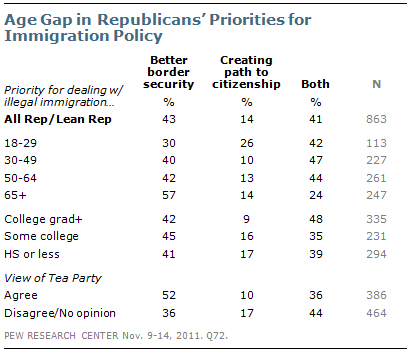
There is a substantial age gap over immigration policies in opinions among Republicans and Republican-leaning independents. A majority (57%) of Republicans and GOP leaners 65 and older say border security and stricter enforcement alone should be the priority for immigration policy, while 24% favor a dual approach that would include a path to citizenship.

Among Republicans and GOP leaners younger than 30, 42% say the focus should be on tougher border security and enforcement along with a path to citizenship, while 30% say the priority should only be on better border security and stricter enforcement.

Republicans and Republican leaners who agree with the Tea Party are more likely than those who do not to say that better border security and stronger enforcement of immigration laws should be the priority (52% vs. 36%).

There also are differences among Democrats and independents who lean Democratic. About half of Hispanic Democrats and Democratic leaners (52%) say the priority should be to create a way for illegal immigrants already in the U.S. to become citizens if they meet certain requirements. Only about a quarter of non-Hispanic whites (27%) and African Americans (24%) agree.

Liberal Democrats and Democratic leaners favor a path to citizenship over stronger enforcement by more than two-to-one (37% vs. 15%) while conservative Democrats are divided (30% prioritize security and enforcement, 28% path to citizenship).
Public Split Over In-State Tuition for Illegal Immigrants

Nearly half of the public (48%) thinks an illegal immigrant who went to high school in their state and is accepted to a public college should be eligible for the in-state tuition rate, while 46% disagree.

About three-quarters of Hispanics (77%) say illegal immigrants should be eligible for in-state tuition, compared with 66% of non-Hispanic blacks and just 40% of non-Hispanic whites .

Most Republicans (63%) say illegal immigrants should not be eligible for in-state college tuition. By contrast, 56% of Democrats say they should be eligible. About half of independents (51%) favor in-state tuition for illegal immigrants while 44% are opposed.

About six-in-ten of those younger than 30 (61%) favor allowing illegal immigrants to be eligible for in-state tuition, compared with 38% of those 65 and older. And while there are no significant educational differences in these views, 58% of those with family incomes of less than $30,000 support this proposal, compared with 45% of those in households earning at least $75,000 a year.
 
The internal divisions in both parties over immigration policy priorities are generally reflected in opinions about in-state college tuition for illegal immigrants.

Republicans and Republican leaners are divided by age and income. Two-thirds (68%) of Republicans 65 and older say illegal immigrants should not be eligible for in-state college tuition; just 24% say they should be eligible. Republicans under 30 are divided (48% say they should be eligible, 48% say they should not). Republicans with higher family incomes are more opposed to this proposal than are those with family incomes of less than $30,000.

Nearly three-quarters of Republicans who agree with the Tea Party (74%) say illegal immigrants should not be eligible for in-state tuition. Among Republicans who do not agree with the Tea Party movement, fewer (52%) oppose in-state tuition for illegal immigrants.

Among Democrats and Democratic-leaning independents, fully 82% of Hispanics think an illegal immigrant should be eligible for in-state tuition. Smaller majorities of non-Hispanic blacks (65%) and whites (51%) agree. Two-thirds (66%) of Democrats younger than 30 favor in-state tuition for illegal immigrants, compared with 54% of those 50 and older.

Ashford: Feds have lost their will to fix immigration woes

The head of the Nebraska Legislature's Judiciary Committee expressed pessimism Monday that the federal government will fix the nation's illegal immigration woes.

"We still are in a situation where our federal government has utterly failed to address what is an incredibly important issue -- not only for Nebraska, but for every state,'' Sen. Brad Ashford of Omaha said during an interim hearing to address illegal immigration. "Congress has lost its will and its way."

By some estimates, 45,000 illegal immigrants live in Nebraska and 11 million live in the United States.

Ashford made the comment before hearing an update from Nebraska State Patrol Col. David Sankey on the federal Secure Communities program. Started in 2008, it calls for fingerprints taken by local police to be sent to the FBI and also checked against immigration databases by U.S. Immigration and Customs Enforcement.

The program is being used in some 1,750 jurisdictions in 44 states -- including 12 in Nebraska. That's a little more than half of the nearly 3,200 jurisdictions expected to be a part of Secure Communities by 2013.

Sankey said the 28,500 sets of fingerprints submitted from Nebraska so far in 2011 have resulted in 196 deportations.

"Most of the time, ICE's response is to take no further action unless the person is wanted by authorities for a serious criminal matter," Sankey said. "Of course, state troopers pursue any violations of state law that exist … regardless of ICE's action."

Secure Communities is facing criticism by those who say it erodes trust between police and local immigrant communities. Many people also fear it has resulted in racial profiling.

Ashford said dealing with illegal immigration is a federal matter, a stance that appears to make it unlikely the Judiciary Committee will advance any immigration bills for debate by the Legislature in the upcoming session that starts Jan. 4.

One of those bills (LB48), by Sen. Charlie Janssen of Fremont, would require police officers who stop or arrest a person to check whether he or she is in the country legally if the officers have "reasonable suspicion" to think otherwise. Anyone who cannot prove he or she is here legally would be held for federal authorities.

It is modeled after a 2010 Arizona law, which thrust that state to the epicenter of the national immigration debate.

A federal judge has put parts of the law on hold, and Arizona Republican Gov. Jan Brewer is asking the U.S. Supreme Court to weigh in on the law.

The man who wrote the law, Republican Sen. Russell Pearce, recently was voted out of office in a special recall election.

Many people fear such laws would lead to racial profiling. Those on the other side say such laws are needed because the federal government has dropped the ball on the issue.

Monday, December 5, 2011

U.S. immigration-eyed investment risky

BEIJING, Dec. 5 (Xinhua) -- As more Chinese new rich bet their future on emigrating to the United States, experts warn outbound investors of the pros and cons before deciding where to put their money.

U.S. official figures lately revealed to Xinhua indicates a growing number of Chinese were trying their luck at attaining U.S. permanent residency through investing a minimum of 500,000 U.S. dollars in starting or taking over businesses in the United States.

Xiao Lian, a researcher with the Chinese Academy of Social Sciences (CASS) Institute of American Studies, said in an interview with Xinhua, "Some Chinese might calculate better property protection, living environment and education for kids through immigration to the U.S."

In fiscal year 2011 ending Sept. 30, the U.S. Citizenship and Immigration Services (USCIS) received 2,969 immigration petitions from Chinese entrepreneurs eyeing residency through the Immigrant Investor Program, known in short as "EB-5," USCIS officer Bill Wright responded to a Xinhua email inquiry.

The 2011 figure is double of that in 2010, and a ten-fold increase from 2007, the USCIS data showed. The USCIS approved, also in fiscal year 2011, 934 petitions from Chinese entrepreneurs, a six-fold increase from 2007.

With an investment of 500,000 or more U.S. dollars, successful EB-5 visa applicants, passing strict background checks for verifying wealth sources, may first gain conditional Green Cards, then see the conditions removed in two years before they choose to become U.S. citizens in five years. Spouses and children, accompanying Green Card holders, are authorized to work or attend schools in the U.S.

Quite a few Chinese, particularly wealthy people, are able to meet the 500,000 dollars minimum investment criterion and likely get the status of permanent residents and even U.S. citizens, said Xiao, who nevertheless warns there are looming risks of this approach.

The USCIS requires that all EB-5 visa holders should invest in commercial enterprises, and create or keep at least 10 full-time jobs for qualified U.S. workers within two years since their admission to the United States as Conditional Permanent Residents.

The comparatively higher costs of American labor force -- one major reason why American businessmen have transferred manufacturing bases overseas, to such as China and Vietnam -- likely drive up operating costs and impose a considerable financial burden on foreign investors, Xiao said.

Possible labor disputes would also pose great challenges to Chinese investors, whose English non-proficiency and unfamiliarity with U.S. laws would substantially limit their capability for reaching fair settlements.

In addition, a loss-making enterprise is like a huge hole that investors can never fill with money, and once it fails to survive for two years, investors' EB-5 visas will be canceled, leaving all previous efforts in vain, Xiao said.

Li Yongpeng, a senior immigration consultant in northern Shanxi Province which is abundant with super riches for coal mining, said, "The biggest risk is to pick a troubled business and fail to turn it around."

Enterprises qualifying the minimum investment would be designated by the USCIS to locations featuring high unemployment rates and sluggish economy, and to a rough range from real estate to hotel operation, auto parts businesses to clean energy projects, Li said.

"If investors pick a low-risk enterprise," the consultant, however, said, "the EB-5 employment creation requirement is not much of a challenge."

Li advised potential investors to turn to sectors that are supported by governments and locations where any state government has high credibility.

"There are enterprises that promise stable and long-term economic returns," he said.

A number of EB-5 visa applicants are often unaware of potential losses. Such an ignorance partly results from the fact that many depend on intermediary agencies to handle their immigration cases.

Some consulting agencies have taken advantage of investors' lack of knowledge regarding the EB-5 program and deliberately understated the risks of certain investment projects, Charles Qi, chairman of the Beijing Entry & Exit Service Association, said.

"Potential investors need a complete picture of what they are getting in to," Qi said.

Li Guoxue, a researcher with the CASS Institute of World Economics and Politics, said, U.S. immigration of rich Chinese people might weaken the Chinese economy and hurt the domestic job market.

Such capital, if invested domestically, especially in enterprises in dire need of investment, would create more jobs and earn investors fat returns as well, Li said. Enditem

Legislature looks at immigration policy

LINCOLN -- A federal effort to step up deportation of illegal immigrants who commit violent crimes is also ensnaring those arrested for minor offenses, a state legislative committee was told Monday morning.

In one case in Omaha, a 23-year-old Latino man was deported through the federal Secure Communities program after being detained by police investigating an illegally parked car, according to Pastor Jose Wilkinson, associate pastor of three Catholic parishes in South Omaha.

Wilkinson said the man's pregnant wife was left behind in a hospital to make some difficult medical decisions on her own. Her infant child died in childbirth.

"This is exactly why we don't want law enforcement officers involved in immigration," the priest told the Legislature's Judiciary Committee.

The committee hearing focused on how Nebraska law enforcement agencies deal with illegal immigrants they encounter and how those agencies are cooperating with the federal Secure Communities program.

Under that program, federal immigration officials are automatically forwarded fingerprints of all people who are arrested from 13 Nebraska counties. Those counties — the largest in the state — are the first to be incorporated into the program.

Col. David Sankey, superintendent of the Nebraska State Patrol, said that this year, 28,492 fingerprints have been forwarded to federal authorities, resulting in 196 deportations.

While the Secure Communities program is supposed to target those who commit serious felony crimes, officials with Omaha's Latino Center of the Midlands and the Lincoln-based Appleseed Center for Law in the Public Interest said it is also resulting in the deportation of those who have been arrested for minor offenses.

Avoya Travel / American Express Receives Top Travel Industry Award for Innovation

Live Leads program praised with Travel Weekly Gold Magellan Award

MIAMI, Dec. 5, 2011 -- /PRNewswire/ -- Avoya Travel™ / American Express®, one of the leading travel companies in North America and beyond, today announced its exclusive Live Leads™ program was honored with Travel Weekly magazine's Gold Magellan Award. Avoya Travel won the industry's coveted award for "Travel Agent Innovation," recognizing the company's pioneering leadership in creating exceptional vacation experiences for travelers worldwide.

Avoya Travel's (http://www.AvoyaTravel.com) Live Leads program enables a revolutionary leap forward in how travelers purchase their vacations. Using a patent-pending system, the Live Leads program connects travelers with destination and product experts who have a certified history of successful vacation planning and the highest measures of traveler satisfaction. With hundreds of Independent Agencies in its expert network, Avoya Travel creates the perfect match between traveler and expert to create a more personal and rewarding vacation experience. And, unlike other services where travelers must haggle to get their lower prices, Avoya Travel provides exclusive offers, a low price guarantee, and the benefits and support of American Express.

"As an industry-leading innovation, our exclusive Live Leads program enables our network of Independent Agencies to exceed travelers' expectations and provide unmatched services for today's on-demand customers," said Brad Anderson, Co-President of Avoya Travel. "Winning the industry's highest award for innovation is a tremendous achievement and attests that Avoya Travel represents the highest standard of excellence, and we will continue to provide the best vacation experiences to consumers."

As seen within the travel industry, Avoya Travel is the only company investing millions of dollars in strategic and tactical consumer marketing to generate Live Leads. Producing hundreds of millions of dollars in annual revenue, Live Leads are offered 24/7 by phone, Internet, and text message to the company's network of independent travel agencies using its patent-pending technology. Live Leads enable travel professionals to focus on selling vacations and are the primary booking source for Avoya Travel's Independent Agencies.

The Travel Weekly Magellan Awards distinguish the best in the business across the entire spectrum of the travel industry, presenting gold and silver awards to top travel organizations and professionals worldwide. Travel Weekly editors and industry leaders such as Bob Dickinson, former President and CEO of Carnival Cruise Lines, Peter Greenberg, Travel Editor for CBS News' The Early Show, and more.

With Live Leads, Avoya Travel has won virtually every supplier's top award for its ability to generate new business, including being named "Travel Agency of the Year" by Carnival Cruises, Royal Caribbean, Celebrity Cruises, American Express Travel, Oceania Cruises, Norwegian Cruise Line, MSC Cruises, and Brendan Vacations.

Avoya Travel has a long-standing reputation in the travel industry for being one of the top-producing and most innovative travel agencies worldwide. The company has been a part of the American Express Travel Representative Network for over 20 years and is supported by an elite network of independently owned and operated agencies.

Travelers interested in booking their next trip with Avoya Travel, an American Express Travel Representative, should call 800-753-1463 or visit http://www.AvoyaTravel.com. Professional sellers of travel interested in growing their business by affiliating with Avoya Travel should call 800-521-2597 or visit http://www.JoinAvoya.com.

About Avoya Travel / American Express:

Avoya Travel™ / American Express® (http://www.AvoyaTravel.com), formally known as America's Vacation Center®, is one of the largest and most awarded travel companies in North America and beyond. As an American Express Travel Representative for more than 20 years, Avoya Travel is deeply committed to Integrity and Professionalism™, quality service, and success in every aspect of planning vacations and cruises. With hundreds of Independent Agencies in its network, Avoya Travel provides exclusive discounts, amenities, and first-class customer service to travelers worldwide.

Immigration Positions Of President Barack Obama And Republican Presidential Hopefuls, With Comments

NumbersUSA[1] has prepared report cards for President Barack Obama and nine of the Republican presidential hopefuls[2]. According to NumbersUSA, the chief difficulties America faces because of current immigration are not triggered by who the immigrants are but by how many they are. An "A+" means that the individual being graded virtually always supports lower immigration and lower U.S. population growth. An "F-" means that the individual virtually always acts to force higher immigration and U.S. population growth. Note that the Republican hopefuls do not have high grades. In fact, three have failing grades.
The graphic above was released by NumbersUSA here.

NEWT GINGRICH
Gingrich's immigration position is based on three principles. First, no "comprehensive" plan can work. Immigration reform can be outlined as a complete proposal but it has to be passed in a series of steps with each one passed on its own merits. Second, under no circumstance should a path to citizenship be created which would allow those who have broken the law to receive precedence over those who have patiently waited to immigrate lawfully. Those who have adhered to our immigration law should not be usurped by those who have violated it. Third, the goal of legality must be reconciled with the reality that there are millions of immigrants currently here outside the law, some with strong family and community ties, and some with no ties. A system has to be developed to confer lawful status, but not citizenship to those who have deep ties, repatriates those who have no family or community ties in a dignified way, and quickly sends home those who have committed criminal and other destructive acts.

He has proposed the following immigration plan, which he calls, "Ten Steps to a Legal Nation[3]."

1. Control the border. We need 100% control of the border.
2. Create a 21st Century Visa Program.
3. In-source the best brains in the world.
4. Allow foreigners who want to invest their money and create jobs in America to do so.
5. Establish a guest-worker program, and outsource management of the program to sophisticated managers of anti-fraud systems, such as American Express or Visa.
6. Create a path to earned legality for some of the millions of people who are here outside the law.
7. Ensure that the deportation of criminals and gang members is efficient and fast.
8. Require every new citizen and every young American to learn American history and the key principles of American Exceptionalism.
9. English must be the official language of government.
10. Permit undocumented aliens to obtain lawful status by doing military service.

The path to legalization in this plan would include a "citizens' review" process. Committees would be established to screen the applications in individual communities and determine who will continue on this path to legality, and who will be sent home. While this process is ongoing, those here outside the law would be granted temporary legal status for a certain, limited period of time until all have had an opportunity to apply and appear before a committee. The initial step in this process would be a criminal background check. If the applicants do not have a criminal record, the local committees would assess their applications. Congress would provide the committees with understandable, clear, objective legal standards to use in evaluating the applications[4].

Comment. Greg Siskind and I have proposed a program that would address the problem of dealing with applicants in unlawful status while their applications are pending. See Pre-Registration: A Proposal to Kick-Start Comprehensive Immigration Reform[5].
MICHELE BACHMANN

According to Bachmann, Immigrants who come into this country illegally should not get a special pathway to stay here. This type of amnesty will only encourage other immigrants to enter our country illegally[6]. The United States must enforce our immigration laws, period. Reform must not reward those who choose to break our laws by entering the country illegally. The failure of the federal government to enforce immigration laws costs federal, state and local governments billions of dollars annually.America should always welcome, without any trace of discrimination, all legal immigrants. The emphasis must be on the word "legal." The extension of benefits to illegal immigrants would be "madness[7]." We must have an equal emphasis on border security and homeland security. Among other things, a fence she be erected on every inch of the Mexican border.

Immigration reforms should be postponed until the border is secure. Congress must work to secure our nation's borders and enforce the immigration laws already in place. Once this is achieved, improvements to the current system can be considered.

The last time our immigration laws were overhauled was in 1986, with amnesty granted to three million illegal immigrants. At the time, Americans voters were led to believe this would solve our immigration problem. However, since then the number of illegal immigrants has quadrupled (by conservative estimates).

Comment: The Illegal Immigration Reform and Immigrant Responsibility Act of 1996 (IIRIRA)[8] overhauled the immigration laws more recently than 1986. In fact, it provided a more comprehensive overhaul of our immigration laws than the Act she is talking about, which I think is the Immigration Reform and Control Act of 1986 (IRCA)[9]. The plan when IRCA was passed was to clear the slate by giving lawful status to unlawful aliens already in the United States, and then prevent unlawful aliens from coming in the future by taking away the "job magnet" with employer sanctions. The enforcement piece did not happen. During the administration of President Bush, for instance, employers receiving final orders for administrative fines in any year between FY2003 and FY2009 represented less than .001% of U.S. employers[10].
RICK PERRY

Endorsed by controversial Arizona Sheriff Joe Arpaio[11]. "I don't know the governor that much, I've talked to him a few times but to me he's an honorable, ethical person with a great family. We need that too in Washington. He's a fighter and I'm here to lend all my support to ensure that he becomes president of the United States[12]."

Perry criticizes the Obama administration's catch and release policy under which non-violent illegal aliens are released into the general public with instructions to return when called. According to Perry, every illegal alien who is apprehended should be detained and then deported. Amnesty should not be on the table, period. There should be no amnesty in the United States[13]. Nevertheless, he supports establishing a path to citizenship for young men and women who have done military service for the United States[14].
Actions taken as a Governor.
Championed a Voter ID law that ensures only American citizens will be able to vote in elections;
Signed into law a requirement that only citizens and legal residents may obtain a driver's license;
Signed a law that requires counties to assist the state in tracking the number of illegal immigrants in Texas county jails; and
Protected a Texas law that prevents any public agency, taxing jurisdiction, or economic development corporation from receiving public subsidies if they have hired undocumented workers[15].

He also takes the position that the border needs to be secure before having a conversation about immigration reform. One of the first things he will do if he is elected, is to deploy thousands of National Guard personnel to secure the southern border.

On abolishing sanctuary cities in Texas. Governor Perry called for abolishing sanctuary cities in a State of the State address, and he made it an emergency item for the Legislature. Law enforcement officers should have the discretion they need to do their job. Sanctuary city policies handcuff law enforcement officers in order to further a political agenda.

On banning drivers licenses for illegal immigrants. Having a driver's license is a privilege, not a right. Do not extend this privilege to individuals who are here illegally.

On the Arizona law. Securing the border and enforcing immigration laws are the federal government's constitutional responsibility, and it's time for Washington to do its job. In the meantime, the states have a right to develop their own solutions.

On the border fence. Strategic fencing is a critical component of border security, and it works when used in the right places. Expedite construction of strategic fencing along the border, especially in high traffic areas where manpower alone is insufficient to do the job[16].
MITT ROMNEY

"Certainly we have to secure the border. And we talk about people who have been here 25 years, that is the extreme exception. … I'm not going to start drawing lines here about who gets to stay and who get to go. The principle is that we are not going to have an amnesty system that says that people who come here illegally get to stay for the rest of their life in this country legally[17]."

As governor, he vetoed legislation that would have provided in-state tuition rates to undocumented immigrants, and he strengthened the authority state troopers have to enforce immigration laws. It is hard to justify giving illegal immigrants a $22,000 a year break on tuition when American citizens from other states cannot get that advantage. We must stop providing the incentives that promote illegal immigration.

Individuals who are here illegally should begin a process either of returning to their homes -- particularly those who are unable to be here without government support or those who are involved in crime -- or begin a process of registering for citizenship, applying for citizenship, and then carrying out the process necessary to get there[18].

Complete construction of a high-tech fence along the border, and invest in adequate manpower and resources to maintain it.

We need to get tough on employers who hire illegal immigrants. That means putting in place an employment verification system that is both reliable and secure[19].
HERMAN CAIN

"Americans have embraced their role as the world's premier "melting pot," welcoming immigrants from every corner of the planet. We readily learn about other cultures, customs and beliefs. We appreciate those who are willing to come to this country and make America a more vibrant and enriched place. Americans do resent, however, the willingness of some to circumvent our laws and enter our nation illegally. While many, if not most, illegal immigrants are peaceful people simply seeking to provide for their families, some are not. In fact, some are quite dangerous, jeopardizing the safety and well-being of American citizens[20]."

Illegal immigration has increased illegal activity. This includes the horrendous crimes of drug smuggling and human trafficking. Weak borders have caused a compounding problem of terrorists assimilating with illegal immigrants. The terrorists then cross the border with the illegal immigrants. If the group they are in is caught entering without inspection, they will try to avoid detection by appearing to be immigrants coming to the United States to work.

Illegal immigration also puts a tremendous strain on America's entitlement and health care systems. Illegal immigrants usually are uninsured and unable to pay for medical care. They receive medical care at hospitals and do not pay for it. The hospitals have to cover these costs, so they pass them on to the people who pay their medical bills. This increases costs for all Americans, and it does not always work. Several hospitals in the United States have declared bankruptcy because of the unreimbursed costs of caring for illegal immigrants.

We must secure our borders, enforce our laws and promote the existing paths to citizenship. Protecting our nation's sovereignty should be a paramount concern of those elected to lead us, not an afterthought or a reaction when the problem has become much worse[21]. An insecure border is a national security threat. We know that terrorists have come into this country by way of Mexico[22].
JOHN HUNTSMAN

"When elected president, I'm simply going to prove to the American people that we can secure the border. That's what they want done. And I'm not going to talk about anything else until we get it done[23]."

H1B visa process is broken. We have to fix this process. We need H-1B visas to bring brainpower to this country to shore up our economic might[24].

Focus on fixing legal immigration as well as illegal. If we want to do something about attracting brainpower to this country, we need to focus as much on legal immigration as we are on illegal immigration[25].

End the patchwork of state laws. State involvement in immigration enforcement has created a patchwork of solutions in the states, which makes for a very complex and confusing environment[26].
RON PAUL

"If you subsidize something or give people incentives, you get more of it. So if you give easy road to citizenship, you're going to have more illegals ... mandating to the states and to Texas that we have to provide free medical care and free education, that's a great burden. It's a great burden to California and all the border states. So I would say eliminate all these benefits and talk about eliminating the welfare state because it's detrimental not only to here but the people that come because that's the incentive to bring their families with them[27]."

Secure the border and enforce U.S. laws instead of policing the world and implementing UN mandates.

Amnesty should not be granted, and there should be an end to birthright citizenship. As President, he would encourage legal immigration by streamlining the entry process without rewarding lawbreakers[28].
GARY JOHNSON

"America is a land of immigrants. Legal immigration should focus on making it easier and simpler for willing workers to come here with a temporary work visa, pay taxes, contribute to society, and fill jobs as the market demands. As the former governor of a southern border state, I know fences and walls do not keep out illegal immigrants. Real border security means knowing who is coming here and why. With workable employer verification systems, smarter border enforcement, and common sense, a national problem can be turned into a national benefit."

The United States must adopt two approaches.
#1. Simplify Legal Immigration.
Make it easier for immigrants to get a work visa. If they pass a background check, give them a Social Security card.
Establish a two-year grace period for illegal immigrants to attain work visas.
Give immigrants with temporary work visas access to the normal procedures for gaining permanent status and citizenship.

#2. Tackle Illegal Immigration.
Legalize marijuana.
Streamline the legal immigration process to reduce illegal immigration and allow the U.S. to know who enters the country and for what reasons.
Enforce a "one strike, you're out" rule for immigrants who circumvent the streamlined work visa process.
Impose and enforce sanctions on employers for noncompliance with immigration laws[29].

RICK SANTORUM

No in-state tuition for illegal immigrants. Most folks who want go to the State of Texas or any other college out of state have to pay the full tuition. Why are we subsidizing the illegal immigrants? They can go. They just have to borrow money, find other sources to be able to go. And why should they be given preferential treatment as an illegal in this country?

Finish the border fence. We need to build more fence. We need to secure the border using technology and more personnel. And until we build that border, we should neither have storm troopers come in and throw people out of the country nor should we provide amnesty[30].

No tricks like 1986; secure the border first. If we discuss immigration reform before securing the border, we will face the same trick that was pulled in 1986. We are going to secure the border first. Then we will have the immigration reform discussion[31].

Comment. Santorum is referring to what happened with the Immigration Reform and Control Act of 1986 (IRCA). The Republicans agreed to the IRCA legalization program with the understanding that future illegal immigration would be stopped by removing the job magnet with an employer sanctions program to discourage the hiring of more undocumented aliens. The legalization program took place, but the enforcement piece was not implemented. The result is that we have almost four times the number of undocumented immigrants now than we had in 1986. Concern that this will happen again is a major obstacle to Republican coopertion on a comprehensive immigration reform bill, and I do not think that a secure border will be enough to satisfy that concern.

No promises and no government benefits to immigrants. We want immigrants to come to this country, but we want them to come here like my grandfather and my father came here. They made sacrifices. They came in the 1920s. There were no promises. There were no government benefits. They came because they wanted to be free and they wanted to be good law-abiding citizens[32].

No benefits for illegal immigrants. The federal government should not require states to provide government services for illegal immigrants. People who have come here legally wanted the opportunities of this country, not government benefits. We should not be offering government benefits to people who broke the law to come here or overstayed their visa[33].

PRESIDENT BARACK OBAMA

Enforcement. President Obama has focused enforcement efforts on his administration's highest priorities. This includes aliens who are a threat to national security; recent illegal entrants; repeat violators of immigration law; and aliens who are fugitives from justice or otherwise obstruct immigration controls[34].
A Blueprint for Building a 21st Century Immigration System[35]

Responsibility of the Federal Government to Secure our Borders

The Challenge. Significant challenges must be faced in developing and maintaining the infrastructure, technology, and manpower necessary to secure our borders. For instance, despite progress in combating transnational criminal organizations, much work is still needed to prevent these sophisticated criminal enterprises from smuggling drugs, guns, cash, and people into the United States.

Principles for Moving Forward. New ideas must be developed that include tough but fair procedures to crack down on illegal border crossers, traffickers, smugglers, criminals, employers who hire illegal workers, and those who overstay their visas. Maintain strong partnerships and cooperation with Mexico in order to work together to secure both sides of the border and reduce crime and illegal activity. Reduce the incentives for people to cross the border illegally by increasing interior and workplace enforcement.
Proposals for Change.
Continue to invest in technological assets along the border;
Crack down on misuse of passports and visas to commit fraud and expand criminal penalties associated with such offenses;
Increase existing penalties and sanctions, with particular emphasis to immigration-related crimes;
Continue to support border relief grants to help fund state, local, and tribal agencies grappling with border issues;
Mandate increased civil rights and civil liberties training for Border Patrol officers; and
Address critical detention issues, including expanding the use of alternatives to detention.

Accountability for Businesses that Break the Law by Undermining American Workers and Exploiting Undocumented Workers

The Challenge. Create an effective electronic employee verification system which ensures that only individuals authorized to work are hired for jobs in the United States.

Principles for Moving Forward. Effective worksite enforcement measures must produce swift action against those who hire illegal labor and exploit workers, including more stringent penalties for those who violate the law. Employers must be equipped with reliable tools, such as mandatory electronic employment verification that builds off of the existing E-Verify system with improved fraud detection.
Proposals for Change.
Phase in mandatory use of the E-Verify system in conjunction with a program that requires the undocumented population to get right with the law;
Establish a standardized process for efficiently reviewing cases when the E-Verify system is unable to confirm a worker's authorization status;
Increase civil penalties for employers who knowingly hire unauthorized workers, violate anti-discrimination provisions, or engage in retaliation against employees; and
Develop a biometric identifier for verifying employment authorization.

Strengthening Our Economic Competitiveness by Creating a Legal Immigration System that Reflects Our Values and Meets Our Diverse Needs

The Challenge. Existing policies provide limited avenues for talented and industrious individuals to work and reside in the United States.

Principles for Moving Forward. Make changes to the legal immigration system to meet our diverse needs. This would include encouraging top foreign talent in priority fields to stay in the U.S. after their post-graduate study at American universities by allowing select graduate students to obtain a green card. Make it easier for foreign businessmen to come to the United States to start companies and create jobs by providing more visas for immigrant entrepreneurs. Require American employers to pay foreign workers fair wages and to only use foreign workers when U.S. workers are not available. Reform the current agriculture worker program by passing and implementing the AgJOBS Act, which would provide farms a legal way to hire the foreign workers they rely on and a path for those workers to earn legal status. And finally, reform our family-based immigration system to reunite families in a timely and humane manner.
Proposals for Change.
Encourage foreign students to stay in the U.S. and contribute to our economy by stapling a green card to the diplomas of science, technology, engineering and mathematics (STEM), PhDs and select STEM Masters Degrees students;
Pass the DREAM Act to allow young people who were brought to the U.S. as minors to earn legal status;
Create a start-up Visa that would allow foreign entrepreneurs who receive financing from U.S. investors to come to the U.S. to start their businesses, and remain permanently if their companies create jobs for American workers and generate revenue;
Change the categories and per country caps for family and employment-based visas to ensure that high-skilled immigrants are able to remain in the U.S. permanently and U.S. citizens and legal permanent residents are able to reunite with their families more quickly;
Make changes to the H-2A temporary agriculture worker program to balance the needs of businesses and worker rights;
Strengthen the H-1B visa program to fill the need for high-skilled workers when American employees are not available, increase worker protections, and improve enforcement mechanisms, and
Establish a new, small and targeted temporary workers program for lower skilled, non-seasonal, non-agricultural workers to be hired when no American worker is available.
Comment. American employers should be able to hire as many foreign workers as they need if suitable American employees are not available, but the present system of continuously raising the number of visas available for foreign employees just perpetuates the problem. We can reduce the need for foreign workers by encouraging and assisting Americans to get the training and education needed to do the work presently being done by foreign employees. This is especially necessary now. The unemployment rate for October of this year was 9.0%[36]. The Blueprint should address the need to provide additional employment for Americans and reduce dependence on foreign workers.

Responsibility from People who are Living in the United States Illegally

The Challenge. National security and economic prosperity depend on knowing who resides in our country and creating opportunities for them to join the legal economy.

Comment: In most cases, if the fingerprints of undocumented aliens are not in FBI, police, or CIA files, we have to rely on what the aliens say and the documents they present to establish their true identities. If this problem is not resolved before a legalization program is established, we will be giving lawful status and the ability to travel in and out of the United States freely to millions of people without knowing who they really are or where they are from.

Principles for Moving Forward. Fixing our broken immigration system requires holding those living here illegally responsible for their actions. They must get right with the law before they can earn lawful status.

Proposals for Change. Require undocumented immigrants to register and submit to rigorous security check and verification of eligibility, including submitting their fingerprints for criminal and national security background checks.


Comment. How do you do a security check or a background investigation on someone if you do not know who he is or where he is from? Realistically, the only possibility is to match the alien's fingerprints to prints that are on file with the FBI, police, or CIA; and the value of a match depends on whether the true identity of the person was known when the fingerprints on file were taken.

Individuals will be required to pay a registration fee and a series of fines;
Individuals will have to learn English and basic American civics and demonstrate that they have paid any back taxes;
Applicants currently waiting outside the country to become legal permanent residents, as is legally required, would be eligible to receive their visas before individuals in the legalization program could apply for permanent residence. That is, illegal immigrants who complete all the requirements of the legalization program will have to go to the back of the line.

Comment. This only helps the people who are in line before the legalization program begins. The people who get in line after the legalization applicants have filed their applications will be standing in line behind them, and someone at the back of that line could have ten million legalization applicants in front of him.

Twitter Delicious Facebook Digg Stumbleupon Favorites More

 
Design by Free WordPress Themes | Bloggerized by Lasantha - Premium Blogger Themes | GreenGeeks Review