Showing posts with label U.S. Citizenship. Show all posts

Sunday, March 4, 2012

Tourism blossoms in Kuwait

In an ancient crossroads of desert and sea, a mixture of the 21st century and the timeless coexists


KUWAIT - In this ancient crossroads of sand and sea, a fascinating mixture coexists of the 21st century and the timeless.

Best known in the United States as the country liberated from Saddam Hussein by US and coalition troops in the 1991 Gulf War, and later as the staging point for the 2003 invasion of Iraq, this postage-stamp-size emirate on the Persian Gulf has undergone a dizzying building boom.

Dazzling, futuristic office towers dot the downtown and waterfront boulevards of this sprawling city, while the latest Mercedes-Benzes and BMWs roam its streets in weaving, near-reckless fashion - usually with one cellphone, and sometimes two, attached to the drivers’ ears.
But on the fringes, on the flat, horizon-reaching sands that extend toward Saudi Arabia to the south and Iraq to the north, migrating Bedouins still set up tents beside teeming, high-speed roadways that resemble US interstate highways. Sometimes, a satellite dish is positioned beside the tent.

It’s a picture that combines the complexities of the modern Arab state, one that embraces a modernistic, oil-financed march toward the future while managing to nurture the links to its ancient culture and migrating past.
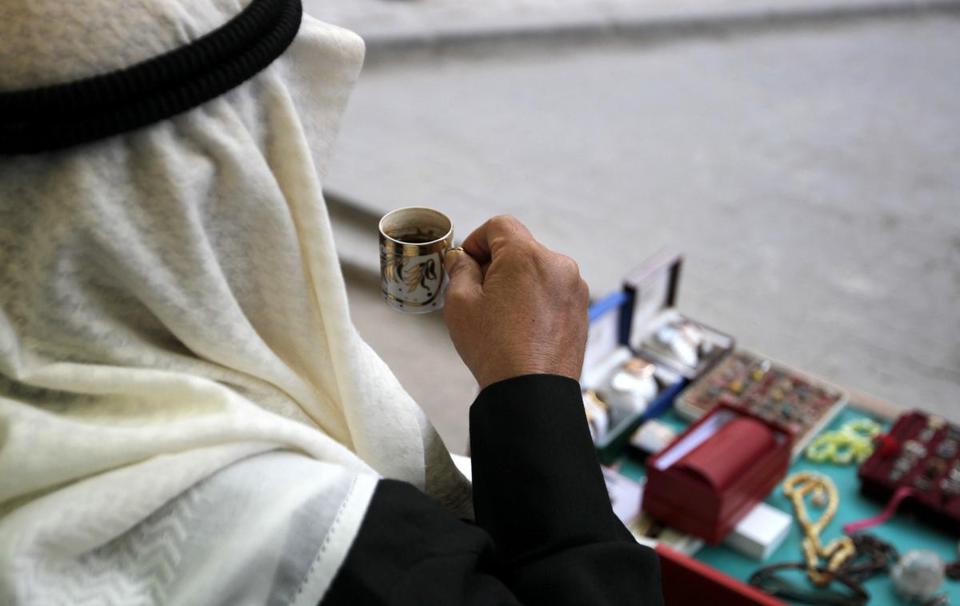
Walk the streets of downtown Kuwait City, and the traditional market, the crowded souk, offers hand-crafted Persian rugs and Kashmir shawls in a shadowy warren of narrow alleys. Heads turn to follow you as your eyes, unaccustomed to the kaleidoscope of the souk, try to absorb the bright colors, rich fabrics, dangling lightbulbs, and beckoning vendors who stand nearly motionless inside each narrow cubbyhole of commerce.

Almost immediately, my attention was seized by a booth with dozens of Indian shawls. My guide frowned slightly as I fingered the light, smooth merchandise hanging from pins and racks along its walls. He tugged on my arm: “There is a better shop down here, a better price.’’

There, a vendor unrolled rug after rug until I found just the right combinaton of color and texture for a price that, even after a few low-key rounds of gestures and bargaining, seemed like a steal. My guide was right.

Western tourists are a relative rarity; indeed, Kuwait has only about 90,000 vacationers per year. But they are not made to feel self-conscious. Whether walking along the outdoor promenade at the upscale, yacht-filled Marina Mall, or strolling among the locals in the souk, the ambience is laid-back and almost cosmopolitan. Smiling greetings and nods of welcome are common; so are the Paris-bought suits and high-three-figure sunglasses.

“There are a lot of Americans at the restaurants and malls, and the locals have much respect for them,’’ said Jenny Aguilar, guest relations manager at the Hilton Kuwait Resort, a luxury hotel built on a wide beach on the gulf. “During the [1991] war, it was the Americans who were here to guard the country from the Iraqis.’’

Many Americans come for business and stay for extended periods, Aguilar said, and their families often follow. As such, top-flight hotels like the Hilton offer an almost Western experience with rows of designer shops, well-equipped health clubs, and expansive pools.

Indeed, in December, a hallway at the Hilton featured a towering Christmas tree, a nightly concert of carols, and even a Santa Claus who mugged for photos with guests wielding smartphones and cameras. “Santa!’’ I said one night in startled recognition. St. Nicholas grinned - he obviously knew his name - but could not converse in English.

One glaring difference at the hotels - a reminder that Kuwait is a Muslim country - is the absence of alcohol. The restaurants in this country feature faux-cocktail bars, where drinks are spiked with fruit juice instead of the hard stuff. “Mixed with mango or pineapple?’’ my waitress asked me one night. My first instinct was to reply, “Mango or pineapple with what?’’ but I fought the urge. As I discovered, those tiny umbrellas in the concoctions are only a playful, winking nod to a forbidden indulgence.

Another reminder is the varying degree of traditional Arab dress. Although many young Kuwaitis of both sexes dress stylishly in expensive, Western-style clothing, many older men and women adhere to centuries-old concepts of proper public appearance. At the Hilton, a Muslim woman swam with her son while wearing a full-length body covering and another for her head.

Kuwait City was settled about 300 years ago and grew quickly, serving as a transit point for trade that linked India, the Middle East, and Europe. The British profited from Kuwait’s strategic location, where shipments of textiles, spices, and other goods crossed on their journey to and from India.

At the dawn of the 20th century, the British agreed to provide Kuwait with naval protection as a curb against the ambitions of the Ottoman Empire. Then, in 1936, the first oil wells were drilled. Kuwait gained independence in 1961.

Today, the pace of change is accelerating further. Along the highways in this metropolitan area of 2.4 million people, the familiar facades of Burger King, McDonald’s, and Pizza Hut are a sign of sometimes jarring change. Fast food, American-style, has come to Kuwait with a muscular visibility that vies for space with the pastel housing and apartment complexes that are mushrooming at astonishing speed out of what was empty desert only a decade or two ago.

The reason, of course, is oil - and lots of it. Ten percent of the world’s reserves are estimated to lie underneath the sands that bake in temperatures over 120 degrees Fahrenheit in July and August. The result is that Kuwaitis are a wealthy people, whose routine services - the province of taxi drivers, hotel staff, and laborers - are performed primarily by non-citizen immigrants from places such as the Philippines and Pakistan.

After a short time here, most visitors will see and sense this division, one of an unapologetic, two-tier society whose yawning gap seems unbridgeable. As such, Kuwait is vigilant about who enters the country and how long they stay. The lack of proper visa credentials - needed both for entering the country and leaving it - can lead to detention.

Entrance visas can be obtained upon arrival at Kuwait International Airport, where waits of an hour or more at a visa-control station are needed to gain approval to enter. Similarly, approval must be obtained to leave the country, where customs officials scrupulously ensure that travelers have not overstayed their welcome.

Once out the doors of the airport, getting around Kuwait is relatively easy. Taxis are everywhere, the drivers usually speak English, and rental cars are available. However, only international driver’s licenses are allowed for foreigners; a US license is not accepted.

Americans who want to take the wheel might find the roadways slightly terrifying. Traffic routinely weaves in and out at high speed, police do not appear to patrol regularly, and I saw several serious crashes on the major highways into and out of Kuwait City - at least one of which had what appeared to be a fatality on the road beside his car.

A stress-free way to soak up the sights is to ask the hotel concierge for a taxi driver who, for a reasonable fee, can act as both driver and guide. That way, tourists can visit multiple locations within a day, stroll and shop at their leisure, and enjoy the convenience of knowing that a ride to the next destination awaits them whenever they choose.

Visitors can nearly always count on dry weather; the country averages only 22 days with rain per year. Dust storms can occur at any time, but most often during the stifling summer. The most comfortable months are from November through March, when average high temperatures oscillate between 67 in January to the low 80s in November and March.

Without worrying about heat exhaustion, tourists will find that “Kuwait has a lot to offer,’’ said Aguilar.

Those offerings range from a panoramic view atop the two soaring Kuwait Towers, which reach 600 feet high; to ancient artifacts at the National Museum; to a day trip to one of Kuwait’s islands. There, a fully crewed dhow, or traditional Arab sailing vessel, can be hired to ply the gulf. The emirate also hosts pearl-diving festivals.

Shopping is a major pastime, and the city is dotted with high-end malls. Nearly everything a shopper can find on Newbury Street in Boston can be found here. Fine restaurants are also an option in the malls and hotels, where the cuisine spans a wide and interesting range from Middle Eastern to Chinese to European. At The Teatro, a restaurant on the gulf, the food is prepared at individual stations, elegantly presented, and cooked to order whether the choice is shrimp, steak, chicken, pasta, or any other of dozens of options. The service is impeccable, the staff attentive but not obsequious, and even the acoustic guitar player - from Japan - as cool and mellow as one might expect in an upscale US dinner club.

For tourists who crave a sampling of the traditional, a walk through the souk is a must. Although a first-time visitor can navigate the maze with only a few wrong turns, using a guide - that daylong taxi driver, possibly - will help find the best stalls, the best deals, and the best experience.

While walking the souk, ask to be taken to the nearby fish market, with its glistening mounds of fish, fresh from the gulf. A large adjoining room, rich with the smell of the sea, serves as a place for the fishmongers to kneel and pray.

Kuwait is a safe place, but common-sense precautions should be taken. Avoid dark places, stay on the major boulevards at night, and be respectful toward the people and their lifestyle, which is more relaxed than in strictly religious Saudi Arabia but remains unmistakably and proudly Muslim.

Millions of US service members, contractors, and business people have passed through here in the last two decades. Now, with the Iraq war over and the US presence winding down in Afghanistan, Kuwait is hoping Americans find another reason to visit.

Thursday, March 1, 2012

US professors travel to Iran to discuss Occupy Wall Street movement


The Occupy Wall Street movement may be losing its spotlight in the United States, but it's gaining attention in Iran, where a handful of American professors recently traveled to attend a conference focusing on the anti-capitalist protests.

"The discourse (in Iran) seems to be veering from 'Down with America!' to 'Down with the 1 Percent!'" said Heather Gautney, a self-described "Occupy Wall Street activist" and a sociology professor at Fordham University in New York. "In my view, this is quite a welcome development, and speaks to Iranians' affection for Americans despite all the political conflict."

Gautney was one of four U.S. professors last week to attend the two-day conference at Tehran University, in a country whose people -- despite any possible dissatisfaction -- are not in a position to take to the streets, as she described it. Consequently, she said, Iranian professors and students view the Occupy movement as "an object of study," not something to emulate anytime soon.

When she and the other professors were first invited to the conference, they were worried about the organizers' motivations, Gautney admitted. But after seeing a list of about 30 questions that would be posed to them, "it seemed like a very legitimate kind of project," she said.

In particular, organizers wanted to hear the professors speak about: What is the significance of the movement? How did it come about? Who are the protagonists? What are the goals?

"I got the sense that they were trying to confirm impressions that they had, confirm things that they had read in the press, in part so that they could integrate into their own and also into their classroom," Gautney said.

Nevertheless, government-controlled media in Iran didn't miss an opportunity to highlight the American professors' presence in Tehran. In an English-language report posted online, Iran's PressTV offered this headline from the conference: "Experts: Occupy Wall Street likely to topple US administration."

But no one in the report, including the American professors, said any such thing.

Two weeks earlier, Iran's PressTV posted a report from another Occupy Wall Street conference in Tehran, during which American religious activists said the Occupy movement "will redesign the world order."

A man identified as Imam Abdul Alim Musa from the Masjid al-Islam mosque in Washington said Occupy activists "feel that all of us are part of the 99 percent" and "are against one government killing scientists, engineers, peaceful people," referring to the recent assassination of an Iranian scientist working on Iran's nuclear program.

"So they are naturally against Zionism," Musa said in the report, provided to Fox News by the Washington-based Middle East Media Research Institute. "The monster today is global Zionism."

In the United States, some critics of the Occupy movement have pointed to several videos from protests featuring what the critics describe as anti-Semitic language.

Gautney said she would "vehemently disagree" with any such comments, saying the only enemy of Occupy Wall Street is inequality.

"I find (the imam's) claim quite disturbing and an awful attempt to use (the movement) as a pawn in religious conflicts of which is it not at all a part," she said.

As for the conference she attended, Gautney acknowledged a few presentations were "highly rhetorical," including one mentioning "the imperialism" of Europeans dating back to the days of Christopher Columbus. And, she said, "time and time again" Iranians asked if the Occupy movement is a signal "that there are problems with the liberal, democratic" system.

But she indicated she disagreed with any sentiments suggesting the demise of the U.S. government.

"I don't think any of us think that Occupy Wall Street is signaling the death of capitalism," she said. "(But) we certainly can see that it is signaling some problems in the system. ... We have a deeply unequal social and political system, and part of that is due to severe power inequalities."

Still, even when Gautney disagreed with some of the statements made at the conference, she wasn't always comfortable voicing her opinion.

"I felt my role there was to maintain my positions as representing the movement," she said. "To come into another country and start advising them on how to do things -- especially (since) I have no education in Islamic history, I have no real understanding of the society -- it would have been foolish and irresponsible. I didn't see my role as one of taking up the fight, spreading the Occupy Wall Street to Iran."

What's more, voicing some of her opinions could have been dangerous.

"You don't know what the level of control is, so you don't want to go places where you could get yourself into trouble," she said. "There's no U.S. Embassy there. There's no support mechanism. So I didn't feel like I had the freedom of speech to veer away from my ... talk about the movement."

Asked why she would attend a conference at which she couldn't speak her mind, Gautney said, "What you can do is give them real information about the movement."

She said one "misperception" among Iranians is that that U.S. media coverage of the Occupy movement "was very negative," and that news outlets " failed to report on a lot of what had been going on."

"We had an opposite impression," Gautney said of herself and her fellow activists. "From within the U.S., it was up and down, but for the most part there was a lot of positive reporting and a lot of media presence."

So, she said, she was able to "correct" a "complete misperception of what's going on."

In addition, Gautney was able to answer Iranians' questions about life in the United States, whom she described as "incredibly curious about American society."

In particular, Gautney said, Iranians were interested in the "mechanisms" of the U.S. economic crisis, including debt and the housing market's collapse. At the same time, many female students asked her questions such as: What does it mean to be a single parent? Do women have abortions? And, Why are so many teenage girls having children?

Conversations about the Iranian regime were "limited" because, in Gautney's assessment, Iranians "have to tow a line there" and "weren't really turning (the) lens inward."

In addition, she said United Nations sanctions against Iran are "really hitting the poor and middle-class people" and undercutting opportunities for uprising from within.

"It sort of positions people against the West rather than allowing them to find spaces of dissent within their own country," Gautney said. "It sort of unifies the country, and it gives them something to unify around."

Monday, February 27, 2012

Romney’s Arizona law ‘model’ would hurt all immigrants

By Andres Oppenheimer
aoppenheimer@MiamiHerald.com

If Mitt Romney becomes the next president of the United States and honors his latest vow to turn the Arizona immigration law into a “model” for the entire country, life in America could become quite unpleasant for many of us who look like immigrants, or speak English with a foreign accent.

In the Feb. 22 Republican debate in Arizona, where Romney and his main rival Rick Santorum were competing for the state’s anti-illegal immigration vote, Romney praised Arizona’s E-Verify system to check employees’ immigration status and said, “I think we see a model here in Arizona.” He added that, if elected, he would stop current federal lawsuits against Arizona-style laws “from day one.”

“Dios MĂ­o!” I said to myself when I heard that. Judging from what we have seen in states that have passed Arizona-styled laws, that would lead to arbitrary arrests and interrogations not only of undocumented immigrants, but of legal residents and U.S. citizens as well.

The 2010 Arizona law requires, among other things, that local police demand immigration papers when they have a reasonable suspicion that a person is in the country illegally. It was suspended after a federal lawsuit questioning its constitutionality and is before the U.S. Supreme Court.

Supporters of the law deny it would lead to a wild goose chase of foreign-looking people, and to widespread harassment of immigrants. They say the law does not allow police officers to stop people at random, because it specifically requires that they demand immigration papers only when they carry out a “lawful stop, detention or arrest.”

But those are vague terms, critics say. A police officer wanting to make overtime could legally stop people to ask whether they saw something suspicious around the corner, then arrest them for not having proper immigration papers.

In addition, the Arizona law requires that local police act as immigration inspectors not only when they legally stop somebody for a crime, but also when they do it for a violation of a city ordinance.

If somebody calls the police to complain that a neighbor is playing music too loud at a party next door, an officer could show up at the party and detain anybody there who can’t prove their legal status, opponents of the law say.

“The central problem is that it opens the door to widespread racial profiling based on what individuals look like or sound like,” Karen Tumlin, an attorney with the National Immigration Law Center in Los Angeles, told me last week. “The ‘reasonable suspicion’ wording would force cops to make judgments based on what people look like.”

It has already happened, and not just with Latin American or Asia-born people. In Alabama, one of several states that has passed Arizona-styled laws, a German executive with Mercedes Benz was recently arrested under the state’s new immigration law near his company’s manufacturing plant for not carrying documents proving his legal immigration status, the Associated Press reported Nov. 19.

The 46-year-old German visitor’s rental car was stopped by a police officer and the man was arrested when he could not prove his legal immigration status, Tuscaloosa Police Chief Steven Anderson told the wire agency. The visitor was released when an associate retrieved his passport from his hotel room.

Two weeks later, a Japanese employee from a nearby Honda plant was arrested and jailed for three days under Alabama’s immigration law after he was stopped during a checkpoint used by police to detect unlicensed drivers, even after he showed his international driver’s license, a valid passport and a U.S. work permit. There have been dozens of similar cases since Alabama’s anti-immigrations law was enacted.

A recent study by Alabama’s Center for Business and Economic Research economist Sam Addy concluded that the Alabama law could cost the state as much as $10.8 billion a year. Another study says Arizona’s immigration law has cost that state’s tourism industry $490 million.

Can you imagine what would happen in tourism and foreign trade-dependent states such as Florida if Arizona-like laws became the law of the land? Or what it would do to the real estate and convention industries in cities like Miami or New York?

My opinion: By almost any measure, Arizona-style laws are morally questionable and economically disastrous, and increasingly unnecessary at a time when illegal immigration has dropped dramatically after the 2008 U.S. economic downturn.

If Romney — and, to be fair, Santorum as well — stopped federal lawsuits against these xenophobic laws and allowed them to become a “model” for the entire nation, America would cease to be the country it has always been.

Saturday, December 10, 2011

State Dept official : SC immigration law threatens U.S. citizens' safety


COLUMBIA, S.C. (WACH, AP) -- A top-ranking U.S. State Department official says South Carolina's tough new immigration law has not only damaged the country's reputation but could also endanger U.S. citizens abroad.

Deputy Secretary of State William J. Burns says in court documents that the law interferes with federal authorities' jurisdiction over immigration and could subject U.S. citizens to retaliation when they travel.

"Act No. 69 undermines the diverse immigration administration and enforcement tools made available to federal authorities and establishes a distinct state-specific immigration policy, driven by an individual state's own policy choices, which clashes with U.S. foreign affairs priorities, risks significant harassment of foreign nationals, and has the potential to harm a wide range of delicate U.S. foreign relations interests," said Burns in a statement.

Burns, who previously served as the U.S. ambassador to Russia and Jordan, is a career diplomat and foreign service officer who said he is tasked with helping the secretary of state form U.S. foreign policy.

His statement was filed as part of a U.S. Department of Justice lawsuit against Gov. Nikki Haley over the state's new law, which takes effect Jan. 1. Prosecutors want to halt the law while their lawsuit challenging its constitutionality moves forward.
The measure requires police to call federal immigration officials if they suspect someone is in the country illegally. Justice Department officials are challenging similar laws in other states.

South Carolina Attorney General Alan Wilson has said he is willing to take the fight for South Carolina's immigration law to the U.S. Supreme Court.

Critics, including some law enforcement officials, have argued the law could put a burden on the state's prisons.

Do you think South Carolina's immigration law has damaged the country's reputation or could put U.S. citizens at risk while travelling outside the country?

Gay immigrants in U.S. deserve protection

The San Francisco Bay Area is home to thousands of lesbian, gay, bisexual and transgender immigrants from across the globe. Some have been beaten and jailed in their native countries for daring to hold a loved one's hand in public. Others have hidden who they are for years, fearing that they would be shunned by their families and communities. Many have come to America in search of freedom, equality and acceptance.

This week, President Obama sent an important message to LGBT people here and across the globe. He directed federal agencies to ensure that U.S. diplomacy and foreign aid promote and protect the human rights of LGBT persons. In his announcement, he reiterated his belief that "no country should deny people their rights because of who[m] they love." We applaud the goal of these new international initiatives to combat foreign governments' criminalization of LGBT status and to combat discrimination, homophobia and intolerance.

Yet, the U.S. government's expressed commitment to human rights abroad stands in stark contrast with the plight of LGBT immigrants in this country. Under U.S. immigration laws, LGBT individuals are denied basic rights because of whom they love.

For example, immigrants may be deported and permanently separated from their same-sex spouses or partners without legal recourse. It does not matter to the U.S. government how long couples have been together or how the lives that they have built together would be shattered by forced separation. Moreover, LGBT refugees seeking safe haven in the United States often find that our system of justice is not how they imagined it would be.

They may be forced to "prove" their sexual orientation or gender identity to skeptical U.S. Asylum Officers or immigration judges. This is a demeaning experience for many LGBT individuals whose very existences have repeatedly been called into question or denied by their families and communities.

In addition, U.S. courts have become increasingly hostile to LGBT refugees seeking asylum in the country, pointing to purported human rights advancements in other countries. Yet, too often, there is a focus on the narrow question of whether it is technically "legal" to be gay, lesbian or transgender in another country, without acknowledging the genuine peril faced by LGBT persons who live with the omnipresent threat of violence in their homes, in their workplaces or walking on the street.

While we hope that the Obama administration's newly announced foreign initiatives will help bring about much-needed change across the globe, we urge our elected officials to safeguard the human rights of LGBT people here and abroad. Our moral authority on the world stage will only be enhanced if we lead by example and ensure that no country, including the United States, denies people their rights because of whom they love.

Philip Hwang is the director of policy and programs at the Lawyers' Committee for Civil Rights of the San Francisco Bay Area. Noemi Calonje is the Immigration Project director at the National Center for Lesbian Rights.

U.S. Immigrant Business Owners Supported by Chicago Officials

immigrant business owners, Mayor Rahm Emanuel announced on December 6, 2011.

Following other cities and states, Chicago has now kicked off its municipal department focusing on immigrant entrepreneurs. The Office of New Americans is headed by former activist Adolfo Hernandez. He's from the Little Village neighborhood, one of the largest Mexican business communities in the U.S. The department coordinates training and workshops for immigrant entrepreneurs in hope of creating jobs in the U.S. and promoting Chicago as a global economic hub. In addition, The Office of New Americans will soon expand its concentration to other issues like English language and U.S. citizenship.

According to the Mayor, the opening of this department is considered a step toward making Chicago "the most immigrant-friendly city in the world". Similarly, Mr. Hernandez said it's a signal that the city wants immigrant business. He also indicated that Chicago's history is closely tied to the U.S. immigration story and it's important to recognize that "immigrants bring a lot".

Statistics revealed that immigrants were more than twice as likely to start businesses as non-immigrants in 2010, and the number of immigrant business owners in the U.S. keeps growing, according to a study by Robert Fairlie, a professor at the University of California in Santa Cruz who has researched the issue for the U.S. Small Business Administration.

If you are interested in Visas to the USA, contact Migration Expert for information and advice on which visa is best suited to you. You can also try our visa eligibility assessment to see if you are eligible to apply for a visa to the United States of America.

Saturday, December 3, 2011

New Asheville exhibit presents diversity of immigrant experience in WNC

Community exhibit presents diversity of experience in WNC
ASHEVILLE — For Carolina McCready, art, the language of the human spirit, teaches people how to feel about complex issues, cutting through the static of biased politics and hate.

That theory is the organizing principle behind The Artery’s new exhibit about immigration, “Nuestras Historias, Nuestras Voces” (Our Stories, Our Voices). The community art project is sponsored in part by Latino Advocacy Coalition, where McCready is co-director. The exhibit reception is 7-9 p.m. today.

“Art talks to people’s hearts — people can learn much more through art and the way that it speaks to you,” McCready said. “Since immigration is such a polarized and complicated topic, we hope to speak to people’s hearts and not their minds.

“The effects of local immigration enforcement efforts on our communities are large, and the general public needs to feel these stories.”

The pieces in the multimedia exhibit — which includes works from seven artists with roots in Texas, Mexico, Romania and elsewhere — are inspired by The 100 Stories Project, a documentation project focusing on human rights abuses, and designed as a tool for organizing in immigrant communities, McCready said.

“The stories project started in 2008 spearheaded by five grassroots groups in Henderson and Buncombe counties,” she said. “Immigrants living in Western North Carolina have faced dramatic discrimination and abuse in recent years.”

Those abuses, she said, include workplace raids, such as the 2008 raid at Mills Manufacturing in Asheville and this week’s raid at Shogun Buffet and Hibachi Grill, as well as denial of driver’s licenses for undocumented residents, limited access to higher education and constant use of discriminatory license checkpoints.

“The local deportation programs had devastating effects on immigrants in Western North Carolina,” McCready said.

Those effects prompted the groups to start documenting these stories and have been used in theater pieces, art exhibitions, meetings with elected officials, and in protests and marches.
These stories inspired artist Martha Skinner to create a “10 X 10” table and performance. The project involves a collective drawing by 10 local immigrants to the stop-and-go rhythm of music created by another 10 local immigrants, she said in an email.

She envisions the piece to represent “the many faces of immigration and the transformation that takes place when one merges the stories of two cultures.”

Curator Victor Palomino conceived the exhibit to demonstrate this community’s diversity of experience and emotion.

“As artists, we hope to create dialogue and include the voices of those living in the shadows,” Palomino said. “This exhibition conveys the moments of resilience and celebration, as well as episodes of discrimination and fear experienced in a diverse range of ways.”

Organizers plan to take the exhibit to UNC Asheville and Warren Wilson College. “We would love to see the exhibit travel to other community locations and centers,” McCready said.

“By presenting the stories of Latino experiences in WNC and sharing them widely, we can take a first step in creating an environment in which cross-cultural dialogue might begin,” McCready said.

Also contributing to the 100 Stories Project are the Center for Participatory Change, WNC Workers Center and Nuestro Centro Coalition of Latin American Organizations.
In addition to Skinner, a Colombian designer and educator, the multimedia exhibit at The Artery features Sandra Garcia, a visual artist of Colombian descent; DeWayne Barton, a sculptor, poet, and African American organizer; Adrianna Vasiut, a Romanian painter; Kenna Sommer, a local visual artist and teacher; Chris Corral, a Texas native of Mexican descent who is a figurative painter; Oscar Santana, local Latin music DJ from Mexico.

Friday, December 2, 2011

County receives U.S. aid, for now, to fight illegal immigration

It has become an annual exhibition in the government's eternal struggle to balance budgets and fight illegal immigration.

Politicians propose removing the federal funds that flow to local law-enforcement agencies as reimbursement for the costs of housing undocumented immigrants, and every year those funds are reinstated.

This year's restoration of funding came just before Thanksgiving in a quietly passed appropriations bill that included funding for farms, research and transportation. The bill also included $240 million to reimburse jailers for the costs of housing undocumented inmates.

On Wednesday, the Maricopa County Board of Supervisors passed a portion of those funds through to the Sheriff's Office, giving the agency $2.2 million to offset some of the costs associated with undocumented inmates.

The federal funds also included more than $9 million for the Department of Corrections.

The money is allocated annually based on the number of days each undocumented immigrant is housed in a jail or prison. The reimbursement rate is about $30 per inmate per day.

Daily incarceration costs can vary based on factors such as where the inmates are housed. It costs about $56 each day to keep a convict in an Arizona state prison.

County jails and the state have received nearly $100 million through the program since 2006, but federal lawmakers eye the money each year when it comes time to balance the budget.

This year's allotment was in jeopardy after President Barack Obama introduced a budget in the spring that eliminated the money, but the funding found its way into a multifaceted appropriations bill that Obama signed Nov. 18.

Officials in Arizona were thankful for the $12 million that came the state's way this year but said it does not come close to covering taxpayers' costs.

"Some money's better than nothing," Maricopa County Sheriff Joe Arpaio said. "It's still not as much as we should be receiving."

It is a familiar refrain that crosses party lines.

Former Democratic Gov. Janet Napolitano regularly billed the federal government in an attempt to recapture some of the expenses the state incurred to house undocumented inmates. And former Republican state Treasurer Dean Martin followed suit and sent federal officials a $1 billion bill in early 2010 in an ill-fated attempt to recoup some of the same expenses.

But in a climate where every federal dollar spent is being scrutinized, it can be hard for politicians to balance their desire for the federal government to meet its obligations and for fiscal conservatism.

Gov. Jan Brewer is among them.

Brewer is sensitive to the federal government's budget crunch, said spokesman Matt Benson, but Brewer wants cuts to come from areas other than the State Criminal Alien Assistance Program.

"The governor doesn't believe that SCAAP funding for states is the best approach to reducing federal spending because ultimately those costs are being born by the states," Benson said. "It's not like they disappear."

Rep. Jeff Flake, a fiscal conservative, was among the six Arizona delegates who voted against the appropriations bill that included SCAAP funds. Sen. John Kyl and Reps. Ed Pastor and Paul Gosar voted for the measure, and Rep. Gabrielle Giffords did not vote.

Flake said Arizonans who are not accustomed to the money serving as a political football should get used to it.

"Unfortunately, I think that what's past is prologue here. We're going to see more of this battle every year," Flake said. "There will be increased pressures, I think, on all funding. It's not like you have to rob something in another area of government (to continue funding the program)."

Keeping the reimbursement program alive, Flake said, will require reducing some of the money that flows from the Department of Homeland Security to state and local law-enforcement agencies if there is not an obvious connection to federal mandates.

"Whether we like it or not, providing funding for local fire departments and (Community Oriented Policing grant) funding, that certainly is appreciated by folks at the local level, but there's not really a federal nexus there," Flake said. "Here, there is

Menendez, Colleagues Re-introduce Comprehensive Immigration Reform

WASHINGTON – Today U.S. Senators Robert Menendez (D-NJ), Harry Reid (D-NV), Patrick Leahy (D-VT), Dick Durbin (D-IL), Chuck Schumer (D-NY) John Kerry (D-MA) and Kirsten Gillibrand (D-NY) re-introduced a comprehensive immigration reform bill aimed at addressing the broken immigration system with tough, smart, and fair measures.

The bill includes measures to strengthen border security, enhance worksite enforcement of immigration laws, and requirements that the estimated 11 million undocumented immigrants present in the U.S. register with the government, pay their taxes, learn English, pay a fine, pass a background check, and wait in line for permanent residence.

“This legislation signals to the American people that we are serious about fixing our broken immigration system,” said Menendez. “We stand for a complete solution - a real solution - to end undocumented immigration and restore the rule of law. This is common-sense legislation that addresses the realities of the situation, stops the flow across our borders, and contributes to our economic recovery. If we can put political grandstanding aside and come together on a comprehensive, pragmatic bill like this one, we can bring resolution to a great national need.”

“Effective reform of our immigration system will only come about as the result of a good-faith bipartisan effort, and this legislation is a very strong starting point for that process,” said Senator Leahy. “But one thing we should all support is a civil debate about how best to update our immigration laws to curb the tide of illegal immigration, continue to strengthen our borders, and create a system that works best for America.”

“Today we are living with a broken immigration system that weakens our national security, hurts our workers, and falls short of the most basic standard of justice,” Durbin said. “To fix this system, we need a comprehensive approach that is tough, fair, and practical. Senator Menendez has drafted a good bill and I’m proud to support it.”

“Our immigration system is broken and the status quo is unacceptable,” said Senator Gillibrand. “We need to right-size the system by uniting families while upholding America’s security and the rule of law. I am committed to working with my colleagues in passing a comprehensive immigration reform bill that improves border security while treating immigrants fairly, providing a path to hard earned citizenship, and allowing our youth a chance at the American dream.”

The Comprehensive Immigration Reform Act of 2011 includes both a mandatory employment verification system and a program to require undocumented immigrants in the U.S. as of June 1, 2011 to register with the government, learn English, and pay fines and taxes on their way to becoming Americans.

The bill promotes effective and accountable enforcement within the U.S. through measures such as: additional resources for the Border Patrol; expanded penalties for passport and document fraud; new requirements for the Department of Homeland Security to track entries and exits at the border; common-sense rules governing detention to ensure U.S. citizens are not unlawfully detained; and new criminal penalties for fraud and misuse of Social Security numbers.

A Standing Commission on Immigration, Labor Markets, and the National interest would be created as part of the bill to evaluate labor market and economic conditions and recommend quotas for employment-based visa programs to the Congress that would protect American jobs.

Thursday, December 1, 2011

U.S. immigration chief getting serious about startups & immigrant entrepreneurs (exclusive)

U.S. Citizenship and Immigration Services director Alejandro Mayorkas is getting serious about creating reforms that would make it easier for foreign entrepreneurs to settle in the US.

A group of VCs, academics and thought leaders recently petitioned Mayorkas about the roadblocks to foreigners creating startups in the United States.

To their surprise, Mayorkas responded immediately and quite positively, asking for more advice and promising swift action to welcome more foreign entrepreneurs.

Vivek Wadhwa, an entrepreneur, academic and columnist, was on the list of signatories petitioning the director and said he was surprised at Mayorkas’ response.

In an email exchange with VentureBeat, he said, “I expected this would be a battle I would have to fight through the media and through policy makers. I believe that Alejandro is serious in his intent and genuinely wants to fix the problem. The question is whether the bureaucracy will let him.

“If he does follow through, it will make a real difference. Great job-creating entrepreneurs … won’t be deported, they will be welcomed.”

This issue has been raging since at least the Startup Visa Act was first introduced in Congress in 2010. The Act has yet to undergo judiciary committee review.

In a VentureBeat post on American brain drain, Wadhwa wrote, “During the last 20 years, we admitted record numbers of international students and highly educated foreign workers on temporary visas. But we never expanded the number of permanent resident visas that allow them to stay permanently.”

For this reason and others, Wadhwa continued, “72 percent of Indian and 81 percent of Chinese returnees said that the opportunities to start their own businesses were better or much better in their home countries.” As a result, he said, America is losing new jobs and new businesses.

Last month, USCIS announced an Entrepreneurs in Residence initiative, spearheaded by Mayorkas. The goal of the initiative was “to ensure that our policies and processes fully realize the immigration law’s potential to create and protect American jobs,” as Mayorkas said at the time.

As part of the EIR initiative, USCIS asked industry experts to recommend policy changes that would have a positive impact on American entrepreneurship. In response, a group of leaders ranging from investors such as Fred Wilson and Brad Feld to academics such as Benn Konsynski and AnnaLee Saxenian to the United States Chamber of Commerce wrote Mayorkas an open letter.

In this letter, the group recommended improved training materials and certain “changes to the Adjudicator’s Field Manual (AFM) to guide adjudicators in assessing petitions by prospective entrepreneurs under the Startup Initiative.” In simple terms, the group found that the process of setting up a legal business and establishing residency in the U.S. was needlessly complicated for foreign entrepreneurs of small startups.

First, the group recommended a basic training video for government officials who decide on whether or not a foreign entrepreneur passes muster. These adjudicators, the group said, needed simple education on what a startup is, its phases of development and how it grows into a full-fledged business.

Second, the group stated that the manual for adjudicators needed some changes along the same lines, “to promote and encourage foreign entrepreneurs to start businesses in the United States, as well as facilitate the process of adjudicating those petitions.”

“We believe these changes will help level the playing field for entrepreneurs interested in starting businesses in the United States,” the group concluded.

In response, Mayorkas has written, “Your ideas are excellent, and I would like to follow up on them immediately.”

Mayorkas said the training video specifically was a good idea and that he wanted “a suggested training video outline identifying the major points you believe need to be communicated to adjudicators handling entrepreneurs’ petitions.”

As for the manual for adjudicators, Mayorkas wrote, “I will schedule and host a public engagement focused on the discrete sections of the Adjudicators’ Field Manual that are most relevant to entrepreneurs’ petitions, with the goal of revising those sections as needed. If you have suggested revisions already in mind, I would appreciate receiving them.”

The director finished, “I want to move as quickly as possible. We are focused on ensuring that the law’s full potential to attract foreign entrepreneurial talent is realized.”

Twitter Delicious Facebook Digg Stumbleupon Favorites More

 
Design by Free WordPress Themes | Bloggerized by Lasantha - Premium Blogger Themes | GreenGeeks Review