Showing posts with label Illegal immigrants. Show all posts

Monday, February 27, 2012

Reforms fail to dent net immigration rate

Persistently low levels of emigration from the UK combined with an increasing number of immigrants from Africa, Asia and the Caribbean have contributed to the net migration rate remaining stable at a quarter of a million being added to the UK population each year, despite government efforts to bring net immigration down.

The data, released on Thursday by the Office of National Statistics, showed that 593,000 people entered the UK and 343,000 departed in the year to June 2011, resulting in a net inflow of 250,000. This represents an increase of 15,000 during the coalition government’s first year in office.

Home Office ministers are battling to reduce the net figure in order to meet the Conservatives’ election pledge of bringing net immigration down to the tens of thousands by the end of the parliament. They have already introduced reforms to immigration policy for those who come to the UK to work and study, and are due to announce more changes on migrants coming to join their families in the next month.

However, the task of reducing the headline immigration level is made difficult by ongoing immigration from European Union countries and unusually low numbers of Britons leaving the country to live or work abroad. Neither of these is under government control.

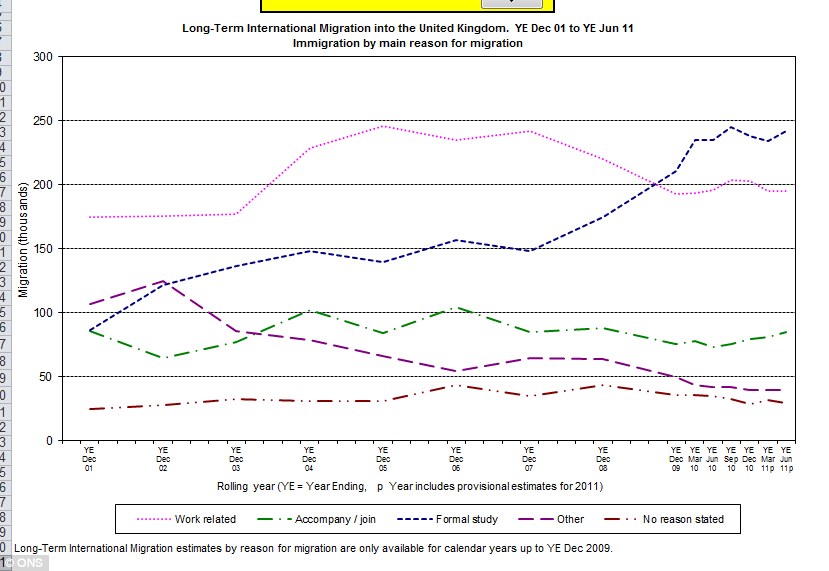
The latest data show a record number of 170,000 migrants coming to the UK from African Commonwealth countries and the Indian subcontinent, a group sometimes called the “new Commonwealth” as opposed to the “old Commonwealth” of Canada and Australia. Two thirds of these came to study. Overall, education remains the most common reason for migration to the UK, and is responsible for around 40 per cent of the total inflow.

Damian Green, immigration minister, drew attention to separate Home Office data showing that visas for study and work had decreased by 6 per cent to the year ending June 2011.

“Our reforms are starting to take effect,” Mr Green said on Thursday. “Figures from the second half of last year show a significant decrease in the number of student and work visas issued, an early indicator for the long-term direction of net migration.”

“This government remains committed to bringing net migration down from the hundreds of thousands to the tens of thousands over the course of the parliament,” Mr Green confirmed.

However Scott Blinder, senior researcher at Oxford’s Migration Observatory, cautioned that “many factors” contribute to determining immigration levels, and that a drop in visa issuing may not be entirely due to recent policy changes.

“Policies are important – for example, changes to the shortage occupation list might make a big difference, even though the cap on work visas gets more attention,” Mr Blinder said. “But political and economic conditions matter as well, both here and globally. Visas issued for work have in fact been declining since 2006, and the reasons why are not clear.”

Chris Bryant, shadow immigration minister, said Thursday’s figures showed that net migration was going in the “wrong direction” despite the Home Office’s reforms. “We need honesty and competence from this government on immigration. Instead we get tough rhetoric not matched by the reality on the ground,” Mr Bryant said. “The country deserves better than that.”

Net migration to the UK stuck at 250,000 despite Cameron's tough talk on slashing numbers

Net migration swells population by a quarter of a million in 12 monTotal number of migrants coming into the country now stands at 593,000 - one of the highest figures recorded


Immigration has swelled the population by a quarter of a million people in just 12 months despite the government’s pledge to cut net migration, official figures showed today.

The figure – the number of people added to the total population after immigration and emigration are both taken into account – has remained steady since it peaked at 255,000 in the year to September 2010.

Net migration for the year to June 2011 was 250,000.

The Government has pledged to cut net migration to 1990s levels of the tens of thousands by 2015.

The latest figures mean that ministers are likely to have to deal with increasing criticism from Tory backbenchers and migration pressure groups about their failure to get to grips with immigration.

The number of people leaving the UK has fallen considerably from a peak of 427,000 in 2008, the ONS said.
But net migration has been going up rather than down and is currently running around 15,000 higher than when David Cameron entered Downing Street

The latest figure is up from the figure of 235,000 for the year to June 2010, according to the ONS.

The impact of immigration was boosted by record numbers of people coming to live in Britain from countries classed as part of the New Commonwealth.

UK Migration 2001-2011
While emigration has dipped since 2008, immigration has remained steady, meaning an increase in net migration since the Coalition came to power

An unprecedented 170,000 people in a year came from countries in Africa, Asia and the Caribbean, two out of three of them to study at British universities and colleges.

The full number of migrants coming into the country in the 12 months to June 2011 was 593,000, itself one of the highest totals ever recorded, and a level which shows that immigration into Britain has not fallen since Labour opened the borders to Poles and other Eastern European citizens in 2004.

That figure is up from 582,000 in the year to June 2010, estimated figures published by the ONS showed.

This means that Britain’s population will grow by 2.5million people because of immigration alone in 10 years, and it suggests that the landmark 70 million population total will be reached 15 years from now.

Net migration was high because many fewer Britons have been emigrating to live abroad since the recession began.
Net migration has actually worsened int he past two years, today's figures show

Some 343,000 British people left the country in the year to June 2011, nearly 10 per cent down on the numbers in 2008.

Study remains the most common reason for migrating to the UK, with 242,000 students coming in the year to June 2011.

Immigration Minister Damian Green said: 'Our reforms are starting to take effect.

'Home Office figures from the second half of last year show a significant decrease in the number of student and work visas issued, an early indicator for the long-term direction of net migration.

'Net migration remains too high but, as the ONS states, it is now steady, having fallen from a recent peak in the year to September 2010.

Reasons for immigration to UK
The number giving no stated reason for coming to the UK has remained steady in the past decade
----------------------------------------------------------------------------------
Growing numbers of foreign students
Overseas students coming to study in the UK has been one of the biggest drivers of immigration
-----------------------------------------------------------------------------------
'This Government remains committed to bringing net migration down from the hundreds of thousands to the tens of thousands over the course of this Parliament.'

Sir Andrew Green, chairman of campaign group Migration Watch UK, said: 'These figures are disappointing.

'They show that the immigration supertanker has been brought to a halt but massive efforts by the Government will be essential if their manifesto promise is to be kept.

'For example, the student visa system, which admits half a million non-EU students a year, needs a much more effective means of testing whether the applicants are genuine and intend to return home.'
Net migration has remained steady despite a pledge by David Cameron to tighten borders

Shadow immigration minister Chris Bryant said: 'On net migration, rather than the Prime Minister's 'no ifs, no buts' pledge to cut net migration to the tens of thousands, this data shows it's still going in the wrong direction.

'We need honesty and competence from this Government on immigration. Instead we get tough rhetoric not matched by the reality on the ground. The country deserves better than that.'

He added: 'These figures show the Government's complete failure to combat illegal immigration.

'This Government is deporting fewer foreign criminals, stopping fewer people who shouldn't be in the UK from coming in, and removing fewer people who should not be here. That is a serious failure of this Tory-led Government.'
Migration from New Commonwealth countries has been one of the key drivers of immigration
---------------------------------------------------------------------------------
Meanwhile, asylum applications rose 11 per cent last year to 19,804, compared with 17,916 in 2010, separate figures published today by the Home Office showed.

The figures for every quarter last year were higher than 12 months earlier, mainly due to an increase in applications from Pakistan, Libya and Iran, officials said.

And the number of people removed or departing voluntarily from the UK last year fell 13 per cent to 52,526 from 60,244 during 2010.

Matt Cavanagh, associate director of the Institute for Public Policy Research (IPPR) think-tank, said: 'Reducing immigration is a legitimate goal, but politicians should be wary of promising what they can't deliver.

'There is also a risk that ministers will be tempted to take more extreme measures in pursuit of their elusive target, including on those areas of immigration which are most important to our economy, and which surveys show the public are less bothered about, including skilled workers and overseas students.'

The ONS figures published today also showed that 690,000 national insurance numbers were allocated to non-UK nationals in the 12 months to September last year, up 11 per cent from the 623,000 in the previous year.

Mr Cavanagh said these figures were 'one way of estimating the total number coming here to work' and were 'likely to reinforce widespread fears that immigration is exacerbating unemployment'

Saturday, December 10, 2011

Alabama GOP Rethinks Immigration Law

Phillip Rawls of the Associated Press is reporting that Alabama Republicans, who pushed through the nation's toughest law against illegal immigrants, are having second thoughts amid a backlash from big business. The backlash is being fueled by the embarrassing traffic stops of two foreign employees tied to the state's prized Honda and Mercedes plants.

Luther Strange, the Republican attorney general, is calling for some of the strictest parts of the law to be repealed, namely the sections that make it a crime for an illegal immigrant to fail to carry registration documents and that require public schools to collect information on the immigration status of students. Both sections have been put on hold temporarily by a federal court.

Rawls writes:

Gov. Robert Bentley, who signed the law, said he's contacting foreign executives to tell them they and their companies are still welcome in Alabama.

"We are not anti-foreign companies. We are very pro-foreign companies," he said.

Is that funk band Cameo we hear playing in the background? Strange, pun intended, and Bentley are talking out of the sides of their necks. Let's revisit this quagmire: When hardworking American citizens argue against the strict law, the Alabama GOP moves forward with enacting it. When foreign companies with foreign interests argue against the controversial law, the Alabama GOP rethinks the law and decides to repeal some of the more heinous parts of it.

We're not rocket scientists, but that logic doesn't quite add up. What does add up? The Alabama GOP disposing of laws that they claimed were necessary in order to continue doing business with foreigners, who they don't really want in this country unless there is money to be had. On another note, just where were these foreign executives when the GOP was pushing this xenophobic law through at lightning speed?

Tuesday, December 6, 2011

City of Gatineau publishes 'statement of values' for immigrants

By Arthur Weinreb
Dec 6, 2011


Gatineau - Although the Quebec city published the guide in October, a controversy is now brewing over some of what newcomers to Quebec are being told. To some, it is reminiscent of what happened in Herouxville in 2007.
The guide lists 16 points that newly arrived immigrants to Canada who settle in Gatineau should adhere to. By following these guidelines, the city hopes the newcomers will be better able to adapt to their new home. The statement of values is supported by Quebec's Ministry of Immigration and Cultural Communities on the basis it is necessary for recent immigrants to understand Quebec's core values.
Gatineau, located just across the river from Ottawa, is the fourth largest city in Quebec. According to its website, the population in 2006 was 242,124. As a percentage of the population, immigrants comprised 8.7% of the population in 2006, compared to just 5.6% in 1991.
Some of the points are far from controversial. Immigrants are told they must learn French even though they live in close proximity to Ontario. The newcomers are also told that men and women have equal rights in La Belle Province.
Some points are less neutral. New immigrants are informed that bribing public officials is unacceptable. They are also told that punctuality is important and they should arrive at appointments a few minutes early. And as Quebec is a secular province, newcomers are told it is better not to display their religion in public.
Other points in the document have really raised the ire of critics. One of the points that is controversial is contained in the point that outlines how violence against women and children is unacceptable in the province. Besides indicating that physical and sexual violence is wrong, newcomers are also warned not to "willfully starve" their children.
Recent immigrants are also warned about using certain spices that cause body odour and strong cooking smells emanating from their homes. These smells, they are told, can prevent them from adapting to their new home. Statements such as these have been described as "infantile" and "paternalistic' by critics.
Regarding advising immigrants to feed their children and not starve them, Daniel Weinstock, a professor of ethics at the Universite de Montreal, was quoted as saying,

Imagine a Quebecker going abroad and being told, 'By the way, you might not know this, but if your team loses a hockey game, it's not okay to burn peoples' cars.'

Comparisons are being made between Gatineau's statement of values and the code of conduct that was released by the Quebec village of Herouxville in 2007. Aimed primarily at Muslims, newcomers to the tiny village were told it was not acceptable to stone women in public, female circumcision was wrong, and that faces should not be covered in public, except on Halloween. Some of these statements were removed after complaints were received.
But the statement of values does have supporters in Quebec. Carmelo Marchese, who works with Quebec newcomers and is an immigrant himself, said that immigrants need to learn these values in order to adjust. If some paragraphs are seen as offensive it is because they are being taken out of context.

Immigration Equality Praises Obama Administration's Call to Protect LGBT Human Rights Abroad

Group Says Memo "ensures that the federal government will continue to be a key partner in Immigration Equality's efforts" to assist those fleeing persecution from abroad

WASHINGTON, Dec. 6, 2011 /PRNewswire-USNewswire/ -- Immigration Equality, a national organization advancing equality under U.S. immigration law for lesbian, gay, bisexual, transgender, and HIV-positive individuals, praised new guidance issued today by the Obama Administration on the human rights of lesbian, gay, bisexual and transgender people abroad. The organization specifically praised the Administration's call for U.S. agencies to "protect vulnerable LGBT refugees and asylum seekers" who flee anti-LGBT persecution. Through a memorandum, and a speech by Secretary of State Hillary Clinton, the Administration sent a strong message that it views LGBT rights as human rights. Speaking in Geneva, Secretary Clinton boldly proclaimed, "Gay rights are human rights, and human rights are gay rights."

Immigration Equality is the nation's largest provider of legal counsel to LGBT and HIV-positive asylum seekers, and the expert trainer on sexual orientation and gender identity claims for the Department of Homeland Security's asylum and refugee protection officers. In 2011 alone, Immigration Equality has already won nearly 100 asylum cases, with 258 cases pending. At the invitation of the Department of Homeland Security, Immigration Equality has trained more than 100 officers on LGBT asylum and refugee issues. Today's Presidential Memorandum makes clear that those training programs are a key part of its plan, noting that government agencies "shall ensure appropriate training is in place so that relevant Federal Government personnel and key partners can effectively address the protection of LGBT refugee and asylum seekers . . ."

"Today the administration committed its muscle to helping provide a safe haven for LGBT people who face violence, persecution and abuse in their home countries," said Victoria Neilson, the group's legal director. "Immigration Equality hears from more than 1,000 LGBT people a year who are fleeing persecution. Many face daunting challenges in escaping their home country, let alone reaching the shores of the United States. By instructing foreign service officers to offer all available assistance to those who seek their help, the White House is extending a helping hand to some of the world's most vulnerable individuals."

Immigration Equality is a national organization fighting for equality under U.S. immigration law for lesbian, gay, bisexual, transgender, and HIV-positive individuals

Alabama attorney general questions tough immigration law

MONTGOMERY, Ala. (AP) – The top legal official in the U.S. state with the country's toughest immigration law has suggested throwing out parts of the law after challenges by the federal government and strong protests by rights and business groups.
In a letter to legislative leaders, Alabama Attorney General Luther Strange said the proposed changes would make the law "easier to defend in court" and "remove burdens on law-abiding citizens."

The letter, sent last week and acquired by The Associated Press, represents the first time the attorney general has expressed concerns since he started defending the law against a federal court challenge filed by about 30 organizations and individuals.

STORY: Ruling on Ala. immigration law averts exodus
OUR VIEW: Alabama nets more than illegal immigrants
OPPOSING VIEW: Alabama just enforcing federal law

The law is considered by both opponents and supporters as the toughest in the U.S. against illegal immigrants.

The state Legislature passed the law to scare off illegal immigrants and open up jobs in a state suffering from more than 9% unemployment. The law took effect in late September, except for provisions put on hold temporarily by federal courts.

Some immigrants then fled the state, and some employers found they couldn't find people to fill the jobs they left behind.

Governor Robert Bentley on Monday said he is concerned the law might be affecting industrial recruitment. He said the law needs simplifying, but it shouldn't be repealed.

And a leading business organization in Alabama's largest urban area called for revisions Tuesday, expressing concerns that the law taints Alabama's image around the world. The Birmingham Business Alliance said complying with the law is a burden for businesses and local governments. The group did not offer specific changes.

Strange, the attorney general, recommended repealing a section of the law that makes it a crime for an illegal immigrant to fail to carry registration documents. That section has been put on hold temporarily by a federal court. Strange said federal law already makes it a crime and repealing it would allow police "to focus on more important aspects of the law."

He also suggested repealing the requirement that public schools collect information on the immigration status of students. That section is also on hold.

His letter was written in response to Senate President Pro Tem Del Marsh, who said the Legislature would only consider changes recommended by the attorney general. Marsh and House Speaker Mike Hubbard did not immediately respond to requests for comments about the letter.

Strange said his recommendations were based only on the legal challenge to the law and on efforts to make the law clearer. "The legislative leadership asked for our opinion and we provided it," he said in an email.

Also Tuesday, state agriculture officials met with farmers to discuss their concerns that the law has driven off the laborers they will need to plant their crops in the spring. Officials discussed the possibility of using prison inmates to fill labor shortages.

One of the attorneys challenging the law, Karen Tumlin of the Immigration Law Center, said officials are beginning to see the "devastating" impact the law is having.

Sunday, December 4, 2011

Immigration Minister Chris Bowen set to revive Malaysia Solution

IMMIGRATION Minister Chris Bowen says the government will again try to get its Malaysia Solution through the parliament, just days after the Labor party endorsed offshore processing for the first time.

But Mr Bowen conceded the Malaysia Solution would ultimately fail on the floor of the parliament without a change in the Coalition's opposition to the policy.

Friday, December 2, 2011

December 3, 2011 County’s protest against federal immigration law turns criminal aliens loose

U.S. Immigration and Customs Enforcement has shared exclusively with The Daily Caller descriptions of three violent illegal immigrants recently released from custody in Cook County, Ill., instead of being forwarded to immigration jails and processed for deportation.

Releases like these became commonplace following the Board of Commissioners’ approval of a controversial ordinance that effectively — and immediately — ended the Chicago-area county’s participation in ICE “detainer” orders.

When the ordinance was debated in September, backers warned against the needless deportation of poor migrant workers ticketed for speeding one day and expelled from the United States the next. Instead, ICE spokeswoman Gail Montenegro told TheDC, the new law has quickly become associated with vicious criminal aliens released back into Chicago communities as soon as they can post bail.

Among them:

“A 32-year-old Mexican national charged with a felony and traffic offenses after running a red light and then punching the police officer who arrested him, sending the officer to the hospital. On Sept. 7, 2011, he was released from Cook County despite an immigration detainer.

“A 28-year-old Mexican national arrested in September and charged with criminal trespass to vehicles (misdemeanor), aggravated battery of a peace officer (felony), and battery-cause bodily harm (misdemeanor). She was released from Cook County two days after her arrest despite an immigration detainer.

“A 33-year-old Mexican national arrested in September and charged with felony possession of cocaine. He was previously deported by the Border Patrol on Feb. 27, 2009 under an expedited removal order; that removal order would have been reinstated by ICE. He was released from Cook County on the day after his arrest despite an immigration detainer. Re-entry after deportation is a felony punishable by up to 20 years in federal prison.

Thursday, December 1, 2011

Illegal immigrants in U.S. have put down roots

More than 60 percent of adult illegal immigrants in the U.S. have lived here for at least 10 years and nearly half have minor children, according to a report published Thursday by the Pew Hispanic Center.

The analysis based on data from the March 2010 Current Population Survey and the Pew Hispanic Center's 2010 National Survey of Latinos shows a marked increase in the long-term duration of illegal immigrants in the U.S. compared with a decade ago.

Currently, about 35 percent of illegal immigrants adults have been in the U.S. for 15 years or more; in 2000 only about 16 percent had been in the country for that long, says the report, titled "Unauthorized Immigrants: Length of Residency, Patterns of Parenthood."

An additional 28 percent have been in the country for 10 to 14 years, a percentage that has not changed since 2000. Meanwhile, the percentage of illegal immigrants who have lived in the country for fewer than five years dropped to 15 percent in 2010 from 32 percent in 2000.

According to the report, the increased duration of unauthorized immigrants in the country reflects a surge in illegal immigration in the late 1990s and early 2000s but has since slowed because of the sputtering U.S. economy and increased border enforcement.

Twitter Delicious Facebook Digg Stumbleupon Favorites More

 
Design by Free WordPress Themes | Bloggerized by Lasantha - Premium Blogger Themes | GreenGeeks Review