Showing posts with label visa immigration status. Show all posts

Sunday, March 4, 2012

Student Finds U.S. Immigration Laws Tough To Navigate


NORTH MIAMI (CBS4) – The North Miami High School Valedictorian fighting to stay in the United States has hired a new attorney.

On Friday, Daniela Pelaez, 18, retained Nera Shefer to fight a potential deportation back to her native Colombia. On Monday an immigration judge granted Pelaez an order for voluntary deportation.

“As part of the strategy of the case sometimes we as lawyers sometimes recommend to take this. Yes it is something that we have to request,” said Shefer. “But its not offered to everybody and sometimes we do take that in lieu of a deportation order. But at the end of the day, it could have the same effect and it appears in Daniela’s case, it would have that same effect if nothing is done immediately.”

The immigration judge on Monday denied Pelaez’s request for a green card, surprising immigration advocates like Cheryl Little.

“She’s entitled to a green card… it’s my understanding through other means,” said Little, Executive Director of Americans for Immigrant Justice. “I think she has a very compelling case. I think at the end of the day she’ll get it.”

Right now Pelaez has a number of legal options. Immediately her lawyer said she will file an appeal. That process could take two to four years. In the interim, Shefer said Daniela should be able to stay in the United States.

She can also take the route of filing for citizenship under her father. He recently became a permanent resident under his son, Daniela’s brother. Johan Pelaez is a U.S. citizen because of his service in the U.S. Army.

“We are really against the clock,” said Shefer. “We are trying to do everything that is available to us under the law in order for her to stay here permanently.”

Serbia wins support for joining EU European foreign ministers back Balkan nation's candidacy despite resistance from neighbour Romania

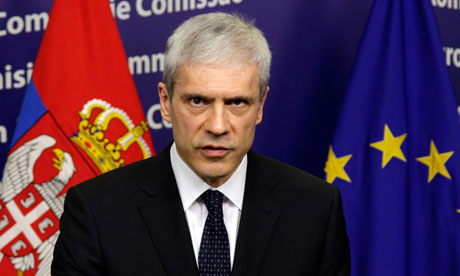
The Serbian president, Boris Tadic, speaks in Brussels on Tuesday. Photograph: Virginia Mayo/AP


Serbia took a large step towards integrating with mainstream Europe on Tuesday when European Union foreign ministers called for the country to be made a candidate for union membership.

The breakthrough came despite surprising resistance from neighbouring Romania, and followed a deal last week when Belgrade abandoned boycotting the attendance of Kosovo at regional and international meetings because it views Kosovo as part of Serbia and refuses to recognise its independence.

The decision by the foreign ministers, which needs to be endorsed by EU government heads at a Brussels summit on Thursday, puts Serbia on the path to EU membership, leaving behind the legacy of the 1990s when Balkan wars and ethnic pogroms earned it the status of an international pariah.

But while Belgrade now faces long years of arduous negotiations before it can become a member, Brussels has not yet named a date for opening the negotiations. EU governments will push for greater rapprochement between Serbia and Kosovo before agreeing to start talks.

The tensions with Kosovo, the Albanian-majority former southern province of Serbia which declared independence four years ago, scuppered Belgrade's chances of getting an EU green light in December amid clashes on the Serbia-Kosovo border. But last week, under EU mediation, Serbia yielded – under a complicated formula – to Kosovo attendance and representation at international meetings. Previously Belgrade had boycotted any such meetings on the grounds that it does not view Kosovo as a country.

Tuesday's breakthrough was held up for several hours by Romania, which insisted on greater protections and rights for the Romanian ethnic minority in Serbia, an issue that had not previously been a problem.

While it will be many years before Serbia joins the EU, the Brussels green light represents a boost for the president, Boris Tadic, before elections later this year. He will base his campaign on a policy that claims Serbia can join the EU without giving up Kosovo.

Under last week's deal, Kosovo is to be labelled with an asterisk and without the word republic when its officials take part in international and regional meetings. The asterisk refers to a footnote on the United Nations security council resolution on Kosovo's breakaway status and to an international court of justice ruling that the secession was not a breach of international law.

The granting of candidate status to Serbia is to be balanced by giving Kosovo an association agreement with the EU, the preliminary stage to talks about membership. But this is complicated by the fact that five EU countries do not recognise Kosovo's independence.

Thursday, March 1, 2012

In Arizona, Republicans shy away from immigration debate


PHOENIX, Arizona — Immigration fuels fierce passions in Arizona, both for and against the waves of immigrants who cross its southern border with Mexico -- but you would hardly know it to listen to Republican candidates.

Mitt Romney, who won the party's primary here handily this week, barely mentioned it in his campaign stops, as he focused on the economy and jobs, issues on which it is easier to find common ground in these tough times.

Arizona Senator John McCain, who won the Republican candidacy in 2008 but lost the White House to Democrat Barack Obama, acknowledged as much here on Tuesday when he spoke on behalf of Romney, who he has endorsed since January.

In a brief speech he trumpeted the former Massachusetts governor's economic credentials, as well as his ability to be commander in chief and restore America's power and influence in the world.

But not a word about immigration.

"I think it's pretty clear that immigration was not the biggest issue in this campaign, in fact it wasn't mentioned that much. The biggest issue on this campaign is jobs and the economy," he told AFP.

Arizona, which has a vast legal and illegal Hispanic population, has been in the eye of a storm since it became the first US state to vote a law -- so called "SB1070" -- allowing police to stop and search any person they suspect.

The Obama administration opposed the law, and has managed to freeze its most contested parts until a Supreme Court ruling in June -- although this has not stopped other states including Utah and Alabama from following Arizona's lead.

Republican state lawmaker John Kavanagh agrees with McCain that immigration has not featured as prominently as one might have expected.

"It's gone on the back burner because our dismal economy has pushed (it) to the side," he told AFP, adding "immigration is still a big problem in Arizona."

"Less illegals are crossing the borders because there are less jobs, but the underlying problem is still there, and we know that when the economy improves and the jobs come back, so too will the illegals," he added.

For civil rights groups, the real problem for Republicans -- who held a TV debate here last week -- is not that they relegate immigration to a secondary campaign issue, but that they don't propose any solutions.

"They are basically talking about keeping 11 million in the same situation, and they are talking about deportation," said Eduardo Barraza, director of the Hispanic Institute of Social Issues in Mesa, outside Phoenix.

In the debate, the candidates did agree on one thing: the need to secure the border with Mexico, by whatever means possible.

And Romney took the opportunity to vigorously defend Arizona's immigration law, and to reiterate his opposition to the so-called DREAM Act, which would let youngsters who came to the US illegally to go to college or join the army.

"I wouldn't say that immigration has not been addressed," said Alessandra Soler Meetze, head of the Arizona branch of the American Civil Liberties Union (ACLU).

"I feel like they are propagating and perpetuating immigration myths to please their public... what is certainly missing is a serious discussion about it. We have to move beyond this extremist rhetoric."

For Camila Gallardo, spokeswoman of the National Council of La Raza, the main Hispanic rights group in the US, "so far unfortunately the Republicans' arguments are pretty negative."

"We hope that once the primaries are finished, the person chosen will make an effort to talk to our community respectfully, and that they will make real proposals," she added.

Because, while neglected in the primaries, immigration could return as a major theme in the real presidential campaign, between whoever wins the Republican nomination and Obama in the run-up to the November vote.

Soler Meetze said the Supreme Court's decision in June will "send a very important message to the states.

"It's gonna answer this question as to who has the authority to regulate immigration matters. I do think that after this decision, the issue is going to rise again."

Barraza is more doubtful, notably if the economy is still flagging during the campaign leading up to the November 6 presidential election.

"Because how in the world could anybody think now, in the political context, that bringing all these people into legality, legalizing all these people is gonna benefit the economy?" he asked.

"In a way yes, because they will pay taxes, but in the same way it is gonna be seen as millions of people being able to get jobs legally. So is that something that this society is ready to accept? I would say no."

Twitter Delicious Facebook Digg Stumbleupon Favorites More

 
Design by Free WordPress Themes | Bloggerized by Lasantha - Premium Blogger Themes | GreenGeeks Review